
Green growth, faster approvals key to Viksit Bharat reforms: Bhupender Yadav
ADVERTISEMENT
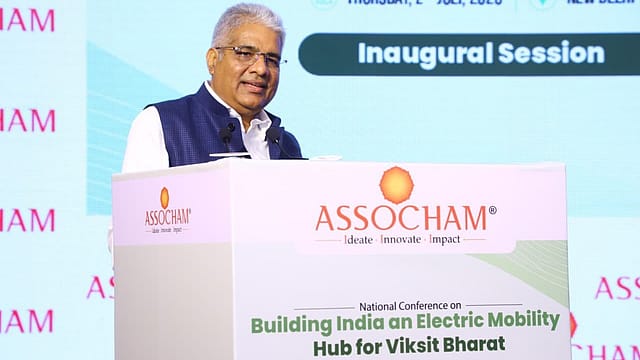
The Centre is accelerating reforms to make India's environmental regulatory framework faster, more transparent and industry-friendly, while ensuring sustainability remains central to economic growth, Union Union Minister of Environment, Forest and Climate Change Bhupender Yadav said on Thursday.
Speaking at ASSOCHAM's National Conference on Building India an Electric Mobility Hub for Viksit Bharat', Yadav stated that reforms aimed at building a Viksit Bharat must be anchored around green growth, improved quality of life, world-class infrastructure and transparent governance.
"The goal of our reforms should be to achieve maximum green growth in the country. Green economy is important, and MSMEs have a very significant role to play in creating green jobs and driving green growth," Yadav said.
He stressed that environmental reforms are designed to improve ease of doing business without compromising ecological safeguards. "A better standard of living is not merely about increasing expenditure. It also means addressing challenges related to air, water, biodiversity and the environment. Ecology and economy have to move together," he said.
Faster approvals, lighter compliance
Highlighting the government's reform agenda, Yadav said the Ministry of Environment, Forest and Climate Change has implemented 51 reforms over the past two years, including 24 legal and regulatory changes and 27 digital governance initiatives.
According to the minister, environmental approvals that used to take nearly 600 days in 2014 are now being granted in 57 days, well below the ministry's benchmark timeline of 105 days. Forest clearance timelines have also been reduced from 362 days to 83 days, reflecting what he described as a 90% improvement in approval processes and a 71% improvement in forest clearance timelines.
"We have simplified several procedures. If an industrial unit expands production by up to 40% in phases without creating any additional environmental burden, it no longer requires fresh environmental clearance or a public hearing," he said.
Yadav added that the government has exempted Common Effluent Treatment Plants (CETPs) from separate environmental clearance requirements, enabled pre-approved industrial estates to accommodate new units without individual environmental clearances, and expanded the 'white category' of non-polluting industries from 36 to 86 sectors.
AI-powered clearances, circular economy
The minister said the government is preparing to roll out PARIVESH 3.0, which will integrate artificial intelligence and machine learning into environmental decision-making.
"We have already digitised environment, forest, wildlife and coastal clearances. With PARIVESH 3.0, AI-powered decision support, digital compliance monitoring and integration with the PM Gati Shakti platform will make approvals faster, more accurate and more transparent," he said.
Yadav also said the government has introduced a One Nation, One Consent Framework across most states and extended the validity of Consent to Operate from five years to 25 years across industrial categories. Environmental clearance validity has also been increased for several sectors, while time spent in litigation before the National Company Law Tribunal (NCLT) will no longer count against project validity.
Highlighting India's climate progress, Yadav said the country has already achieved its 45% emissions intensity reduction target for 2030 and reached the goal of 50% non-fossil fuel electricity capacity nine years ahead of schedule.
"The future lies in the circular economy. The world is moving away from 'take, make and waste' towards 'reuse, recycle and reproduce'. Industry must partner with the government to promote green employment, sustainable infrastructure and responsible resource use as we build a Viksit Bharat," he said.