
India, EU adopt strategic agenda to deepen ties across trade, tech, security, and global governance
ADVERTISEMENT
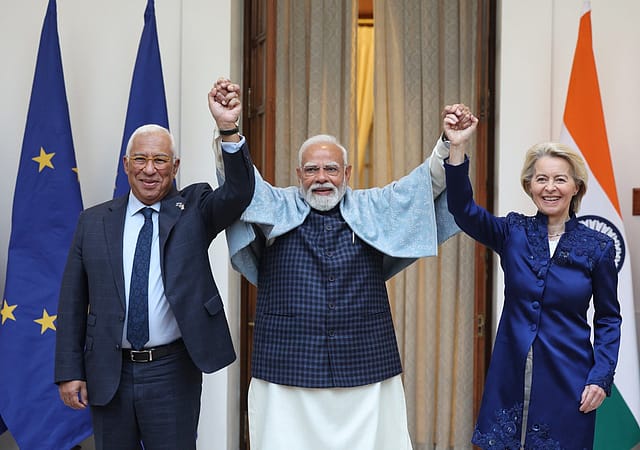
India and the European Union (EU) on Tuesday endorsed a Joint Comprehensive Strategic Agenda at the 16th India-EU Summit in New Delhi, marking a significant step towards deepening and broadening their long-standing strategic partnership. The agenda aims to better coordinate EU-India cooperation across a wide range of sectors to deliver “mutually beneficial, concrete and transformative outcomes” for both sides and the wider world, the Ministry of External Affairs (MEA) said in a statement.
The road map is structured around four core pillars—prosperity and sustainability; technology and innovation; security and defence; and connectivity and global issues—supported by a set of cross-cutting enablers aimed at improving mobility, institutional coordination, business engagement, and people-to-people ties.
Trade, investment, and economic resilience
The two sides hailed the conclusion of the India-EU Free Trade Agreement (FTA) as a historic milestone and called for its timely implementation to unlock new opportunities for shared prosperity, resilience and stronger global supply chains.
In addition to the FTA, India and the EU agreed to conclude an Investment Protection Agreement to provide predictable and high-standard safeguards for investors, as well as an agreement on Geographical Indications to protect iconic products and boost bilateral trade.
The agenda also calls for deeper cooperation on customs, financial services regulation, and macroeconomic dialogue while scaling up Team Europe Global Gateway investments in India, with the European Investment Bank playing a key role.
Supply chains, semiconductors, and economic security
Recognising growing global vulnerabilities, the agenda places strong emphasis on supply-chain resilience and economic security. Both sides agreed to assess external risks, expand collaboration in strategic value chains, and implement the India-EU Semiconductor Memorandum of Understanding.
The partnership will focus on strengthening semiconductor supply chains, promoting joint R&D in chip design and sustainable manufacturing technologies, and advancing collaboration in biotechnology, pharmaceuticals, critical minerals, and climate-sensitive sectors.
Talks on economic security will also be broadened within the framework of the India-EU Trade and Technology Council, including issues related to research security and protection of sensitive technologies.
Clean energy, climate action, and sustainability
A major pillar of the agenda is cooperation on the clean energy transition and climate resilience. India and the EU agreed to strengthen the Clean Energy and Climate Partnership, covering areas such as smart grids, energy storage, electricity regulation, and climate diplomacy.
Key initiatives include operationalising the India-EU Green Hydrogen Task Force, organising an India-EU Wind Business Summit, and expanding collaboration on sustainable mobility, including sustainable aviation fuels, electric vehicles and charging standards.
The road map also outlines cooperation on industrial decarbonisation, carbon markets, climate adaptation, disaster resilience, water security, circular economy, sustainable agriculture, and resilient health systems. Both sides committed to working together on global climate frameworks, including the Paris Agreement and biodiversity targets.
Technology, digital cooperation, and innovation
In the technology and innovation pillar, India and the EU committed to closer collaboration on critical and emerging technologies such as artificial intelligence, quantum computing, advanced semiconductors, clean tech and biotechnology.
Plans include setting up India-EU Innovation Hubs, promoting joint research, supporting deep-tech startups through an India-EU Startup Partnership, and advancing cooperation on trustworthy, human-centric AI. The two sides also agreed to deepen cooperation on space technologies, high-performance computing and electric vehicle charging infrastructure.
On the digital front, the agenda emphasises building a secure, fair and interoperable digital ecosystem through regulatory cooperation, robust data protection frameworks and trusted telecom networks, including collaboration under the Bharat 6G alliance and EU 6G initiatives.
Security, defence, and regional stability
Security and defence cooperation forms another key pillar of the agenda. India and the EU agreed to implement the security and defence partnership, enhance annual dialogues, and work towards concluding a Security of Information Agreement to facilitate classified exchanges.
On regional and global security, both sides reaffirmed their commitment to a free, open and inclusive Indo-Pacific, enhanced coordination on Ukraine, and deeper engagement through regional institutions such as the Indo-Pacific Oceans Initiative and the Indian Ocean Rim Association.
Connectivity and global governance
Connectivity initiatives under the agenda include closer collaboration on the India-Middle East-Europe Economic Corridor, development of green shipping corridors, aviation cooperation, and enhanced digital connectivity through projects such as the Blue Raman submarine cable.
India and the EU also committed to joint action in third countries on clean energy, climate resilience, disaster risk reduction, and humanitarian assistance while strengthening coordination in multilateral forums such as the UN, G20, and WTO.
Mobility, business, and institutions
Supporting the core pillars are enablers focused on skills mobility, education, business engagement, and institutional coordination. These include launching a pilot European Legal Gateway Office in India, modernising visa procedures, expanding student and researcher exchanges, and promoting recognition of qualifications.