
India is transforming from ambitions to execution, says Sunil Mathur
ADVERTISEMENT
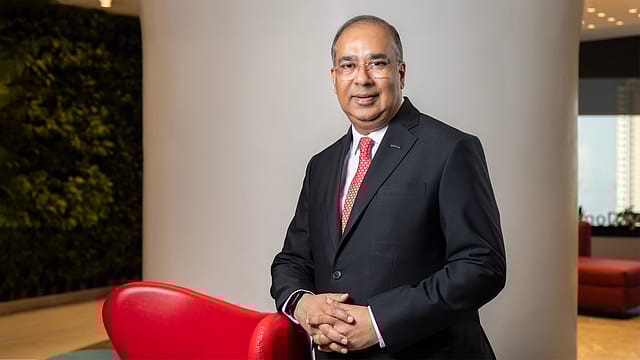
India’s economic narrative has shifted decisively over the past from ambition to implementation. For a global industrial technology giant like Siemens, that shift is not theoretical; it is visible in orders, investments, and the pace of execution on the ground.
Sunil Mathur, managing director and CEO of Siemens Ltd - the flagship Siemens AG company in India - and one of the longest-serving multinational CEOs in the country, has had a front-row seat to this transformation. In this interview with PB Jayakumar, he explains why India has become one of Siemens’ most important global markets, how infrastructure-led growth is reshaping industry, and why digitalisation is redefining Siemens’ engagement with customers.
India is positioning itself as a trillion-dollar economy with strong GDP growth. From a global MNC perspective — and as one of the longest-serving MNC CEOs in India — how do you view India’s growth? Which sectors are most relevant to Siemens?
Let me start with the global perspective and then come to India.
For Siemens AG, India is now the fourth-largest country in our global ecosystem and the fastest-growing market worldwide. As a result, India has become a major strategic focus for our global leadership. Our global CEO visits India frequently — sometimes multiple times a year — reflecting how seriously Siemens views this market.
From an Indian perspective, the transformation in the past decade has been remarkable. Earlier, budget announcements often saw partial execution. Today, we are seeing 80–85% implementation, which is a significant shift toward real delivery.
A good example is the Rs 26,000-crore locomotive project we secured — Siemens Mobility's largest locomotive order globally. The tender-to-award cycle took just nine months, something unprecedented anywhere in the world for a project of that scale and complexity. Within 2 years, we achieved over 90% localisation across design, engineering, procurement, and manufacturing. This demonstrates the strength of India’s industrial ecosystem.
More broadly, India’s GDP growth has accelerated from around 4.5% to 6.5–7%, with ambitions to reach even higher. The engine behind this growth is capital expenditure in infrastructure — railways, highways, airports, and renewable energy. These investments are critical to logistics, manufacturing efficiency, and supply chain strength. India is no longer just about vision — execution is visible on the ground. That momentum is what excites Siemens.
Over the past few years, how has Siemens invested to align with this opportunity? Are orders translating into growth across segments?
Absolutely. Siemens’ footprint in India reflects our confidence in the market. We operate 35 manufacturing facilities under the broader Siemens AG ecosystem, including energy and healthcare businesses. We employ roughly 30,000 people, with over 10,000 focused on software and digital capabilities.
Siemens is evolving from a traditional electrical equipment company into a technology and digital solutions provider. Earlier, customers specified hardware like switchgear or motors. Today, we engage at a higher level — asking customers about their operational challenges and delivering integrated electrification, automation, and digital solutions.
For example, in industries like cement — where energy costs account for about 40% of production — our solutions help optimise energy usage through deep process understanding and digital monitoring.
We apply this expertise across 23 industrial verticals in which we operate, including manufacturing, infrastructure, pharmaceuticals, electronics, and transportation. Our Kalwa facility monitors electrical consumption across 1,300 Siemens locations in 90 countries, showcasing the power of digitalisation in energy efficiency. This integrated capability allows us to support India’s priorities — energy access, smart manufacturing, railway modernisation, and efficient buildings.
Government capital expenditure has accelerated significantly. Has private sector investment kept pace, especially after COVID?
Yes, private sector capex has picked up meaningfully. Pre-COVID, capacity utilisation was around 52%. Today, it exceeds 80%, signalling renewed investment confidence. Large private players are investing heavily in sectors like semiconductors, battery manufacturing, solar energy, ports, and airports. Pharmaceuticals are also performing well. Some sectors — such as automotive and steel — still face challenges. Steel, for example, has been affected by global dumping pressures. But overall, private sector investment is aligning with the broader economic momentum.
Of the various verticals Siemens operates in, which sectors do you see driving Siemens’ business in India?
Very clearly, mobility is one of the biggest drivers. That includes Indian Railways, metro systems, electrification, and signalling — the entire ecosystem of modern transportation. Beyond that, data centres are huge. Electronics and semiconductors are major growth areas. Pharmaceuticals, aerospace, and defence are also very important sectors for us. We don’t manufacture weapons. In sectors like defence, our role is as a technology partner. We provide electrification, automation, and software solutions that help design products, optimise manufacturing processes, and improve factory efficiency. Essentially, we enable manufacturers to operate at global standards.
We are a technology company that combines the virtual and the physical. We can digitally design a product, simulate its performance, design the production process, machines, and facilities — all before anything is built. For example, automotive 'wind tunnel testing' used to require expensive physical infrastructure. Today, we can simulate those tests digitally with high precision. Industrial artificial intelligence allows us to predict outcomes, optimise performance, and reduce costs — but with manufacturing-grade accuracy, where precision is critical.
Predictive maintenance and data analytics are widely discussed. How far have Indian companies adopted these technologies?
Large Indian companies are adopting advanced digital technologies quickly because they compete globally. Medium-sized companies are slower, but that’s where a major opportunity lies. If India wants to become a global manufacturing hub — and we already are a software hub — combining those strengths is essential. That integration will be a key competitive advantage.
What role does India play in Siemens’ global ecosystem?
India is deeply integrated into Siemens globally. We have around 10,000 software professionals here, and almost every Siemens product worldwide has some Indian footprint. Our R&D presence in India is one of the largest within Siemens. We also operate global competency centres for engineering, software, and shared services. Around 15–18% of what we manufacture in India feeds into Siemens’ global supply chain. When you already operate 25 factories under Siemens Ltd, growth is about expanding capabilities rather than simply building new facilities. We’ve invested in rolling stock manufacturing, bogie production, and upgraded medium-voltage technologies. It’s about introducing new product lines, greener technologies, and advanced manufacturing capabilities aligned with market needs.
How do you see India’s energy transition progressing — especially renewables and green hydrogen?
Renewables are growing rapidly, but base-load requirements mean fossil fuels will continue for some time, albeit with cleaner technologies. Green hydrogen is progressing, though commercialisation takes time globally. India has the potential to achieve cost breakthroughs, and I’m confident innovation will accelerate adoption.
Which industries will see the biggest transformation in the coming decade? How will AI reshape manufacturing in India?
Data centres will be huge due to industrial digitisation. Electronics and semiconductors will strengthen supply chain resilience. Pharmaceuticals, aerospace, defence, and energy transition technologies will also undergo major change.
AI will change manufacturing processes completely. Western factories operate at near-maximum productivity, while India still has room to grow. Technology enables speed, flexibility, and mass customisation. Manufacturing is moving from serial production to flexible systems where customised products can be produced without stopping the line. Digitalisation is the key enabler. We provide the enabling technologies — software, electrification, and automation. Whether it’s rail electrification or electric vehicle development, we support design, simulation, and production optimisation. Energy efficiency technologies — like those we deploy from our Kalwa facility — help industries and infrastructure reduce consumption and operate more sustainably.
Technology changes the nature of jobs — it doesn’t eliminate opportunity. Every industrial transition has created new employment categories. AI and automation will increase productivity, create new skills demand, and ultimately expand economic opportunity. The key is preparing the workforce for evolving roles.