
India-Russia summit: PM Modi to host Putin for key talks on oil, defence and global geopolitics
ADVERTISEMENT
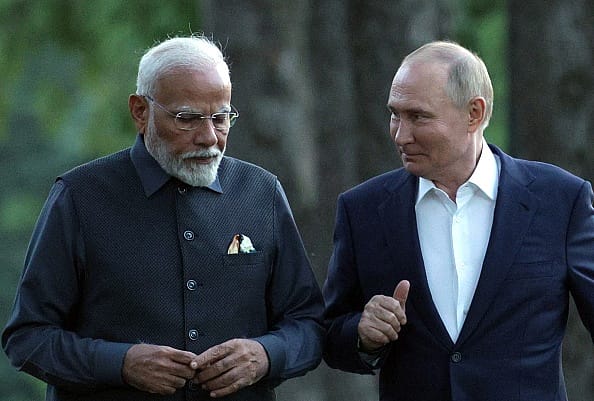
Russian President Vladimir Putin will visit India for the 23rd India-Russia Annual Summit, for the first time in four years, today. He will meet Prime Minister Narendra Modi in a private dinner hosted by the PM for him. The two leaders are expected to talk about key issues related to strategic and economic ties between India and Russia. They are also going to discuss key global issues, including the Russia-Ukraine war.
However, Putin’s major meetings are scheduled for Friday. He will visit Rashtrapati Bhavan, followed by a key bilateral meeting at the Hyderabad House. The two leaders will also take part in the India-Russia Business Forum, where key industry leaders are also expected to take part. According to reports, the two leaders are also expected to issue a joint statement, which will elaborate on bilateral agreements that will be signed across different areas. Before this, the PM had met Putin during the SCO summit in Tianjin, China, this year.
Energy ties in focus
Indian imports of Russian oil will remain a key agenda item during Putin’s visit to India. Bilateral trade between the two countries has undergone a phenomenal shift in the last four years after India accepted Russia’s offer of discounted crude, helping reduce India’s import bill for the commodity while providing a lifeline to Russia’s war-affected economy.
Total trade between the two countries stood at $68.7 billion in 2024–25, five per cent higher than $65.4 billion in 2023–24, which itself marked a 32.5% year-on-year jump from $49.4 billion in 2022–23—driven largely by India’s high crude oil imports from Russia. In 2020–21, before the Ukraine war pushed Russia to offer record-low crude prices to friendly countries like India, bilateral trade was just $8.1 billion. It rose 61.21% to $13.1 billion the following year and then surged 276% to $49.4 billion in 2022–23.
With the US imposing additional tariffs and sanctions on countries continuing to purchase Russian oil, high-level bilateral engagement has become essential for Moscow to ensure India remains a buyer. For India, Russia has become its largest crude supplier, accounting for 30–35% of total oil imports—making discounted crude the backbone of the partnership.
Boost to Make in India
Putin's visit to India after four years will pave the way for strengthening India's defence sector capabilities, especially in boosting the manufacturing of 'Make in India' defence products. Kremlin says discussions between Prime Minister Narendra Modi and Putin will include major defence platforms, such as the supply and manufacturing of fifth-generation Sukhoi Su-57 stealth fighters and additional S-400 air defence systems, which played a crucial role in protecting India's borders during Operation Sindoor.
India and Russia agreed in 2018 to supply 5 units of the S-400 air defence system, valued at about $5 billion. So far, only three squadrons have been delivered, as supplies have been delayed after the start of the Russia-Ukraine conflict. Supply of the remaining units and orders for more S-400s are on the cards, say sources. They say India is considering buying five more S-400 squadrons and plans to acquire the next-generation S-500 systems.
Sources also say New Delhi is going to accelerate high-level negotiations with Moscow for getting the Su-57 fifth-generation fighters, as reports say Moscow has agreed to offer technology transfer, including manufacturing and license to produce critical components like engines, optics, radars, AI components, low-end technologies, sensors, stealth materials, and other classified systems.
Notably, Russia is the prime defence equipment destination for India, the second largest arms importer in the world, about 36% of the requirements in 2020-24, according to data from the Stockholm International Peace Research Institute (SIPRI). India exports about $5 billion to Russia annually, compared with imports of about $64 billion, mainly crude oil, fertilisers and defence equipment, says a report by the Global Trade Research Initiative.