
Indian corporates set to build ISRO’s ‘Bahubali’ rockets
ADVERTISEMENT
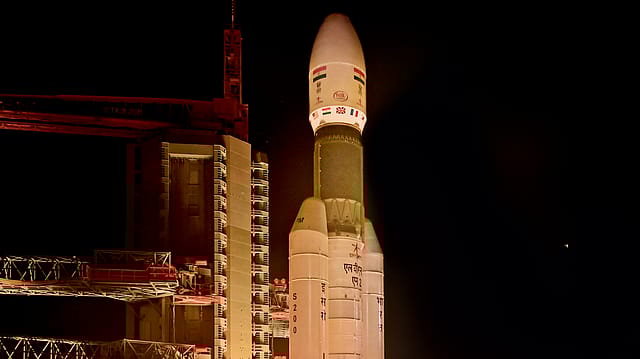
Leading Indian aerospace companies such as Godrej Enterprises Group, Larsen & Toubro , Tata Advanced Systems Limited (TASL), and Hindustan Aeronautics Limited (HAL) may soon get the opportunity to manufacture ISRO’s Launch Vehicle Mark-3 (LVM3), India’s heaviest and most powerful operational medium-lift space launch vehicle.
In a major step towards expanding private sector participation in the country’s space programme, the Indian National Space Promotion and Authorisation Centre (IN-SPACe) has invited Expressions of Interest (EoIs) from Indian companies for the Transfer of Technology (ToT) of ISRO’s Launch Vehicle Mark-3 (LVM3), popularly nicknamed ‘Bahubali’ for its heavy-lift capability.
The LVM3 has established itself as a versatile and dependable workhorse for India’s space programme, with a proven track record of successfully deploying both Indian and international customer payloads into various orbits. Recognising the rapid expansion of the global space economy and the strategic need to significantly increase launch frequencies, IN-SPACe has initiated the transfer of LVM3 technology to private industry for end-to-end realisation, operation and commercialisation of the launch vehicle.
“This opportunity is aimed at capable Indian industries or consortia that have handled multidisciplinary turnkey projects and are keen on assimilating LVM3’s proven technology and offering commercial launch services to compete in the global heavy-lift satellite launch market,” IN-SPACe said while inviting the EoIs, which are restricted to Indian companies.
To facilitate seamless technology absorption, ISRO will provide infrastructure and hand-holding support for a defined period of 42 months or until the selected entity successfully realises and launches two LVM3 vehicles, whichever is earlier.
The move follows a similar initiative recently launched by IN-SPACe, which invited EoIs for the complete transfer of technology for ISRO’s Polar Satellite Launch Vehicle (PSLV) to private industry for commercial launch operations in the global medium-lift market.
Under the eligibility criteria, applicants must have been operational for at least seven years. In the case of a special purpose vehicle (SPV) or consortium, at least one member must have at least 5 years of experience in the space or aerospace sector. Applicants must also demonstrate a strong financial track record, with an average annual turnover exceeding ₹800 crore in any three of the last five years, or a valuation of at least ₹2,000 crore.
ISRO successfully conducted the first orbital test launch of the LVM3 on June 5, 2017. Previously known as the Geosynchronous Satellite Launch Vehicle Mark III (GSLV Mk III), the three-stage medium-lift launch vehicle was developed by the Indian Space Research Organisation (ISRO). It was primarily designed to launch communication satellites into geostationary orbit and is also the designated launch vehicle for India’s human spaceflight programme and scientific missions such as Chandrayaan-2.
With a significantly higher payload capacity than the similarly named GSLV Mk II, the LVM3 has emerged as the backbone of India’s ambitions in heavy-lift launches and future commercial space operations.