
Indian philanthropists more open to supporting climate-related causes, says Rajiv J. Shah of The Rockefeller Foundation
ADVERTISEMENT
At the recently concluded Mumbai Climate Week 2026, the Global Energy Alliance for People and Planet launched the India Grids of the Future Accelerator, a national platform through which the alliance announced a grant of $25 million to modernise power distribution, integrate renewable energy and storage.
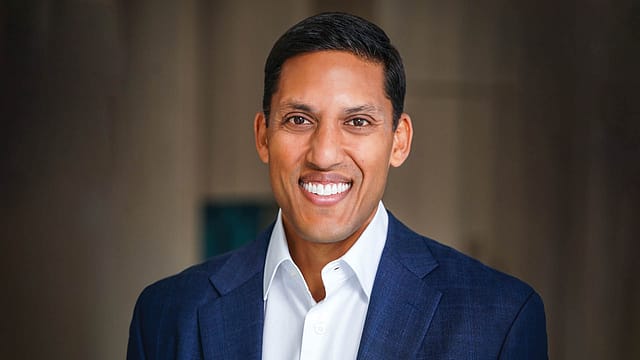
Rajiv J. Shah, president, The Rockefeller Foundation (a key stakeholder of the Global Energy Alliance for People and Planet), in an interview with Fortune India, talks about how the transition to renewable energy would improve livelihoods especially in rural India and bring more women into the workforce.
Excerpts:
Can you tell us about the India Grids of the Future Accelerator initiative?
Rockefeller Foundation has been active in India since the 1930s. We have always prioritised efforts where science and innovation can really lift people up in scale. We have always had a disproportionate focus on rural communities and women. In this modern era our big bet is that energy transition can help lift up rural livelihoods at scale. To do that we need to transition rural communities from erratic, unreliable access to power to totally reliable electricity that is low cost, it allows you build businesses and scale growth and create employment. We established the Global Energy Alliance to create public-private partnerships to do that at scale.
Our target in India is to reach 300 million people with improved electricity, primarily through renewable access improvements in rural communities. We will create digital twins of the actual grid infrastructure. A digital twin is a comprehensive digital twin of the physical infrastructure that defines an entire state grid. We have done this now in Rajasthan and what you see when you do it is that it enables optimised planning of how to ensure communities that don’t have robust access, can get better access and it allows you to do planning for distributed renewable production while also serving communities of farmers, entrepreneurs and workers in those rural communities. It allows them to scale businesses and create jobs.
The digital twin completely digitises the physical infrastructure. So, every pole, every connection, every transmission point, every grid entry point for power generation is fully mapped and digitised. We did it with a local AI entrepreneur in Rajasthan. They are using people on bikes to take photos, they are using drones to cover track lines. For a relatively low cost they are able to create a full digital twin. Once you have the digital twin, you can use AI to model.
One of the big failures of grid management over the last 100 years has been a failure to understand latent demand. It’s not that people don’t have demand for electricity, when they are using back-up diesel for their businesses, it costs them 80 cents a kilowatt, then of course they use it sparingly, because it is expensive. If they have reliable power available for 8 cents, all of a sudden, they are consuming a lot more of it. That’s good because that is increasing labour productivity and creating jobs in those communities. Grids of the Future will allow us for the first time to model comprehensibly, optimise the transition to renewables and optimise access for people.
This initiative will be implemented through public-private partnerships. How important are public-private partnerships for the success of these projects?
Everything we do are public-private partnerships, we try to do them at scale. Our Foundation since decades has been involved in dozens of public private partnerships. A year ago, we launched an effort to reach 300 million people with electricity in Africa, across 27 countries. We had all 27 heads of States come to a summit meeting where they issued reforms, detailed plans and targets and committed $40 billion to achieve electrification alongside private companies. We did the same thing in the US in areas for improving diet quality of people who are pre-diabetic so that they never get diabetes and we did that in partnership with insurance companies.
In all of these examples there are few lessons that emerge – the first is you have to be very clear what the goal is and it is essential to have a quantitative measurable target. Another element of successful public-private partnership is you the need the public sector to be fully committed. Having the Maharashtra CM say that we are committed and they want every pole, every wire, every transmission box in a digital twin model, that type of leadership is irreplaceable. You also have to really believe in the private sector. Private companies need to access markets, some need contracts and resources to be successful. If you can break the barriers of skepticism and really develop ways to collaborate, those are big drivers of success.
How will Grids of the Future improve livelihoods?
The real reason for the Grids of the Future Accelerator is not just to protect the environment or climate, it is more from an economic competitiveness perspective. The sooner you can transition to stable, low-cost and renewable and perpetual energy, the more of this economy you can unlock. India grows at 8%-8.5% a year, about 54% of the Indian economy is urban and 46% is in rural settings. The reality is that you have much of the high-end economic growth serving the 54% that live in communities of modern infrastructure. The remaining 46% are not on the same path, so you run the risk of solidifying the difference between two Indias. As the world’s most populous country and significant democracy, this energy transition has to be something that includes everybody not just those of us in these settings.
I saw this flour mill outside of Lucknow just a couple of days ago and we had helped them transition to a solar system. They now have power from two hours a day to always on. So, it would take them 6-8 months to fulfill an order and now they can fulfill an order in 3-4 weeks. The women who own that facility, have seen their incomes go up from Rs 800 a month to Rs 8000 a month. That’s the path to create job creation and livelihood improvement.
The other place one can create employment is solar technicians, energy technicians. I met 20 women who are solar technicians. They are trained every Saturday.
Most of the examples you have cited are women. Are you saying that women are the main beneficiaries?
Absolutely, women can be the main beneficiaries of green energy transition. They can be trained to be solar technicians. Our programme is trying to improve 20 million livelihoods – out of that 12 million are farmers, 70% of labour on those farms are women, eight million are small businesses. I would say almost all of those small businesses either are run by women or have a very large labour force participation rate that’s women. Women should be the focus of green energy transition. We know from all of development economics, when you increase labour productivity of women, when you increase their incomes, you start this positive cycle of kids going to better schools, more educational attainment and more generational opportunity get realised. Whereas, the same dollar of additional income going to men has a far less direct impact on community development outcomes.
Can you tell us a little more about the Global Energy Alliance of People and Planet?
At the Glasgow Summit a few years ago, the Rockefeller Foundation with a group of private and public partners (IKEA Foundation and Bezos Earth Fund) launched a Global Energy Alliance of People and Planet. For the Rockefeller Foundation, it is the single biggest grant investment we have made in our 115-year history. We made a $500 million commitment. The purpose of that is to reach one billion people who live in energy constraint communities with renewable electrification, lower the price of productive labour and improve job creation and economic empowerment primarily for women and also for people who live in those communities, which are disproportionately rural, dependent on very small businesses, entrepreneurial activity and are either off grid or connected to a grid but in an incredibly erratic, ineffective way.
Since its inception, the product has already reached 91 million people which is still less than 10% of the overall target but is good progress. Through the Global Energy Alliance for People and Planet, we have launched Mission 300 in Africa, which is the partnership with 27 Government and mobilized $40 billion over there. We have launched this large-scale effort with the Indian Government both at the Centre and States that’s been highly effective and scaling through PM Kusum Yojana (Pradhan Mantri Kisan Urja Suraksha evam Utthan Mahabhiyan) and some other government schemes and we just continue to measure results and try to track progress to reach our target of 1 billion people across the planet. That’s our biggest bet on lifting up those who live in otherwise constraint environments.
I am curious to know how much of philanthropic capital is moving towards renewable energy and other climate related investments.
We are seeing little bit more climate interest among philanthropists from India on our projects. Our projects are getting a lot of co-financing from local philanthropy partners. Globally, the amount of giving to climate related impacts is miniscule. In America, its terribly low. American philanthropies donate about $600 billion a year but the vast majority goes to people’s alma-maters and colleges and universities. A small fraction, may be 25% goes to social impact and an even smaller amount, in single digits, goes to climate.
Climate philanthropy has dried up in last 18 months.
What’s the reason for that?
In America we lost sight. We started talking about climate in degrees and temperature or every conceptual language. We didn’t talk about it as these are rural women who are improving their actual lives so that they can go home to their families and have more dignity and empowerment. That connection back to improving people’s lives in the most practical and understandable way got lost in climate action. Even though the investment we were making were helping to improve people’s lives in left behind communities, the language around it was disconnected from people’s lived experiences. I think that’s why we are seeing a huge backlash against climate action in the US across much of the industrial growth.