
India’s solar exporters may get a tariff tailwind — but the US is racing to build its own domestic industry
ADVERTISEMENT
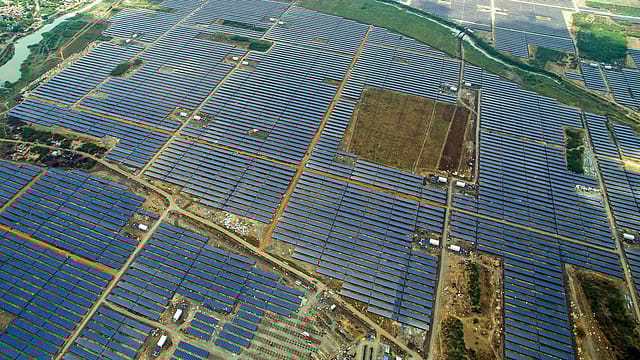
India’s solar exporters are celebrating a tactical win after the Indo-US trade deal promises to reduce reciprocal tariffs on Indian goods — including solar modules and energy storage components — from 25% to 18%. The move gives Indian manufacturers immediate pricing relief in their biggest overseas market. But industry observers caution that the opportunity may be brief, as the United States is rapidly constructing a vertically integrated domestic solar manufacturing ecosystem designed to reduce import dependence.
India’s export momentum has been striking. In FY24, Indian manufacturers shipped roughly $2 billion worth of photovoltaic (PV) modules overseas, with nearly 97% heading to the US. Export value expanded more than twentyfold between FY22 and FY24. In the first nine months of 2025 alone, India exported an estimated 10.4 GW of modules to the US, helping Indian suppliers capture roughly 11% market share — up from under 3% in 2022, according to industry estimates.
The surge reflects India’s aggressive capacity build-out. Operational module manufacturing capacity has reached around 144 GW and is projected to rise to 180 GW by FY30. Yet upstream manufacturing remains a bottleneck. Solar cell capacity stands at just 23.4 GW, even as India installs 45–50 GW of solar capacity annually. Module supply already exceeds domestic demand by roughly 10–15 GW. A recent report from Elara Securities notes that India needs to ramp up backward integration into wafers, ingots and polysilicon to remain competitive in future.
Industry executives see exports as a bridge to scale. “The US and EU deals are set to accelerate exports, attract fresh investments into domestic capacity, and reinforce India’s ambition of becoming a global hub for solar manufacturing,” says Ashwani Sehgal, managing director of Alpex Solar.
Yet the US is simultaneously fortifying its domestic base. As of February, the country has about 65 GW of module manufacturing capacity, with another 30 GW under construction — theoretically sufficient to meet its near-term demand. 'There could be short-term export opportunities from the deal, but as US domestic cell and module capacity ramps up, the need for imports will decline,' according to Raj Prabhu, CEO of Mercom Capital Group.
Three Indian heavyweights — Waaree Energies , Adani Solar and Vikram Solar — have been exporting more than half their output in recent years, largely to the US. New entrants such as Grew Energy, ReNew Power, Navitas Solar, Solex Energy and Saatvik Energy are also pursuing export-led growth while exploring overseas supply chains. Some Indian firms are even planning manufacturing units within the US to hedge against policy shifts.
A booming US market
In 2024, the US installed nearly 50 GW of solar capacity — a record — with solar accounting for over half of all new electricity generation additions. According to the Solar Energy Industries Association (SEIA), total US solar capacity exceeds 266 GW, with the market valued at over $70 billion. SEIA forecasts nearly 250 GW of additional installations between 2025 and 2030.
Parallel to this demand boom is a manufacturing revival catalysed by the Inflation Reduction Act, which incentivises domestic clean-energy production. New investments now span the full value chain — polysilicon to finished modules.
Suniva, America’s oldest and largest monocrystalline solar cell manufacturer, founded in 2007, had production facilities in Georgia and Michigan. The company went bankrupt in 2017 and closed down, citing its inability to compete with cheap solar imports, mainly from China. Following the Inflation Reduction Act (IRA) of 2022 in the US, which promotes domestic clean energy manufacturing, Suniva decided to restart and upgrade its factory in Norcross, Georgia. Aiding companies like Suniva, the George Biden administration doubled tariffs on solar cells, modules and the main raw material, polysilicon imported from China, to 50%.
In 2023, Suniva decided to revive its plant in Georgia, which earlier operated at around 450 MW, with an initial capacity of 1 GW. In March, Suniva, solar PV module manufacturer Heliene and wafer maker Corning announced plans to manufacture the first US-made modules made with polysilicon, wafers and cells manufactured in the United States.
The US has been engaged in a long trade confrontation with Chinese solar suppliers, whose low-cost manufacturing dominance reshaped global markets. While Chinese firms routed exports through Southeast Asia to bypass earlier tariffs, Washington’s current strategy aims to rebuild domestic industrial capacity rather than rely on imports.
For Indian exporters, the tariff reduction offers an immediate margin boost and market expansion opportunity. But the structural story is shifting. As US domestic capacity grows and policy continues favouring local production, India’s competitive edge will increasingly depend on vertical integration, cost efficiency and technology upgrades rather than tariff arbitrage alone.