
Lufthansa says India is a cornerstone market, to benefit from €3 billion global product investment
ADVERTISEMENT
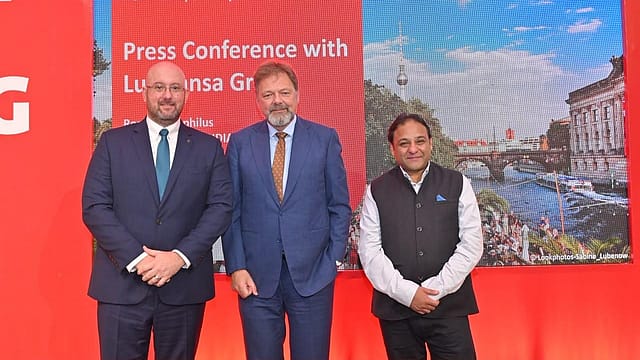
As Lufthansa completes 100 years globally and nearly 70 years in India, the airline says the country has become a cornerstone of its intercontinental network, prompting the German airline to expand capacity, deploy larger aircraft and introduce upgraded premium products as it looks to deepen its presence in the country despite geopolitical disruptions in West Asia.
Speaking on the sidelines of the GNTO Annual Press Conference 2026, Kevin Markette, senior director, sales, South Asia, Lufthansa Group, said India has become the airline group's second largest intercontinental market by frequencies and remains a key growth driver. The group is also investing heavily in customer experience, alongside expanding operations across passenger services, cargo, technology and maintenance.
"We firmly believe in the growth of India. We are here because we are able to profitably grow and also provide the right products for our Indian customers," Markette told Fortune India.
Without disclosing financial performance for India, he indicated that profitability has been strong enough to justify continued investments. "We would not increase capacities and we would not bring in our newest products if we were not making money on routes," he said, adding that India is "a cornerstone" of Lufthansa's intercontinental network.
Lufthansa is also rolling out a multi year €3 billion global investment programme aimed at upgrading the premium customer experience across its network. The programme includes the rollout of the new Allegris long haul cabin product, new aircraft, digital innovations, lounges and other enhancements across the travel experience.
India is among the key markets benefiting from the investment, with Allegris being introduced on Boeing 787-9 aircraft serving Delhi and Hyderabad, while Mumbai will join from August 8, alongside other product upgrades across the network.
"Every passenger travelling into or out of India on Lufthansa in any one of our classes will experience the new product," Markette shared.
India is also one of the Lufthansa Group's fastest growing long-haul markets.
Beyond passenger flights, Markette highlighted the group's growing footprint in the country. Lufthansa Technik Services India employs more than 500 people in Bengaluru, while its systems division, developed through a joint venture with Infosys, has grown to over 200 employees. The airline also operates Lufthansa Cargo services across India and is pursuing additional high level projects that are yet to be announced.
Capacity expansion and geopolitical challenges
Lufthansa's India expansion strategy is centred on deploying larger aircraft, increasing frequencies and adding new routes instead of entering more Indian cities immediately.
The airline is upgrading its Mumbai to Munich service with the Airbus A380 and will launch a new Zurich to Bengaluru route in October. Markette said expansion will continue through bigger and newer aircraft as demand grows.
The introduction of larger aircraft is already lifting capacity. He noted that the Airbus A380 nearly doubles the seating capacity compared with the Airbus A350 on certain routes. On the Mumbai to Munich sector, capacity will increase from about 270 seats to 517 seats overnight, while overall India traffic continues to record steady year on year growth.
Demand remains broad based, with both business and leisure travel performing well, although travel patterns vary across cities. Bengaluru and Hyderabad are heavily driven by corporate demand, while Mumbai has a mix of leisure and business travellers. The airline is also seeing healthy outbound traffic to Europe, North America and beyond through its global network.
On why Lufthansa currently serves only five Indian cities, Markette said airport infrastructure is not the limiting factor. Instead, bilateral air service agreements determine how many frequencies airlines can operate.
"The airports in India are becoming some of the best airports in the world," he said, pointing to Delhi, Bengaluru and Mumbai. While Mumbai continues to face capacity constraints, he said Lufthansa is excited about new airports coming up, including Navi Mumbai and Noida, although it has no immediate plans to serve them.
The airline is also working towards a joint business agreement with Air India after signing a memorandum of understanding earlier this year, with the ambition of creating a broader India to Europe partnership.
Markette acknowledged that the conflict in West Asia has increased flight times and operating costs because of airspace restrictions, although he said the impact on India operations has been relatively limited. "There are a lot of airspace restrictions in the world. It means longer flight times. It means higher costs. We all hope that this issue is resolved as soon as possible," he said.
Globally, the Lufthansa Group reported its highest ever revenue in 2025 at 39.6 billion euros, up 5% from 37.6 billion euros a year earlier. Adjusted EBIT rose to 2 billion euros from 1.6 billion euros, while operating margin improved to 4.9% from 4.4%. The company said geopolitical tensions, including the situation in the Middle East, aircraft delivery delays and softer demand in some markets weighed on yields, which declined 1.3% on a currency adjusted basis. Lufthansa Airlines, however, improved its annual result by about 250 million euros and returned to a positive Adjusted EBIT margin of 0.9%.