
N. Chandrasekaran’s end of tenure puts TCS leadership in the spotlight
ADVERTISEMENT
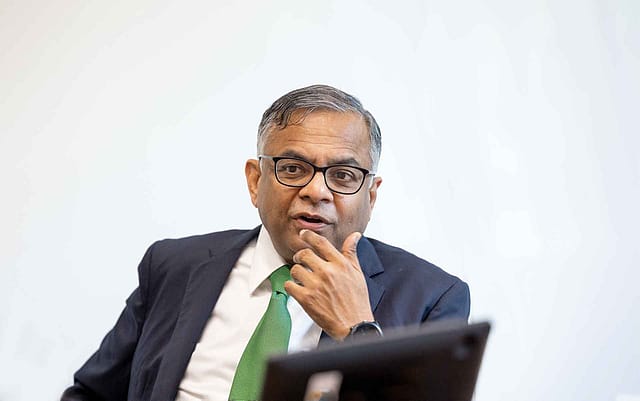
After months of uncertainty around his continuation as the chairman of Tata Sons—the main holding company and promoter of all Tata Group companies—N. Chandrasekaran announced his decision not to offer himself for reappointment beyond his current tenure, which ends on February 20, 2027. In his statement, he referred to the inordinate delay by the Tata Sons board in passing the resolution on his third term, even though Sir Dorabji Tata Trust and Sir Ratan Tata Trust had unanimously recommended the extension for another five years.
Before joining the Tata Sons board in October 2016 and subsequently becoming its chairman in January 2017, Chandrasekaran, or Chandra as he is referred to in the industry, spent nearly three decades at the group’s cash cow, Tata Consultancy Services (TCS) , including an eight-year stint as its CEO & MD. Backed by late Ratan Tata, his appointment as the chairman of Tata Sons also saw him take over the chairmanship of the board of TCS, which at the time was a $17.58 billion company growing at mid- to high-single digits.
Following the end of his first tenure as chairman in 2022, he was renominated for a second term, which now stands to end in February 2027. According to industry watchers, even though he moved out of an executive role at TCS, he remained keenly invested in the company’s developments and its growth. At the company’s 31st annual general meeting, he emphatically said that TCS was becoming an agent-plus-human employer and that over the next three years, TCS will have as many AI agents as human employees. Addressing the weak sentiment around IT stocks and terming it sharp sentiment-driven, he said that business fundamentals such as profitability, revenue growth, and deal pipelines are still holding up for the sector. “I believe the disparity stems from a misconception surrounding the relationship between AI and IT services,” Chandra said, adding that firms like TCS have the edge over new-age firms when it comes to context and trust in the enterprise AI landscape.
Even as Chandra was appointed chairman of TCS, one of the instances, according to reports, which underscored his active interest in the developments at the company was his displeasure over the company’s slowing growth in comparison with peers after Rajesh Gopinathan, earlier the COO of TCS, took charge, and his style of leadership, which ultimately led to an abrupt exit, paving the way for the current CEO and MD K Krithivasan to take over in June 2023 for a period of five years. Krithivasan, who joined TCS in 1989, was heading the Banking, Financial Services, and Insurance (BFSI), the biggest revenue segment, until then. According to industry watchers, as someone Chandra trusted to execute plans, Krithivasan’s consultative approach also played a role in his elevation to the corner office.
As Phil Fersht, founder and CEO, HFS Research, noted in his newsletter, in the immediate future, Krithivasan now has to prove TCS can reinvent itself without Chandra setting the pace. "Krithi, therefore, has more at stake in this succession than almost any other Tata operating-company CEO. He is widely perceived across the industry as closely aligned with Chandra’s leadership philosophy, and he now has to establish unequivocally that the next generation of TCS belongs to him. That challenge arrives just as AI is undermining the old equation where more transformation work inevitably meant more people, more hours, and more service revenue," he wrote.
With longstanding relationships playing a vital role, Fersht also sees Chandra's exit opening up a rare window for TCS' peers to potentially tap into some of its accounts. "The opportunity for all of these firms is not to offer another version of the old offshore model. It is to approach major TCS clients with a more aggressive proposition around AI productivity, vendor consolidation, outcome-based pricing and materially reducing the amount of human labour required to deliver technology services," he wrote.
With Chandra’s chairmanship ending in February 2027, and more importantly, given the latest developments at Tata Sons, this also sets the stage for a change in guard at TCS’s board. According to the company’s stated policy on the appointment of directors, the retirement age for directors is 65 years in the case of executive directors, 70 years in the case of non-executive directors, and 75 years in the case of independent directors. While TCS could now have a new board chair, even though the current CEO and MD, who has turned 62 this year, has two more years remaining in his tenure, TCS’s executive leadership succession is also likely to come under focus next year.
As a group company that pays handsome dividends, leadership stability at TCS is something that is also of paramount importance for the Tata Group after Chandra’s departure. The ‘Chandra effect’ saw technology sector stocks of the group, such as Tata Consultancy Services, Tata Elxsi, Tejas Networks and Tata Communications, all ending the day in the red. The biggest hit, as expected, was taken by TCS stock, which ended the day 3.71% lower at the close of market hours.