
No real spike in petrol, diesel prices in India despite global crude oil market volatility: Puri
ADVERTISEMENT
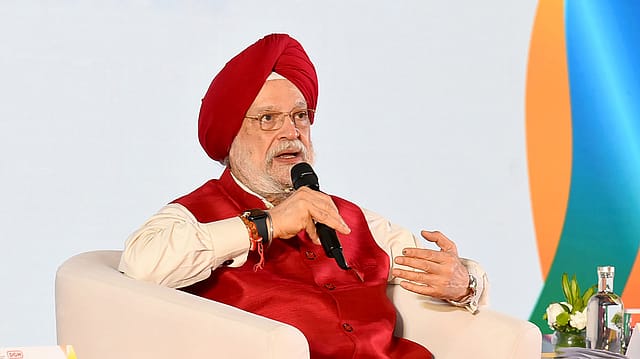
Union Petroleum and Natural Gas Minister Hardeep Singh Puri on Saturday said petrol and diesel prices in the country have not effectively increased despite volatility in global crude oil markets.
Addressing a press conference during his visit to Sonbhadra as part of the Centre's campaign marking 12 years of the Narendra Modi government, Puri further said that Sonbhadra in Uttar Pradesh is shedding its image of being a backward region and is moving towards becoming a model district.
"If we look at the situation in real terms, there has been no increase in petrol and diesel prices in the country," Puri said.
He said Prime Minister Narendra Modi had reduced central excise duty in November 2021, May 2022 and again recently, resulting in the government bearing a burden of around ₹10 per litre each on petrol and diesel.
Responding to a question on whether domestic fuel prices would be reduced in view of softer international crude oil prices, Puri said, "There are 193 countries in the United Nations and only Japan has seen a lower increase in petroleum prices than India."
He said the overall increase in petrol and diesel prices had been limited to ₹7.60 and added that compared to prices prevailing during the Russia-Ukraine conflict that began in 2022, "there has actually been no increase."
Referring to tensions around the Strait of Hormuz, the minister said oil marketing companies were incurring losses of about Rs 1,000 crore per day, but the government ensured that the burden was not passed on to consumers.
"If compared with 2022 prices, the rates are actually lower," he said.
Puri said oil companies were holding inventories of crude purchased at higher prices and fuel prices could soften once lower-priced crude reached refiners.
"At present, companies have stocks of crude oil bought at higher prices. When crude purchased at lower prices reaches them, there is a possibility of a reduction in fuel prices," he said.
Highlighting development in Sonbhadra, Puri said the district had secured the top position in Government of India's Delta Ranking programme.
"Sonbhadra is moving out of the identity of backwardness and will soon establish itself as a model district," he said, attributing the progress to the "double-engine government" of the Centre and the state.
The minister said India had achieved unprecedented progress in infrastructure, energy, social security, welfare and self-reliance during the past 12 years under Modi's leadership.
"Our economy is growing at a very fast pace," he said, adding that India was advancing rapidly towards becoming the world's third-largest economy.
Puri said when Modi assumed office in 2014, India was the world's 11th largest economy, whereas it had now become a $4-trillion economy.
Highlighting local development, he said Sonbhadra's per capita income had increased from Rs 43,000 in 2018 to around Rs 1.2 lakh at present.
"There is still work to be done and all of us are engaged in that effort," he said.
The minister said Uttar Pradesh had emerged as a major centre of economic and industrial growth, with its gross state domestic product rising from around Rs 13 lakh crore in 2016-17 to nearly Rs 36 lakh crore.
He said more than 23,000 startups, over nine lakh government jobs through transparent recruitment processes, and initiatives such as One District One Product (ODOP) had turned the state into a new engine of growth and employment.
"Ayodhya, Kashi and Prayagraj are emerging as world-class spiritual and tourism centres," Puri further said, adding that projects such as the Ram Temple, Kashi Vishwanath Corridor and infrastructure developed for the Mahakumbh had boosted tourism, local employment and economic activity