
Swiggy shares slide as foreign ownership cap fuels outflow fears; Flipkart's food delivery plans add to pressure
ADVERTISEMENT
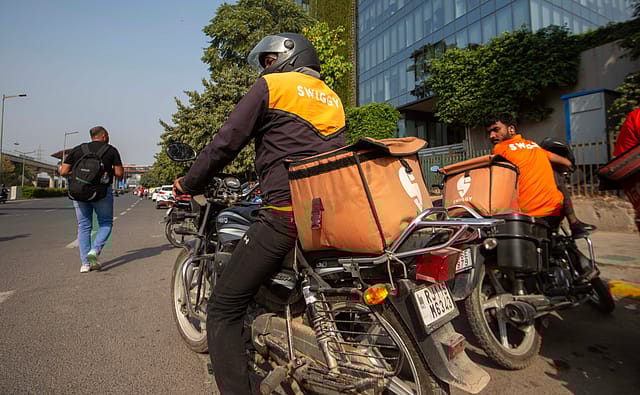
Shares of food delivery and quick commerce platform Swiggy Ltd fell sharply on Friday after the company's proposal to cap foreign ownership at 49.5% triggered concerns over potential passive fund outflows. Sentiment was further weighed down by reports that Walmart-backed Flipkart is preparing to enter the online food delivery business.
The stock fell as much as 7% during the session before recovering some losses to close at ₹251.50, down 3.84% on the National Stock Exchange.
Foreign ownership cap sparks index outflow concerns
The sell-off follows Swiggy's board approval of amendments to its Articles of Association to cap aggregate foreign ownership at 49.5% on a fully diluted basis. The proposal will be put before shareholders at the company's Annual General Meeting on August 18.
The move is aimed at helping Swiggy eventually qualify as an Indian-Owned and Controlled Company (IOCC)—a status that could allow its quick commerce business, Instamart, to adopt an inventory-led operating model under India's foreign investment rules.
However, investors focused on another implication. A lower foreign ownership limit could reduce Swiggy's eligibility for certain global equity indices, raising the possibility of passive fund outflows.
According to Nuvama Alternative & Quantitative Research, the stock could witness passive outflows worth about $460 million, including an estimated $340 million from the MSCI Standard Index and $120 million from FTSE-linked funds.
Swiggy has, however, clarified that reducing foreign ownership below 50% does not automatically make it an IOCC, adding that there has been no change in the company's ownership or control, and that any material development would be disclosed separately.
Brokerages see near-term risks but long-term opportunity
Brokerages remain divided on the long-term implications of the move.
UBS said that achieving IOCC status could eventually enable Instamart to transition to a first-party inventory-led model, which it believes would improve supply chain efficiencies and support margins over time. However, the brokerage noted that the transition depends on the company satisfying all regulatory requirements for IOCC status, not just the foreign ownership threshold.
JM Financial, on the other hand, said the process could take longer than the market expects. The brokerage noted that IOCC eligibility under FEMA regulations depends not only on ownership but also on control and governance requirements, suggesting the operational transition may not materialise until FY28.
Flipkart entry adds another overhang
Adding to investor concerns, reports suggest Flipkart is preparing to launch a pilot food delivery service in Bengaluru within the next month. The company is expected to explore both a standalone platform and integrations through the Open Network for Digital Commerce (ONDC).
A new deep-pocketed competitor could increase competitive intensity in India's online food delivery market, where Swiggy and Eternal-owned Zomato currently dominate.
Investors will now turn their attention to Swiggy's Q1 FY27 results on July 30, when management is expected to provide clarity on the proposed foreign ownership cap, the roadmap towards IOCC status, competitive developments in food delivery, and the outlook for Instamart's profitability.
(DISCLAIMER: The views and opinions expressed by investment experts on fortuneindia.com are either their own or of their organisations, but not necessarily that of fortuneindia.com and its editorial team. Readers are advised to consult certified experts before taking investment decisions.)