
TCS may have as many AI agents as human employees within three years: Chandrasekaran
ADVERTISEMENT
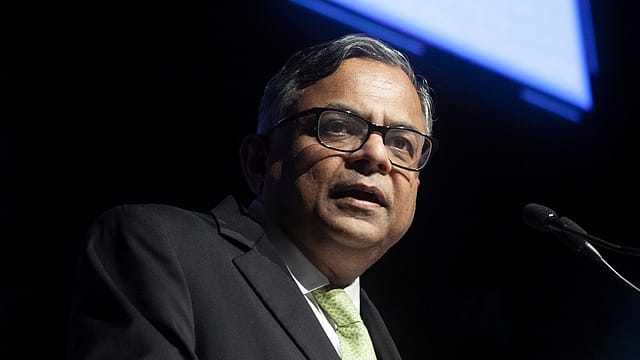
At a time when IT services firms across the globe are realigning to the realities of an artificial intelligence (AI)-first world, N. Chandrasekaran, Chairman of Tata Sons and India’s largest IT services and consulting company Tata Consultancy Services (TCS), sees AI as the most significant opportunity for enterprise IT rather than a threat.
At the company’s 31st AGM, he told shareholders that while IT stocks may be facing a sharp sentiment-driven correction, strong profitability, steady revenue growth, and robust deal pipelines indicate that the sector’s underlying fundamentals remain resilient. “I believe the disparity stems from a misconception surrounding the relationship between AI and IT services,” Chandrasekaran said.
With global enterprise IT spending expected to reach $3 trillion over the next decade—effectively doubling from the current levels—TCS is betting on five major growth opportunities. Chandrasekaran highlighted legacy technology modernisation, AI governance, and oversight within enterprises, the reimagining of business operations through AI, and emerging opportunities in sovereign AI and physical AI as key drivers of new business opportunities.
While elaborating on each of these opportunities and how the company is positioning itself to capitalise on them, Chandrasekaran said, “These opportunities cannot be captured by giving organisations access to AI technology. Enterprises need to organise their data and integrate it into unwieldy IT systems that have evolved over decades. TCS has spent years with customers, maintaining software, managing change and learning the exceptions that never appear in architecture diagrams.”
Emphasising that context and trust will be the most valuable differentiators in the AI era, Chandrasekaran said firms like TCS have an edge over newer-age firms in the enterprise AI landscape, given their deep institutional knowledge, customer relationships, and proven track record of trust. “This derives from deep regulatory knowledge, strong client relationships, and decades of delivering projects across borders. All will be of profound importance in the era of enterprise AI. In enterprise AI, the scarcest resource will not be the model. It will be context and trust,” he said.
With TCS now looking at an annualised AI revenue of $2.4 billion, Chandrasekaran sees the company becoming an agent+ human employer. “I predict that over the next three years, TCS will have as many AI agent as human employees,” he added.