
The 'Peshwa strategy': How PNG jewellers is chasing regional white spaces to build a national foothold
ADVERTISEMENT
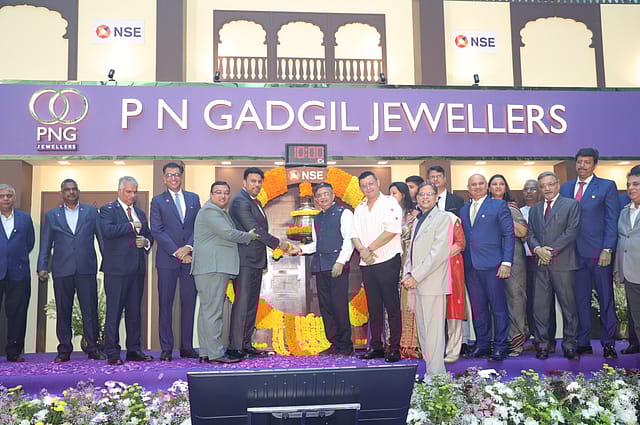
When Maharashtra’s historic Maratha Empire looked to expand its domain in the eighteenth century, the Peshwas did not march straight into the heavily fortified kingdoms of the deep south. Instead, they charted a corridor northwards through Madhya Pradesh, Uttar Pradesh, and onwards to Delhi.
For Dr Saurabh Gadgil, chairman and managing director of PNG Jewellers , that historical playbook offers a practical roadmap for corporate expansion. Rather than wading into the crowded, margin-squeezed jewellery retail landscape of South India, Pune-based company is deploying what Gadgil terms the “Peshwa strategy” to carve out market share across India’s central and northern heartland.
“At that point, we framed the entire path of being the foremost player in Maharashtra and then moving outside the state,” Gadgil shares, referencing the company's post-listing roadmap under what he calls PNG 2.0. Following its September 2024 debut on the bourses, PNG Jewellers has grown to an 80-store network spread across six states and union territories, including Maharashtra, Goa, Uttar Pradesh, Madhya Pradesh, Bihar, and Delhi-NCR.
“We look at ourselves as being one of India's only organised family jewellers. On one side, we have the traits of a family jeweller; the legacy, strong customer connects, generations of customers banking with us. And on the other side, we are organised; we are system driven, process driven, like any other corporate,” he explains.
Gadgil sees an operational logic in bypassing the south for now. South India accounts for approximately 40% of the country’s total jewellery consumption, but it is also dominated by established regional chains and large format outlets averaging 10,000 square feet. By comparison, Central India presents a unified cultural market with common languages, festivals, and buying habits, while lacking large homegrown retail chains.
Tapping higher margins
While western and southern markets are heavily driven by plain gold, Central and North India exhibit a higher propensity for diamond and studded jewellery. In Maharashtra, studded items represent around 10% to 11% of PNG’s product mix, but that figure climbs to 20% in its Central Indian stores, giving the retailer a significant boost in gross margins. Over the next three to four years, Gadgil aims to lift Central India's revenue contribution to between 10% and 12%, eventually targeting 25% to 30% as the brand establishes regional dominance.
To fund this expansion without taking on leverage, the company has deployed the ₹850 crore raised during its initial public offering alongside proceeds from a recent qualified institutional placement that lowered promoter shareholding from 83% to 76%. The retail jewellery generated an all-time high of ₹2,412.98 crore in revenue, a 40.7% annual rise, after crossing ₹10,000 crore in full-year sales in FY26.
From a 3-store entity in the early 2000s, Gadgil has helped PNG to become a 80-store brand today. And supported by internal accruals, the company plans to scale its footprint to 103 stores by March 2027, 140 by March 2028, 175 to 180 by March 2029, and over 200 stores by March 2030.
That footprint will be divided between 110 to 120 traditional large-format legacy showrooms and 80 to 90 outlets of "Yoou," its lightweight, lifestyle retail format. While the core legacy stores cater to traditional bridal demand where nearly 70% of transactions involve exchanging old gold for new designs, the "Yoou" stores target younger buyers with 14-carat and 18-carat everyday jewellery.
Gadgil remains skeptical about chasing national scale through acquisitions, particularly in light of recent industry consolidation such as GRT Jewellers picking up a majority stake in Tribhovandas Bhimji Zaveri Ltd (TBZ The Original). In his view, jewellery retail remains an intrinsically relationship-driven business where corporate integrations struggle to transfer customer loyalty.
“Everyone's trying to follow how things will shape up because gem and jewel industry was not known for merger and acquisitions. Even brands like Kalyan, Tanishq amd Reliance, all grow organically. So, this could set a new trend and, let's wait and watch to see how it evolves,” Gadgil says.
For now, by keeping store inventory turns between 4.5 and 5 times and maintaining annual revenue growth above 30%, PNG Jewellers is betting that steady, organic territorial gains will prove far more durable than quick consolidation.