
The right blend: The man, the machine, and the coffee
ADVERTISEMENT
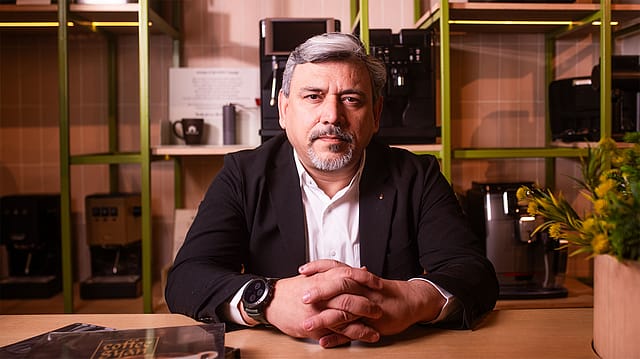
June 2002, Oslo.
The air didn’t smell like coffee. It smelt like fear.
Thirty-nine countries. Machines he had never touched. Rules no one had bothered to explain. Backstage at the World Barista Championship, Vikram Khurana tightened his apron and tried to steady his hands. His pulse, though, refused to listen. India had never stood here before. And neither had he.
Barely a year into Café Coffee Day, the 22-year-old wasn’t just competing. He was carrying a country that didn’t yet know what a barista was. When he stepped onto the stage, everything felt wrong. The machines spoke a foreign language. The beans weren’t his. Even the grinders sounded hostile. His mind began roasting its own dark brew: What if I fail? What if I embarrass India? What if this ends before it even begins?
The room watched. The clock ticked. And somewhere between doubt and discipline, Khurana did the only thing he knew how to do: trust the craft.
The final pour was clean. The milk settled. The cup held. For the first time that day, his hands stopped shaking.
Khurana finished second. It didn’t matter. India had arrived. As he soaked the strong aroma of thunderous applause, the young man knew that coffee wasn’t a job anymore. It was his destiny. “Coffee entered into my blood, and from now on, coffee was my life,” he recounts.
Sweet to bitter: a dark brew
Fifteen years later, destiny returned. But this time, not as applause, but as a bitter contract clause.
By 2017, Khurana was no longer the wide-eyed barista on a foreign stage. He was the face of Kaapi Machines, the company he joined as co-founder and CEO in 2007. Soon, he became the face of the company that specialised in selling coffee machines, and was busy wiring India’s specialty coffee backbone, machine by machine, café by café.
But success had a shelf life. A decade later, disagreements surfaced, shareholding tensions hardened, and clauses were read aloud. One line landed like a shot pulled too fast: You cannot do a similar business for the next few years.
Khurana didn’t raise his voice, but his every word carried heat. “Coffee is in my blood. I cannot leave this profession. I am a barista, and I will stay so,” his tone reeked of defiance. Walking away meant walking into uncertainty. His name, his identity and even the word Kaapi…all were up for dispute. Destiny, it seemed, was trying to detox him of coffee.
But Khurana had learnt something long ago, under unforgiving lights in Oslo: you don’t quit the craft when the machine changes. You recalibrate and brew again. In 2017, Khurana started Kaapi Solutions, a full-stack coffee solutions provider that supplies imported coffee machines, and trains in micro to commercial roasting, grinding, brewing, and barista tutoring. “It was a rebirth for me. I was starting from zero,” he says, adding that he mortgaged his house and put his personal comfort on the line.
The entrepreneur knew the flip side of his move. There was no room for error. “I put everything at stake,” recounts Khurana, who was cautioned by many to temper his ‘bravado’. Friends warned him. It’s a crowded and unorganised market, and it takes years to build trust. Well-wishers tried to drill in another reality: India was still a tea nation, and specialty coffee was just a fad.
Betting on caffeine
Khurana dug into his learning at Oslo: people don’t buy machines. They buy belief. So, he rebuilt from the first principles. There were no brochures, and no hard sells. The only thing that mattered was experience. “If you’re buying a coffee machine,” he told his clients, “You must taste the dream first.” He rolled out showrooms and turned them into experience centres. He converted sales calls into classroom sessions and ensured that customers didn’t walk out with invoices. “I was selling them clarity. Anybody can sell a machine. But the magic lies in how to use them. That’s a craft,” he explains.
Slowly, the crema began to form. Fast forward to 2025. Kaapi Solutions had scripted a strong comeback story. The company posted an operating revenue of ₹107.73 crore, according to regulatory filings by Kappi Solutions. “We are profitable and now clocking an ARR (annual run rate) of ₹125 crore,” he says, sharing the glowing report card of his company’s selling prowess: 15,000 cafés; 2,000 offices; over 1,000 homes; 14,000 machines installed. “We have brewed a strong comeback,” he claims, adding that he has worked with brands such as Costa Coffee, Theos, Paul, Barista, Social, Bikanervala, Haldiram’s, Tim Hortons, and Burger King. In terms of tie-ups with coffee machine makers, Kaapi Solutions has a long roster, including the likes of Astoria, CIME, Rocket, Melitta, Necta, Mazzer, and Eureka.
That may be impressive, but revenue of ₹100 crore in eight years, and a sedate forecast for FY26, makes it a steady growth, not heady, right? Khurana draws an analogy between coffee beans and his entrepreneurial mindset. Coffee, the seasoned barista underlines, speaks in two dialects: arabica and robusta. Arabica whispers—smooth, aromatic, and delicately acidic—making it the darling of specialty coffee. Robusta, in contrast, roars, delivering higher caffeine and a bold, earthy intensity. “I am more of arabica: slow and steady,” he smiles.
Khurana’s instinct now has data backing it. According to a report by Redseer Strategy Consultants, what was once niche is fast becoming mainstream. “Indian consumers increasingly view coffee as more than just a beverage. It represents a lifestyle and a statement,” underlines Redseer in its report titled ‘The Future of Coffee in India: A $3 Billion Opportunity Awaits’.
The study lists out key trends that have helped consumers in gravitating towards the beans. First is the rising demand for specialty coffee. A growing preference for brews like americano and cappuccino over instant and filter coffee signifies a move towards sophistication, reckons the Redseer report. Second, on-the-go convenience. Busy urban professionals are fuelling demand for takeaway options, especially near workplaces and tech parks. Third, artisanal standards. “Brands are raising the bar with in-house roasteries and artisanal brewing techniques, setting new benchmarks for quality and freshness,” it highlights. “By 2028, the outside coffee market in India is projected to grow at a CAGR of 15-20% to become $2.6-3.2 billion market opportunity,” it predicts.
Machines, grinders, and baristas
No wonder, at the centre of the coffee revolution are invisible baristas like Khurana. “India’s specialty coffee revolution didn’t begin with cafés, cool logos, or Instagram menus,” reckons Ashita Aggarwal, professor of marketing at SP Jain Institute of Management and Research (SPJIMR). “It began quietly with machines humming, grinders calibrated, milk steamed to the right temperature, and baristas trained to respect the cup,” she says, underlining that the coffee revolution is brewed by people like Khurana. While India’s specialty coffee boom is visible in cafés, what’s invisible—but equally decisive—are machines, training, consistency, standards, and seasoned baristas. “These men operate where the romance ends, and the grind begins,” says Aggarwal.
Khurana, for his part, refuses to romanticise the coffee revolution in India. He tells us why the brew has turned bitter. “What has gone wrong is the specialty word. It has become an abused word,” he reckons. Every roaster, every café owner, every grower of coffee wants to call his coffee as specialty coffee. “It's absurd,” he says, adding that specialty can be only 1% or less than 1%. And that’s the norm across the world. But in India, everyone wants to use the ‘specialty’ word to gain extra bucks. While there are brands like Blue Tokai and Third Wave that have been flagbearers in the specialty coffee world, there are many who are peddling sub-standard stuff and giving a bad name to specialty coffee, he says.
Another big challenge stems from the lack of consistency in taste. “It indeed is one of the biggest challenges. Machines can make but humans can brew. Brands are not investing in training,” rues Khurana, who lists out another hump. The coffee culture is yet to take deep roots in the country. “India is a food-centric market. It’s not a beverage-centric country,” he says, adding that coffee is not an intrinsic part of the breakfast culture. There are countries, like Australia, that start brewing coffee early. Contrast this with India, where most of the cafes open by 9 am or 10 am. “In Australia, by 9:30 am you have done 60% of your business,” he says.
The prospects, however, looks promising. “Coffee is yet to enter many Tier II and III cities. And these are the places where consumers are upgrading in taste, style, and income,” says Khurana. India, he adds, has over 70 cities with a million-plus population. These are the places that have grown on tea. “Such places are untapped and provide perfect conditions for brewing a coffee revolution in India’s hinterland,” he says.
Though the opportunity is massive, the challenge is equally daunting. Aggarwal of SPJIMR points out the toughest one. Kaapi Solutions, she reckons, must stay true to its game: slow brew. It took the company eight years to cross ₹100-crore mark. “If selling coffee for ₹200 is not easy, imagine selling machines and roasters that cost as high as ₹45 lakh,” she says. The coffee culture in India is still in its early days. “Let the industry reach an inflection point, and then it would be the right time to press on the gas,” says Aggarwal. “Till then, it has to be one cup at a time, and one machine at a time.”
Khurana, for his part, is aware of the big task. “It’s easy to sell a machine. It’s tough to sell—and keep—a promise,” he says. The biggest broke part in the coffee ecosystem in India is after-sales service. “We have close to 100 engineers in the servicing department,” he claims, adding that the company has rolled out its D2C brand of home machines: KofiHaus. Just like a refrigerator, TV, and AC, most Indian households in the cities will have a coffee machine over the next two decades. “We want to make most of this opportunity,” he says.
Ask him how he would rate his performance, and Khurana borrows a line from American poet T.S. Eliot’s poem ‘The Love Song of J. Alfred Prufrock’: “I have measured out my life with coffee spoons.” Khurana, though, didn’t just measure it. He brewed it: one cup, one machine, and one belief at a time.
In Oslo, coffee smelt like fear. Two decades later, it smells like resolve.