
Why Satya Nadella’s “desperate” bid to join CoPilot team is a subtle warning on irrelevance in the age of AI
ADVERTISEMENT
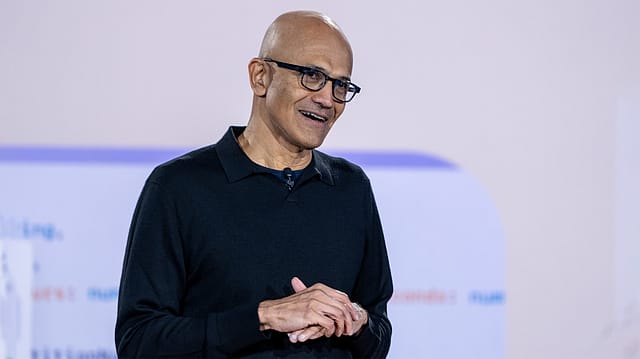
Satya Nadella, CEO of the world’s second-most valued company at over $3.5 trillion company, stood before a packed Mumbai audience of Microsoft employees, developers, policy makers and media on Friday and during the course of his presentation made an interesting remark: “You know, one of my life's ambitions is to figure out how to get a job in the Copilot [Microsoft’s generative AI] team. And so, I'm preparing for it. I'm sort of desperately trying…how to get competent enough to get hired.”
The line elicited chuckles from the crowd. But it wasn't a joke.
Nadella, closing out his three-city Indian tour on Friday, had just sent the most important signal of the entire AI age.
On the surface, his confession comes as a charming self-effacement of a powerful CEO admitting vulnerability. But what he really meant was that the person running Microsoft doesn't assume he’s qualified for the most important team at Microsoft.
It was a subtle warning that in the AI age not just employees, even the CEO’s role is replaceable.
In fact, when Nadella joked about his follicular challenges of “loving Excel when he had hair, still loving Excel when he doesn't”, he was encoding a survival strategy. “It's one of those generational things that just gets better and better in spite of my follicle challenges,” he said.
But what the 58-year-old CEO meant was that Excel stayed relevant across decades by continuously reinventing what it could do. For Nadella, who has “worked on Excel all my life essentially,” this represented something profound: the spreadsheet as the original low-code platform, is now turbocharged with agents that can iterate continuously on sophisticated models, just the way it is done in software engineering.
Nadella's detailed walkthrough of his holiday project wasn't really about deep research tools or cricket teams. It was about what he was doing when he had “time off.” Building. Learning. Upgrading to GPT-5.2. Every morning, he confessed, he goes to his GitHub repo and starts assigning tasks to multiple agents.
When Nadella demonstrated his multi-agent systems, he framed them as the new form of metacognition. “You can use these decision frameworks as the new form of metacognition, right? So, if you have all this abundance of models, the ability to literally do what I did, which is just build your own multi-agent system, right? That's the new commodity.”
In other words, the new baseline skill was building multi-agent systems just the way one creates spreadsheets or documents.
When he spoke about agents being built right into Copilot as simply as “doc new” or “spreadsheet new,” he was describing a future where creating AI agents was as expected as writing documents is today.
Beneath its celebration of progress and investment announcement of $17.5 billion, Nadella's entire Mumbai keynote carried an undercurrent of urgency, that bordered on anxiety. “Models are becoming, quite frankly, a commodity,” he said multiple times, in different ways. The very technology everyone is scrambling to understand, to implement, to build careers around is already a commodity in his view.
Nadella's “desperate trying” to get hired by the Copilot team wasn't really about showing the prowess of Office 365 universe, it was about staying relevant in a world where today's CEO might not qualify for tomorrow's critical role.