
Will Google’s re-entry into the smart glasses segment dent Meta’s market share?
ADVERTISEMENT
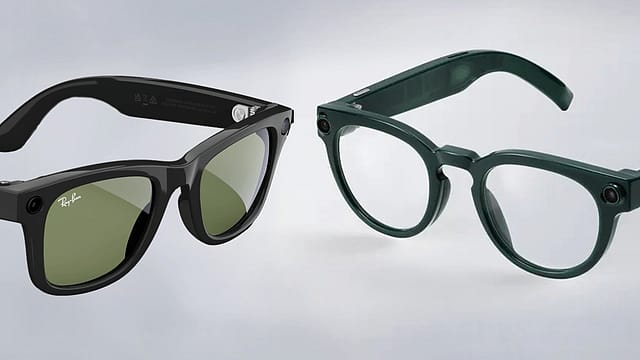
When Google introduced its Android XR OS-powered AI glasses at Google I/O 2026 last week, its features and integration into the company’s larger portfolio could make it a tough contender to Meta’s AI glasses. But this was not Google’s first tryst with smart glasses. In fact, the company had launched a similar product back in 2013, for an eyewatering price tag of $1,500 (£990).
The product did create waves of interest, but after the launch, its sales tanked over privacy issues, and raised eyebrows about its design and usage. Google shut down the glasses soon after, only to bring it back after thirteen years—better and sleeker.
Meta’s growing success
As per Counterpoint Research, Meta already enjoys 80% of the market share in AI glasses, especially with the Meta Ray-Ban models. Since its launch in 2023, with Meta’s glasses saw a steep rise in sales only last year, with shipments of the Ray-Ban Meta AI Glasses (Gen 1) peaking in Q3 2025, primarily driven by seasonal demand.
The Gen 2 model too saw a strong initial market traction, while its sports-focused AI glasses, including the Oakley Meta HSTN and Oakley Meta Vanguard, together accounted for over 30% of Meta’s total shipments in Q4 2025. “Overall, Meta dominated the global rankings for best-selling smart glasses models,” Counterpoint Research noted in another report regarding smart glasses sales.
Meanwhile, Google has partnered with Samsung and eyewear brands Gentle Monster (GM) and Warby Parker, where Samsung is responsible for the glasses’ hardware design, while GM and Warby Parker focus on the industrial and eyewear design, as well as related optical support. Google, meanwhile, provides the Android XR OS, including integration with the Gemini AI assistant and a suite of internet services.
How does Google have the upper hand
Counterpoint’s report states that beyond core functions such as photography and audio playback, the Ray-Ban Meta AI glasses mainly emphasize integration with Meta’s social media ecosystem.
On the other hand, Google ecosystem consists of Gmail, Google Maps, YouTube, Calendar, Photos, and Google Meet. Because of which, the glasses could provide a more seamless “native” integration between the glasses and Android smartphones, particularly for functions such as reminders, calendar event creation, and cross-device, cross-application synchronization to enhance the contextual AI experience, where Meta’s current solution still faces limitations. “As Google integrates these services with Android XR glasses, we expect the usability and application scenarios of AI glasses to expand significantly,” the report read.
While Apple too is gearing up to bring its own glasses, for now both Meta and Google have a level playing field to attract iOS users as its customer base, as both smart glasses provide support both Android and iOS. It comes down to design and style, and usage patterns of iOS customers.
Google does have the advantage by partnering with Samsung, GM and Warby Parker, as it can accelerate the commercialisation of Android XR-powered AI glasses. Banking on Samsung’s popularity, especially in the APAC regions, the partnership brings strengths in consumer electronics manufacturing, imaging and camera optimization, and global smartphone channels, while eyewear partners contribute established retail networks, optical expertise, and brand recognition in the fashion industry.
“However, we expect Google to generate limited profit from the AI glasses segment in the short term, as primary hardware sales revenue will likely be shared among its partners,” the researchers of the reported noted.
Google’s open-platform strategy to be key
While Meta adopts a relatively closed OS strategy, Google is pursuing an open-platform approach focusing on scaling its OS and AI ecosystem. And it is expected that Android XR OS would become a preferred platform for more traditional Android OEMs entering the AI glasses market, as well as for new entrants. When the platform scales, it would unlock additional monetisation opportunities such as advertising, subscription-based on-glass AI services, and potentially improved profit-sharing models with OEM partners.
However, as details regarding the specifications, functionality and pricing of the glasses have not yet been announced, it is too early to draw a definitive conclusion on the near-term competitive impact of Android XR OS-powered AI glasses on Meta. “We also expect both Meta and EssilorLuxottica to adopt a more aggressive marketing and sales strategy this year to counter upcoming launches from Google and Apple.”
What Google needs to do to prove its mettle
As smart glasses have the hurdle of being small and dependent on voice control and AI assistants, Google’s advantage with Gemini would be to create smaller language models that are task-specific language to deliver concise and highly relevant responses, rather than comprehensive but verbose outputs typical of smartphone or PC-based AI systems.
As AI glasses offerings in the current market look alike, as they depend on rely on Qualcomm’s AR1 SoC and Sony’s IMX681 image sensor, Google, with the Samsung collaboration would have offer innovative hardware options to get more customers.
Meta has already landed in legal trouble waters due to privacy—both user and bystander, while also facing debates over controversial features. Google will have to put policies and features in place regarding user data protection and privacy safeguards in its AI glasses to address public concerns and support broader consumer adoption.
Lastly, the report brings out the pricing and segmentation strategy. Google’s partnership with Gentle Monster and Warby Parker caters to value, unlike Meta’s premium position with Ray-Ban and Oakley. As the former companies have a weak presence in the European market, it would come down to how Google and Samsung will differentiate across brands and regions to target the right consumer segments, in terms of product, branding, pricing and channel strategies.
“Nevertheless, we expect the global smart glasses market to evolve from a “Meta-dominated” structure to a “three-horse race” led by Meta, the Android XR OS ecosystem, and Apple starting from 2026/2027,” the report concluded.