
With Embraer, Star Air is making big bets on Indian skies
ADVERTISEMENT
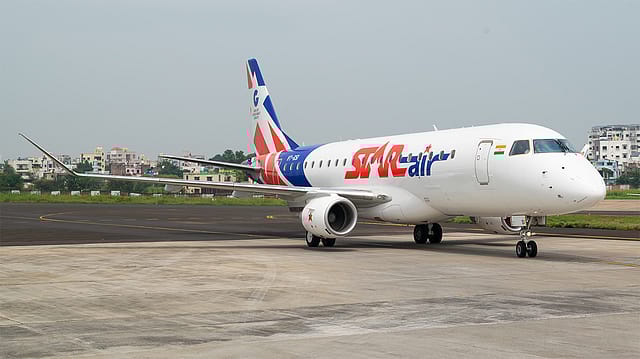
There seems to be no stopping Bengaluru-based Star Air.
After emerging as India’s largest regional airline, Star Air is busy setting serious ambitions for the Indian skies, with plans to purchase as many as 8 new aircraft by FY 27, indicating the massive potential in India’s regional aviation market.
The company currently operates nearly 66 flights a day, using 12 aircraft. Of this, four are helicopters. By the end of the current financial year, the company plans to add two more aircraft, with another 6 in the next financial year. The company is currently finalizing plans to procure the aircraft, which will most certainly be made by the Brazil-based aircraft maker Embraer. Already, eight of its operating aircraft are Embraer.
“As part of the growth strategy, there is obviously an intent to get more aircraft,” Shrenik Ghodawat, the managing director of the Sanjay Ghodawat group that owns Star Air, says. “We are intending to become a 40 to 50-aircraft fleet. In the next five years, we are looking at all the plausible options that are available in the market. So, it could be an operating lease, it could be a financing lease, it could be a sale and leaseback. So, we are considering all these options. There hasn't been anything inked or finalised yet. But our objective is to look at all the possible options and see what is best in terms of ownership cost.”
Star Air’s partnership with Embraer means the Brazilian aircraft maker has finally made inroads into the Indian market, which has been dominated by Boeing, Airbus, and ATR. Embraer had also inaugurated its India office in New Delhi this October, highlighting the aircraft maker's ambitions, and the potential underlying in the Indian market.
“Regional ecosystem is going to be our strategy for the next 5 years,” Ghodawat adds. “We are very focused on going deep, rather than spreading ourselves thin and trying to cover too many cities. Our objective is that with a 40 to 50 aircraft kind of a fleet, even if you are able to cater to about 50 to 60 cities in India and densify it in a way that they are interconnected, there is a good amount of leisure as well as business travel.”
In November this year, Star Air had Rs 150 crore in the first tranche of its Rs 350 crore Series B funding round. The investment came from a group of prominent investors, including Micro Labs Ltd and Deepak Agarwal of Bikaji Foods, and was the first external fundraising since it began operations in 2019.