
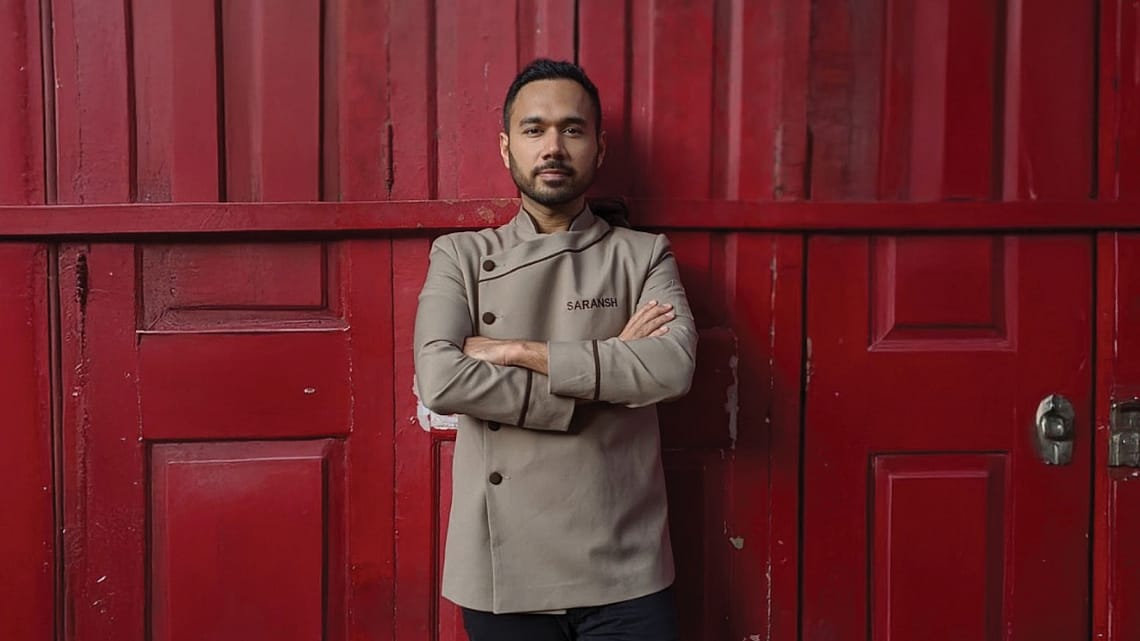
Beyond the butter chicken with Saransh Goila
The accidental icon
Saransh Goila never set out to become the butter chicken guy. In fact, he didn’t even grow up eating the dish. Raised in a vegetarian Sindhi household in Delhi, his comfort food was sai bhaji, aloo tuk and Sindhi kadhi—not smoky tomato gravies enriched with butter and cream.
Yet, over the last decade, Goila has managed to take one of India’s most polarising comfort dishes and turn it into a cult brand that now spans more than 100 kitchens across cities, international markets, and even an English Premier League football stadium, with Goila Butter Chicken operating out of Fulham FC’s Craven Cottage in London on match days.
A formally trained chef, Goila studied culinary arts at Institute of Hotel Management Aurangabad—part of the Taj Group of Hotels—where he met his college batchmate and future business partner Vivek Sahani. Goila Butter Chicken (GBC) began not as a scalable business idea, but as a hashtag born at pop-ups.
Between 2015 and 2016, Goila and Sahani ran an almost nomadic food operation—hosting pop-ups in restaurants, events, and sometimes even at home. Over 12 months, they built a loyal community that came specifically for his version of butter chicken: smoky, balanced, not overly sweet, and unapologetically sauce-forward.
That early phase shaped the brand’s DNA. “We thought we’d open one outlet and let people come experience it,” Goila has said. The inspiration came from old-school Delhi institutions like Rajinder Da Dhaba—single-location legends that slowly took over their neighbourhoods.
Timing meets technology
The first GBC outlet opened in Andheri West in 2016—chosen as much for its low rentals as its potential. But while Goila was thinking like a chef-restaurateur, the ecosystem around him was changing fast. Zomato and Swiggy were just beginning to push food delivery aggressively, and GBC’s digital-first appeal made it an early favourite on these platforms.
For two years, Goila resisted scale. Expansion, when it came, was cautious: Bandra in 2017, Lower Parel in 2018, each funded by reinvesting profits from the previous outlet. But by 2018, two things became impossible to ignore. First, butter chicken—however iconic—was ultimately a convenience product. Much like pizza or burgers, most people wanted it delivered home. Second, food delivery platforms were no longer optional; they were reshaping consumption itself.
That same year, Goila’s butter chicken featured as a pressure-test challenge on MasterChef Australia, where he also appeared as a guest judge—an inflection point in global visibility that forced a mindset shift. “We realised we were thinking like chefs in love with our product, not like custodians of a brand that deserved scale,” he has said.
Making Indian food scalable
Scaling Indian food is notoriously difficult. Unlike burgers or pizzas, Indian gravies are sensitive to ingredients, especially tomatoes, whose acidity and sweetness can vary dramatically. GBC’s first attempt at scale came through an in-house central kitchen that supported 7–8 outlets across Mumbai, Pune, and Goa. It worked—but barely.
Running a commissary with butchery, vegetable prep, and curry production soon revealed itself as a business within a business. Investor conversations and advice from industry operators like Ghost Kitchens India’s Karan Tanna pushed Goila towards a crucial decision: separate product custodianship from operational heavy lifting.
Between 2020 and 2022, the brand invested heavily in R&D, experimenting with cold and frozen supply chains and outsourcing gravy production to large-scale partners. The breakthrough came with extreme standardisation. Every batch was tested like a lab sample—pH levels, acidity, sweetness, salt—because, as Goila puts it, “If you can regulate tomato, you can regulate consistency.”
This obsession with SOPs allowed GBC to crack what many Indian brands struggle with: taste consistency at scale.
The Biryani By Kilo moment
By 2022, GBC was ready to scale—but not alone. Enter Biryani By Kilo (BBK). The biryani brand, founded around the same time as GBC, had already scaled to nearly 100 kitchens across India and was operating in 40+ cities. When BBK co-founder Vishal Jindal asked Goila a simple question—Why haven’t you scaled yet?—it sparked a partnership that would redefine the brand’s future.
BBK acquired Goila Butter Chicken in 2024, taking a majority stake and committing to expand the brand from nine kitchens to over 100. The acquisition brought GBC under BBK’s umbrella and leveraged the biryani firm’s existing kitchen infrastructure to accelerate growth significantly. In 2025, BBK’s parent company, Sky Gate Hospitality, was itself acquired by Devyani International, bringing GBC into the portfolio of one of India’s largest QSR operators.
Today, Goila Butter Chicken operates in around 40 cities with an international presence and ambitions to touch 200 kitchens in the coming years—and is now majority owned by Devyani International, the master franchisee for KFC, Pizza Hut, and Costa Coffee in India. In FY25, the brand reported revenues of ~Rs 50 crores, underscoring the commercial scale it has quietly achieved alongside its cultural footprint.
Goila continues with the brand in a non-equity role as its brand chef and creative custodian, overseeing product integrity, flavour consistency, and long-term brand direction. He also remains the face of the brand—for now—anchoring consumer trust and continuity even as the company scales within a large QSR system.
The real secret sauce
Ask Goila what truly built the brand, and his answer is unequivocal: product first. “Storytelling can carry you for a year or two,” he says. “But if the dish doesn’t hit your palate, it won’t last.”
A decade in, GBC doesn’t chase novelty. It doesn’t launch seasonal menus or experimental spins every quarter. It sells butter chicken—and sells a lot of it. Customers return because they know exactly what they’ll get.
The irony? Goila himself doesn’t consider butter chicken his favourite dish.
The outsider advantage
Growing up vegetarian turned out to be an unlikely advantage. Without nostalgia clouding his judgement, Goila approached butter chicken analytically—breaking it down into texture, flavour, and structure. The original recipe was developed as a vegetarian gravy first, inspired by butter paneer, before chicken was introduced later. He identified the sauce, not the chicken, as the true hero. Since the chicken and gravy are cooked separately, perfecting the base unlocked endless versatility.
That vegetarian-first thinking also explains why GBC resonates with non-meat eaters, despite being a non-vegetarian brand. “If my parents can order from it and enjoy it, that’s the biggest compliment,” Goila says.
Beyond the plate: Ember cookware
In recent years, Goila has expanded his footprint beyond food into cookware, joining Ember as brand chef and innovation lead. The category choice was deeply personal. His early exposure to cookware came during his stint with Chef Sanjeev Kapoor, where he witnessed the early building of Wonderchef. Later, a simple question from his mother—Which utensils should I actually be using?—highlighted how confusing and marketing-led the category had become.
Ember’s pitch aligned with his values: cookware that is both non-toxic and non-stick, without chemical coating. Built around advanced ceramic technology developed in Italy, Ember positions itself at the intersection of health, design, and usability. Goila holds equity in the brand and leads its innovation lab, tying his personal credibility directly to product quality.
Creator, founder, custodian
Unlike many digital-first creators, Goila’s journey was never about monetising attention first. Content followed craft, not the other way around. After winning Food Food Maha Challenge in 2011, he built a sustained media presence across television, digital platforms, and social media—hosting food and travel shows such as Roti Rasta aur India and building a strong online following through recipes, travel storytelling, and behind-the-scenes kitchen content that consistently funnelled audiences into real-world consumption.
That physicality changes the risk profile entirely. “You can’t pivot a kitchen like you pivot content,” he has noted. It also explains why Goila is selective about brand collaborations. Long-term equity, product integrity, and alignment outweigh short-term visibility.
Crucially, GBC is being built to stand independent of Saransh Goila, the personality. The brand’s survival, he believes, depends on customers craving the butter chicken—not the man behind it.
The road ahead
Five years from now, Goila doesn’t box himself into neat labels. Chef. Creator. Founder. Each feels incomplete on its own. His focus is on building durable IP—food brands, cookware, and original content formats that tell Indian food stories globally.
“Peace comes from the work you do,” he often says, “not from recognition.”
From a vegetarian kid in a Sindhi kitchen to serving butter chicken at a Premier League stadium, Saransh Goila’s journey is less about chasing scale—and more about earning it, one consistent plate at a time.