
$6-7 tn for 1.4 bn people doesn't stack up: Sunil Mittal says $30 tn economy must be India’s true north
ADVERTISEMENT
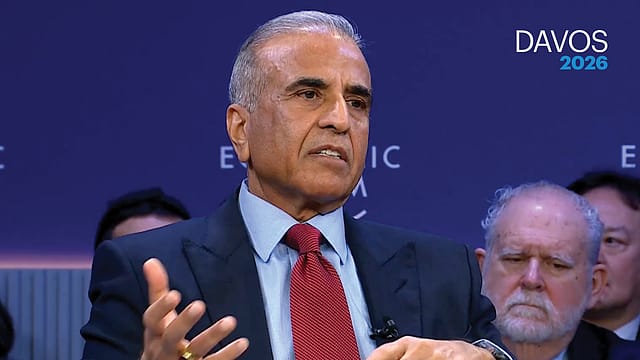
Declaring that India’s ascent to the world’s third-largest economy is "written in the stars," Bharti Enterprises chairman Sunil Mittal on Wednesday told global and domestic leaders at the World Economic Forum that headline growth is a mathematical certainty, but true prosperity requires a leap to a $30 trillion valuation.
Speaking on a high-powered panel alongside union minister Ashwini Vaishnaw and IMF deputy managing director Gita Gopinath, Mittal argued that the current trajectory toward the "number three" spot—projected at roughly $6–7 trillion—is insufficient for India’s 1.4 billion people.
"Six or seven trillion dollars for a population of 1.4 billion simply doesn't stack up," Mittal said. "We will get to number three, but we need to get to $25–30 trillion to ensure every Indian feels the impact of this growth."
Cannot replicate China's growth path
According to Mittal's assessment of the shifting global trade landscape, India cannot replicate the export-led "growth runway" that fuelled China’s rise. "China had 20 to 30 years of a wonderful moment where the US was a huge, open market. That opportunity is no longer available to India," he said, citing the rise of protectionist policies.
Instead, Mittal asserted that India must leverage its "continent of consumers" and its burgeoning digital infrastructure to negotiate from a position of power. He said that the sheer scale of India’s domestic market gives the country "tremendous leverage" to secure fair trade deals, even in a world defined by rising tariff walls.
Digital "cushion" and the manufacturing pivot
A pioneer of India’s telecom revolution, Mittal credited the government for building a "digital highway" that acted as a cushion while physical infrastructure was still being scaled. By prioritising digital connectivity and energy early on, India was able to bypass the long lead times required for "hard" infrastructure like ports and railways.
"We have provided the energy to fire the digital highway while waiting for the hard infrastructure to come up," Mittal said. This digital-first strategy has allowed India to pivot into high-end manufacturing. "I never thought in my lifetime that India would become a global manufacturing destination for electronics or telecom equipment. Seeing the massive exports of Apple phones and other products today is a sea change."
Ease of doing business
When asked about improving India’s business environment, Mittal bluntly rejected the European models. "I can say certainly: nothing from France or the UK. It’s much harder there due to the additional burden of Brussels bureaucracy."
Instead, he pointed to the United States, Singapore, and the UAE as benchmarks for highly encouraged enterprise. Mittal said India has come a long way from a "plethora of handbooks and manuals" that defined the Indian economy when he started his career in 1976. He also urged the government to continue transferring "faith" onto the business community through further simplification of norms.
Outlook for 2026 and beyond
While the IMF recently lifted its 2026 growth forecast for India to 7.3%, Mittal expressed confidence that the country could sustain an 8% "rapid clip" even as the rest of the world faces stagnation.
"India is a market for everybody," Mittal concluded. "What we need is to continue building scale—technology is scale, production is scale. Once we reach a point of consumer surplus to send to the world, India’s fair deal on the global stage will be guaranteed."