
India’s merchandise exports rise over 15% in April-August despite global turmoil: Piyush Goyal
ADVERTISEMENT
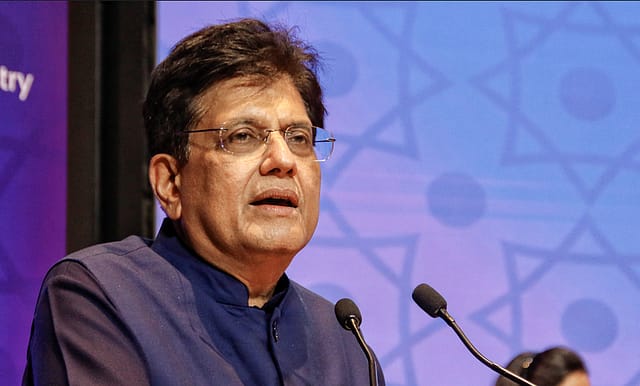
India's merchandise exports rose by more than 15% during April-August this fiscal despite global uncertainties and geopolitical turmoil, Commerce and Industry Minister Piyush Goyal said on Wednesday, highlighting the resilience of the country's external trade.
Speaking at the BRICS Women's Business Alliance (WBA) Women-Led Development Summit 2026 here, Goyal said there was significant untapped potential for India and other BRICS economies to expand trade in both goods and services, particularly by creating greater opportunities for women-led enterprises.
Goyal flags strong export growth despite global trade uncertainties
"Despite all the turmoil that the world is going through today...we are well aware of the softening of internal trade. I am happy to share that our merchandise exports from India have grown between April and August, in the first five months of this fiscal, by upward of 15 per cent," he said.
The Commerce Ministry is scheduled to release the official merchandise export and import data for August on September 15.
During April-July this fiscal, India's exports had risen 17.04 per cent to USD 173.78 billion, while imports increased 19.27 per cent to USD 292.38 billion.
Goyal said BRICS countries should work together to widen opportunities for women entrepreneurs and women-led businesses in international trade, with a particular focus on access to credit, markets and predictable rules of business.
He said an entrepreneur looking to enter international business essentially faces three key barriers — access to finance, access to buyers and markets, and predictable rules that support free trade and create opportunities.
BRICS countries urged to widen market access for women-led businesses
Goyal suggested that BRICS members use financial intermediaries to provide greater support to women entrepreneurs. He also called for governments to encourage women-owned enterprises to participate more actively in international expositions, conferences, seminars, exhibitions and business forums.
"If we can commit our governments to encourage women-owned enterprises to take greater part in international expositions, conferences, seminars, exhibitions, business forums, it will actually help us engage on many more platforms than an annual Women Business Alliance meeting," he said.
He said India would like to bring the lessons learnt from its experience in addressing challenges faced by entrepreneurs, particularly women entrepreneurs, to the BRICS Women's Business Alliance and the broader BRICS business engagement.
On expanding access to international markets, Goyal referred to the BRICS Commerce and Industry Ministers' meeting in Jaipur last month, where ministers agreed on voluntary principles for assessing small exporters.
He said such assessments should not be based merely on invoices and payments, but should also consider an entrepreneur's capabilities and the evolution of the business from the past to the present and its future potential.
Goyal said foreign trade should not be viewed only as a collateralised business, but as an avenue to integrate societies and businesses while opening international opportunities for marginalised sections that may otherwise never consider going overseas.
India pitches common BRICS platform for digital trade, services
Goyal said BRICS countries had also agreed in the Jaipur Consensus to explore a common platform for international trade, which could help tackle the challenge of connecting entrepreneurs with markets and buyers.
He said several financial intermediaries could join such a platform to support women entrepreneurs and small businesses as trade among BRICS economies expands.
Referring to the BRICS work plan on member countries' shared understanding of global value chains, Goyal called for greater participation of women-owned enterprises in international business platforms. He also proposed sector-specific women-led business delegations, such as a fully women-led textile delegation travelling from one BRICS member country to another.
On the issue of predictable business rules, Goyal said international business could not thrive without certainty, open borders and an environment that encourages free trade.
He urged BRICS members to work towards a common platform for electronic trade documentation, including e-invoices, electronic bills of lading and e-customs declarations.
He also referred to the voluntary principles agreed upon to facilitate online cross-border delivery of services while respecting and protecting the laws of individual countries.
At a time when global trade is showing signs of strain and economies are navigating a VUCA environment marked by volatility and uncertainty, with two wars currently underway, Goyal stressed the need for BRICS nations to collectively increase intra-bloc business while continuing to engage with the wider global economy.
With global services trade approaching USD 10 trillion, he said the relatively low level of services trade among BRICS economies pointed to considerable room for expansion.
Goyal said women could play an important role in areas such as mobility, various services and the rapidly expanding digital economy. He stressed the potential for BRICS countries to collaborate on improving service delivery and enabling women entrepreneurs and MSMEs to participate more actively in services and the digital economy.
On access to finance, Goyal called upon the BRICS Women's Business Alliance and the BRICS Business Council to ensure that a study on an invoice-discounting platform reflects the actual requirements of women exporters.
He also urged governments, banks and Exim Banks to consider such invoices when taking lending decisions and called for the proposed Women's Advancement Fund, highlighted in the Jaipur Consensus, to be converted into a concrete initiative.