
Govt says net FDI decline in recent years due to increased repatriation by foreign investors
ADVERTISEMENT
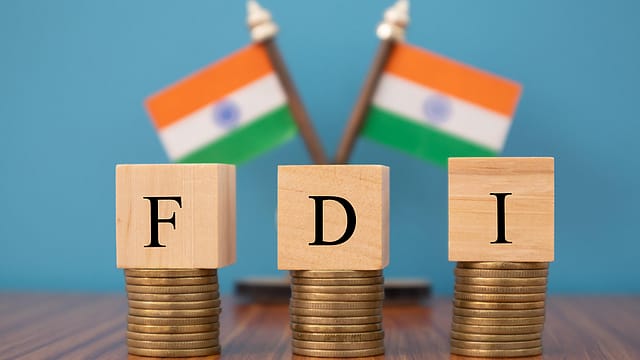
Net foreign direct investment (FDI) declined in recent years, from $27.99 billion in FY23 to $6.95 billion in FY26, due to increased repatriation by foreign investors and rising Overseas Direct Investment (ODI) outflows, Parliament was informed on Tuesday.
Net FDI moderated to $10.13 billion in FY24 and further to $960 million in FY25, Minister of State for Finance Pankaj Chaudhary said in a written reply to the Rajya Sabha quoting RBI data.
In gross terms, he said, India registered a record FDI inflow of $94.84 billion in FY26 as compared to $80.61 billion in FY25.
"The decline in net FDI in recent years recovered to $6.95 billion in FY26 from $0.96 billion in FY25. The recent trend in net FDI inflows is associated with increased repatriation/disinvestment by foreign investors and rising Overseas Direct Investment (ODI) outflows," he said.
The ODI outflow on account of liberalised ODI rules notified in 2022 is helping Indian entities enhance their business footprints abroad enabling them to compete in the global market, adding to the strength of the Indian economy in the long run, he said.
The increasing trend of repatriation indicates that India is not only attracting foreign capital but also delivering strong returns, which enhances its reputation as a reliable investment destination, he said.
Replying to another question, Chaudhary said, the government has been actively undertaking a series of measures to control inflation and mitigate its impact on consumers, particularly the poor and middle class.
The government continuously monitors the prices of essential commodities and undertakes fiscal, administrative and supply-side measures to contain inflation, particularly to protect low- and middle-income households, he said.
Daily price monitoring is complemented by regular reviews by the InterMinisterial Committee (IMC), which recommends measures, including import-export policy interventions, to improve domestic availability.
Some of the measures taken include the augmentation of buffer stocks for essential food items, strategic sales of procured grains in the open market, facilitation of imports and export curbs during periods of short supply, implementation of stock limits to push more supplies of select commodities into the market, retail sales of select food items under the Bharat brand at subsidised rates.
Above all, there is distribution of food grains free of cost to around 81 crore beneficiaries under the National Food Security Act and increasing the disposable income of individuals by exempting annual incomes up to ₹12 lakh (and ₹12.75 lakh for salaried individuals with standard deduction) from income tax, he added.
Further, he said, the rationalisation of the Goods & Services Tax (GST) rates, especially on items consumed by the common man, such as food products, household articles, medicines, medical equipment, agricultural goods and specified automobiles etc., supports affordability for the households.
Replying to another question, Chaudhary said, the monthly average exchange rate of the Indian Rupee (INR) against the US Dollar ($) in May 2014 was ₹59.3/USD, and the corresponding exchange rate in May 2026 was ₹95.6/USD.
Further, he said, INR reached ₹96.57/USD on July 22, 2026.
The value of the INR is market-determined, with no target or specific level or band, he said, and the RBI regularly monitors the foreign exchange market and intervenes in situations of excess volatility.