
India, UAE sign $3-billion gas deal, expand defence ties to boost trade to $200 billion
ADVERTISEMENT
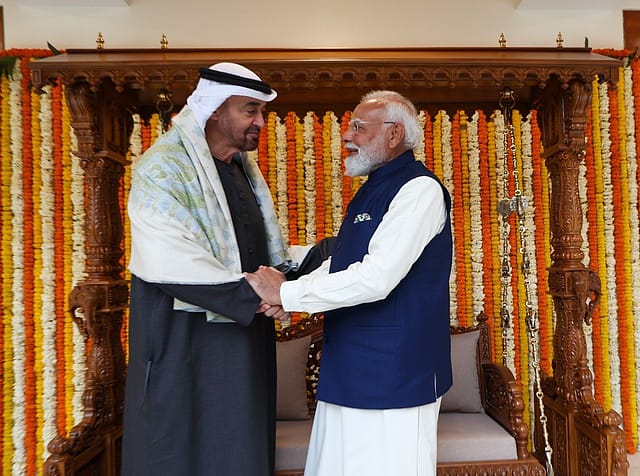
India on Monday signed a $3 billion agreement with the United Arab Emirates to import liquefied natural gas (LNG) during President Sheikh Mohamed bin Zayed Al Nahyan’s visit to New Delhi. The deal was formalised in the presence of Prime Minister Narendra Modi.
Under the agreement, for 10 years Abu Dhabi state firm ADNOC Gas will supply 0.5 million metric tonnes of LNG a year to Hindustan Petroleum, say reports.
Notably, both countries also signed a letter of intent aiming to form a strategic defence partnership and pledged to double bilateral trade to $200 billion in six years. The two sides also discussed the idea of setting up digital embassies to protect sovereign data.
Why are these developments crucial?
The developments are crucial as the UAE is India’s third-largest trading partner and, after Saudi Arabia, India is the second-largest market for UAE exports.
India’s major exports to the UAE include engineering goods, gems and jewellery, petroleum products, textiles, chemicals, and many manufactured items. India imports from the UAE largely energy products such as oil and gas, precious stones and metals, and industrial goods.
Partnership in the space sector
During the bilateral meeting, another Letter of Intent was signed between the Indian National Space Promotion and Authorisation Centre and the UAE’s space agency to support the development of the space industry in the UAE.
On the space agreement, a joint statement issued after the visit said, “This initiative aims to produce an integrated space ecosystem with end-to-end infrastructure and a strong industrial base. It aims to enable India–UAE joint missions, expand global commercial services, create high-skilled employment and start-ups, and strengthen bilateral investment through sustainable business models.”
Defence deal has no relation with situation in Gulf
At a press briefing after the dignitaries departed, Foreign Secretary Vikram Misri said the two leaders also discussed the situation in Yemen, where relations between Saudi Arabia and the UAE have sharply deteriorated.
Responding to a question on whether the India-UAE strategic defence partnership could draw India into a future conflict in the Gulf region, Misri said the Letter of Intent is meant to “work on concluding a framework agreement for Strategic Defence Partnership”.
“So I would really characterise it as a natural evolution from the already considerable defence cooperation between the two countries and not necessarily a response to any specific event that may have taken place in the region or of any intent to get involved in a hypothetical future scenario in the region,” Misri said.