
India’s National Manufacturing Mission must have a commission with real teeth to ‘get things done,’ says Niti Aayog CEO BVR Subrahmanyam
ADVERTISEMENT
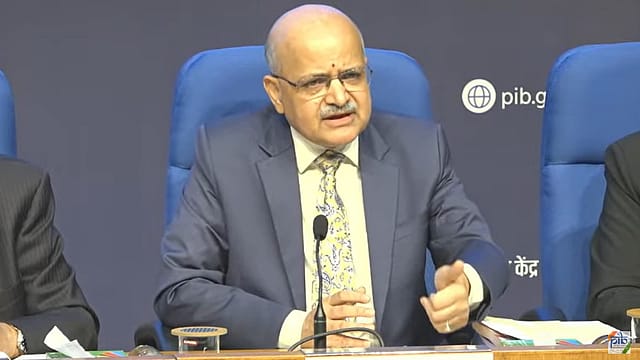
India needs a national body under the government’s National Manufacturing Mission, which will not just be an advisory group but will also be a commission ‘with teeth’ that will get things done, Niti Aayog CEO, BVR Subrahmanyam said today.
Speaking on the second day of the CII Annual Business Summit, Subrahmanyam revealed that the manufacturing mission is a work in progress and the body will be announced in the coming months under the mission.
In the Union Budget 2025–26, Finance Minister Nirmala Sitharaman had announced the launch of a National Manufacturing Mission to boost the Make in India initiative across small, medium and large industries.
The mission aims to provide policy support, execution roadmaps and a governance and monitoring framework for both central ministries and states. The mission is expected to focus on five key areas including ease and cost of doing business, future-ready workforce, a vibrant MSME sector, access to technology, and quality products. The mission anticipates supporting a variety of sectors including clean tech energy, EVs, toys and labour-intensive industries.
“Manufacturing should at least grow at a rate of 15% annually to be able to reach the target of 25% of $30 trillion economy by 2047…[so] why would we need a national manufacturing mission? [Industries] run in places [that are] run majorly by states, [and there are] a lot of pain points at the state level,” Subrahmanyam said.
He shared that while states were asked to prepare their own vision statements last year, over 17 states and UTs have already or are on the verge of completing their vision documents with 5 more coming up with theirs this month.
“By end of this year, every state and UT will have a roadmap for themselves,” he added.
However, in this goal of reaching the $30 trillion economy by 2047 with manufacturing contributing to a whopping $7.4 trillion to this GDP, there remain many roadblocks that Subrahmanyam identified, including regional concentration and or gender inequities.
He outlined key targets that must be achieved in realising this goal of the nation. Putting urbanisation as the first priority, he asserted that the country should bring 50% of its population to urbanised areas fostering rural-urban transformation. Currently, only 30% of the Indian population is living in urbanised areas. He also added that the focus for the country should also be on making energy carbon-friendly to be able to realise the target of Net Zero by 2070. Other areas outlined by the policy think tank chief included transformation of education system, and working towards a transformation of the manufacturing sector.
He suggested also that the country should learn from China. China for the last 30 years systematically has “focused on placing itself at the heart of global value chains in product manufacturing,” he said.
The Chinese government focused on supporting “meaning sectors,” under its Make in China Roadmap, he outlined.
“Money is not the answer, to ensure [industries] become dominant. [India’s mission] must also have clear manufacturing goals [identified] and targets [that are] monitored monthly, quarterly and at multiple levels. [We can even] pick up sectors, where we have potential, or focus on clusters or frontier sectors,” he suggested.
And for all this to happen, Subrahmanyam said that skilling is equally important. He said that for upskilling human capital of the country capable of taking up manufacturing jobs, they should be equipped with basic functional skills including disciplines such as mathematics and English, and some expertise on modern manufacturing. He shared that in this regard, the Niti Aayog is looking at completely restructuring the skilling framework.
“Government needs to fund this skilling, and to make these youth employable, management should be handled by local industry associates. Government should not focus on too much control on the curriculum. It should simply be that the government foots the bill, [but skilling is] managed by the industry,” he concluded.