
Sitharaman signals single-digit customs tariff regime by Budget FY28
ADVERTISEMENT
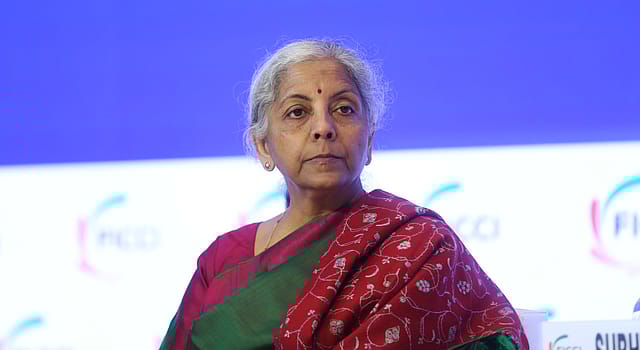
Union Finance Minister Nirmala Sitharaman on Thursday said the government is making steady progress on rationalising India's customs duty structure and aims to bring most tariff rates into a single-digit regime by the Union Budget for FY2027-28, signalling the next phase of its efforts to simplify the country's trade framework and improve manufacturing competitiveness.
Responding to a question during the C.D. Deshmukh Memorial Lecture at the 23rd India Policy Forum organised by the National Council of Applied Economic Research (NCAER), Sitharaman said the government had already reduced customs duties across several product categories and would continue the exercise.
"Yes, there is progress being made. Maybe by the Budget of 2027-28 I would be able to say that, barring a few items... it will come down to single digit. That's continuing and we will keep it up," she said.
The remarks provide one of the clearest timelines yet for the government's ongoing tariff rationalisation programme, which seeks to reduce complexity in customs duties while supporting domestic manufacturing and exports.
Reforms aimed at improving competitiveness
The Centre has progressively simplified customs duty structures over the past few budgets by reducing the number of tariff slabs and removing inverted duty structures across sectors. Industry has long argued that a simpler tariff regime would improve ease of doing business, reduce compliance costs and make Indian manufacturing more globally competitive.
Sitharaman indicated that the exercise remains a work in progress, with only a limited number of product categories yet to be rationalised.
Her comments come as India simultaneously pursues multiple free trade agreements and seeks to position itself as a global manufacturing hub amid shifting supply chains.
PLI success offers lessons for future industrial policy
The Finance Minister also defended the government's Production Linked Incentive (PLI) scheme, saying its success depends on careful policy design, extensive stakeholder consultations and efficient implementation.
"The tailoring of a scheme is very important," she said, describing the mobile manufacturing PLI as "one of the remarkable successes" and noting that a second phase had already been introduced.
She said consultations with industry before launching any scheme are critical to ensuring policies are appropriately designed.
"Stakeholder consultations would have to be meaningful before launch of every scheme... It is both in the consultation, in tailoring and in the execution that the PLI makes a difference," Sitharaman said.
Capex, fiscal discipline remain central to strategy
Sitharaman reiterated that the government's borrowing strategy remains focused on creating productive assets rather than financing recurring expenditure.
"When you borrow money, you borrow it for creating assets... that approach has its reward both for you and for the larger public," she said, arguing that sustained public capital expenditure since the pandemic had helped crowd in private investment by improving infrastructure and connectivity.
The Finance Minister added that governments must remain accountable for debt levels and ensure borrowings are backed by rising revenues and productive investments.
"You don't borrow to service debt... You have to be conscious in not making that borrowing a burden for generations to come," she said.
On financial sector reforms, Sitharaman said the government continues to review the priority sector lending framework to improve the flow of credit to intended beneficiaries.
"I review it every now and then. In fact last week I reviewed it," she said, adding that while funds continue to be routed through institutions such as NABARD and SIDBI where shortfalls occur, the system needs to become more efficient to ensure credit reaches target segments.