
Sudheesh Avikkal: Building A New Language Of Sport, Luxury & Purpose
ADVERTISEMENT
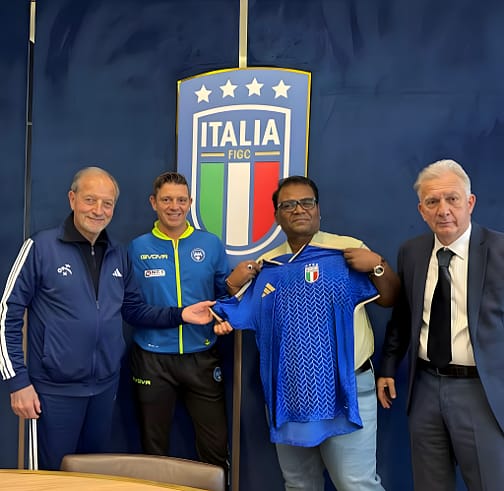
There is a question Sudheesh Avikkal returns to often, not as a slogan for a product launch but as a way of understanding the emotional economy of sport: who is the real hero of the game?
His answer is clear. It is not always the athlete under the spotlight, the franchise owner, or the celebrity whose image fills billboards. It is the fan - the person in the stands, the family watching from home, the traveller who follows a team across cities, the supporter whose loyalty gives sport its atmosphere, memory and meaning.
"Fans are bigger than celebrities," Avikkal says. "It is the passion of the audience that keeps sports alive."
That conviction has become more than a personal belief. It now sits at the centre of Avikkal's expanding world: a fan-first sports platform nearing launch, a development vision that places sport within global peace and sustainability, and S-World, an ultra-luxury private club and lifestyle destination platform planned across key Indian cities. At first glance, these domains appear distant. In Avikkal's hands, they are connected by one theme: the creation of communities around shared experience.
From Kannur To Global Boardrooms
Avikkal's own journey began in Kannur, Kerala, far from the language of international enterprise. He studied Economics at Brennen College in Thalassery before pursuing an MBA at the University of Leicester in the United Kingdom. The academic move gave him confidence, he has said, to think globally and take calculated risks.
His professional life started modestly in 1995, as a receptionist in Mumbai. He recalls that beginning without embarrassment; if anything, it appears to have shaped his belief that no role is too small when approached with discipline and curiosity. Over the years, he moved across financial services, hospitality and sport, eventually rising to become Asia Pacific Head of a Netherlands-based multinational conglomerate and later one of the youngest-performing CEOs in the European Union.
That rise is not merely a story of designation. It reflects a leader formed by cross-cultural exposure and operational pressure. Working with diverse teams, geographies and mindsets seems to have given Avikkal a worldview rooted in adaptability: success, in his telling, is less about inherited privilege than about persistence, learning and the ability to remain grounded while moving upward.
Sport As A Development Language
One of the more distinctive dimensions of Avikkal's public work is his role as United Nations Representative of the Africana Women's Working Group to the UN Economic and Social Council. In that space, his advocacy has centred on a proposition that is both practical and idealistic: sport can be more than entertainment; it can be a strategic instrument for peace, youth empowerment and sustainable development.
In his article, The Power of Sport: Building a Peaceful and Sustainable World, Avikkal argues that sport remains one of humanity's most underestimated tools for progress. It cuts across language, religion, class and nationality. It can reduce inequalities, build discipline among young people, create healthier communities and help societies recovering from conflict find shared rituals again.
What gives the argument weight is that Avikkal does not treat sport as sentimental symbolism alone. He frames it as infrastructure - social infrastructure, emotional infrastructure and, in fragile societies, even peace infrastructure. His call is for governments, multilateral institutions and civil society to fund, measure and formalise sport as part of serious Sustainable Development Goal policy. In his words, sport must move from the margins to the mainstream of development thinking.
The Fan-First Bet
That same instinct - to move attention from the celebrated few to the emotionally invested many - drives Avikkal's upcoming digital sports ecosystem. Built over three years, the platform is designed around fans rather than stars, around participation rather than passive consumption.
The idea is not simply to offer match scores or updates. Avikkal describes it as a space for community, immersive experiences, live engagement, fan stories, travel inspiration and even fashion trends connected to the sporting world. The platform aims to combine technology, entertainment and fandom into a single environment where supporters feel seen, heard and recognised.
In a sports economy often structured around celebrity endorsements and broadcast rights, the premise is quietly disruptive. Fans, Avikkal suggests, are not the background noise of sport; they are its emotional engine. They create the atmosphere, sustain loyalty, travel for experiences and pass identities across generations. A fan-first platform, therefore, is not merely a commercial opportunity. It is an attempt to build a cultural marketplace around belonging.
His proposal for an International Fan's Day extends the same philosophy. If the world can formally celebrate mothers, teachers and tourism, he asks, why not recognise the fans who keep sport and entertainment alive across eras? What might sound whimsical becomes more serious when viewed through Avikkal's broader lens: communities endure when their emotional labour is acknowledged.
S-World And The Architecture Of Experience
The third pillar of Avikkal's current journey is S-World Ultra Luxury Experiences, an ambitious private-club and lifestyle destination platform planned for Pune, Hyderabad and Indore, with openings targeted for 2028. If the sports platform speaks to the fan, S-World speaks to the member - but the organising idea remains similar: create spaces where people gather around meaning, aspiration and refined experience.
Guiding the India vision are global businessman Sudheesh Avikkal and Italian businessman Stuart Mignolo, working alongside acclaimed Spanish designer Ricardo. Together, they bring global enterprise, European refinement and design-led luxury to S-World's first phase of private clubs in India.
The clubs are envisioned not as conventional hospitality venues, but as complete lifestyle destinations where fine dining, sport, wellness, entertainment, business infrastructure and luxury accommodation converge. The Pune flagship, planned across 45 to 50 acres, includes concepts such as a Novak Djokovic Tennis Stadium, a private luxury recliner theatre, soundproof executive rooms, gourmet restaurants, convention facilities and wellness amenities.
Hyderabad adds another layer to the vision with the planned French Village within S-World - an enclave imagined around French luxury brands and curated tasting experiences for cheese, chocolate and wine. The ambition is not simply to import European aesthetics, but to create an immersive cultural experience for India's discerning elite. In Avikkal's wider portfolio, S-World is the luxury expression of a familiar instinct: experience must be designed, not merely delivered.
A Coherent Philosophy
What makes Avikkal's journey compelling is not only its range, but its coherence. The man who argues at global forums that sport can support peace and development is also the entrepreneur building a platform around fans. The business leader shaping ultra-luxury private clubs is also someone who began his career at a reception desk in Mumbai. Across these worlds runs a consistent question: how can enterprise create deeper forms of human connection?
In his UN-linked work, connection becomes peacebuilding, youth empowerment and sustainable development. In sports technology, it becomes fandom, participation and recognition. In S-World, it becomes exclusivity, hospitality, design and community. Each venture speaks to a different audience, yet all of them are concerned with belonging.
That may be why Avikkal's story feels contemporary. The next generation of leadership will not be judged only by the assets it builds or the products it sells. It will be judged by the quality of communities it forms and the meaning it enables. People no longer seek access alone; they seek identity. They do not merely want luxury; they want a world around it. They do not merely want to watch sport; they want to feel part of its emotional universe.
The Road Ahead
Avikkal's future will depend on execution as much as vision. Fan platforms require scale, trust and sustained engagement. Development advocacy requires policy seriousness and institutional partnerships. Ultra-luxury destinations demand operational discipline, design integrity and long-term credibility.
Yet his career has been defined by movement across thresholds: from Kannur to Mumbai, from front-desk beginnings to international leadership, from corporate corridors to sports entrepreneurship, from luxury hospitality to global social purpose. For Avikkal, the ceiling appears not fixed but expanding.
"Do not chase titles - chase purpose," he says. "Your background does not define your ceiling."
In the end, Sudheesh Avikkal's story is not simply about building ventures. It is about building frameworks for people to gather, believe, participate and belong. Whether in a stadium, on a digital platform, at the United Nations, or inside a private club designed for the world's most discerning members, his work points toward the same conclusion: the future belongs to leaders who understand that every institution, every brand and every arena is only as powerful as the human community it is able to create.