
Mumbai airport’s 265-flight shift to Navi Mumbai put on hold: What’s behind the row
ADVERTISEMENT
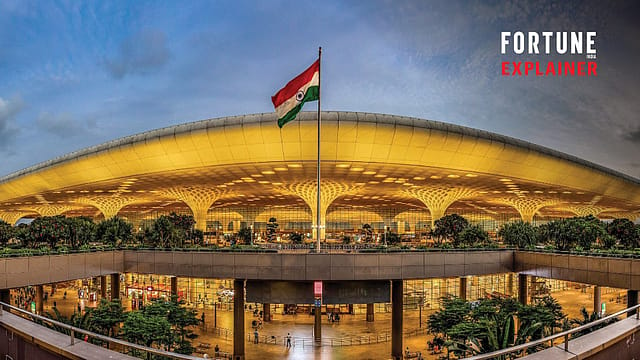
The Union government on Tuesday has put on hold Mumbai International Airport Ltd’s (MIAL) plan to temporarily discontinue 265 weekly international departures from Mumbai airport from October 25, giving airlines and the airport operator more time to work out a transition plan, according to reports.
The decision came after airlines raised concerns over the proposed shift of international operations to Navi Mumbai International Airport (NMIA). The Civil Aviation Ministry has reportedly asked MIAL to hold further discussions with the airlines and work out a mutually acceptable transition plan. Airline companies and Adani Airport Holdings Ltd (AAHL), which operates both airports, are expected to hold further discussions.
The development comes on the day MIAL had asked airlines to identify by 4 pm the international flights or slots they were willing to temporarily discontinue or shift. MIAL had said it would decide the slots itself if airlines did not respond.
Why does MIAL want to move 265 flights?
The issue stems from the planned redevelopment of Terminal 1 (T1) at Chhatrapati Shivaji Maharaj International Airport (CSMIA).
T1 is used largely for domestic operations, while international flights operate from Terminal 2 (T2). MIAL plans to shut parts of T1 in phases and move around 5 million domestic passengers a year to T2 during the redevelopment.
That would require additional space at T2. MIAL has therefore proposed temporarily discontinuing 265 of the 770 weekly international departures currently operating from Mumbai, with airlines asked to shift operations to NMIA, around 50 km away, or temporarily suspend them. MIAL has described the reduction as about 33% of Mumbai’s international departures.
The operator had asked airlines to make the changes from October 25, coinciding with the start of the winter schedule. Fortune India had previously reported that the proposed reductions would affect several carriers, with IndiGo facing the largest cut of 74 weekly international departures, followed by Air India with 33. Akasa Air would see 11 departures shifted, while Air India Express would have seven moved. Emirates and Etihad would each see 10 weekly departures affected.
MIAL has said the move is necessary to facilitate the redevelopment of T1 and the transfer of domestic traffic to T2.
Why are airlines objecting?
Airlines are not opposed to the redevelopment of T1 itself. Their main objection is to the manner and timing of the proposed transition.
The airlines have argued that their winter 2026-27 schedules have already been finalised, with aircraft deployment, crew planning, international connections and passenger bookings built around existing schedules.
The International Air Transport Association (IATA) shot off a letter on September 9 letter to the Civil Aviation Ministry describing the proposed move as a “forced relocation” and sought a transition framework developed in consultation with airlines.
IATA has also raised questions over whether NMIA has all the infrastructure required for the affected international operations, including ground handling, aircraft maintenance, catering, cargo facilities, crew transport, regulatory approvals and passenger connectivity. At the same time, the industry body has said it supports NMIA and the development of Mumbai’s dual-airport system, provided the transition is commercially and operationally workable.
Airlines have also questioned the basis on which MIAL arrived at the number of 265 flights. That question is important because the proposed reduction is not simply about moving passengers from one airport to another. For airlines, changing an established international schedule can affect aircraft utilisation, connecting flights, crew deployment and commercial commitments.
The timeline is at the heart of the dispute
There is also a disagreement over when the redevelopment of T1 was expected to happen.
An AERA consultation paper issued in March 2025 shows that MIAL had already proposed the demolition and reconstruction of T1, with work expected to begin in October-November 2025 and the new terminal to be completed by September 2028.
The Airports Economic Regulatory Authority of India (AERA) said in the paper that there was a need for demolition and reconstruction of T1 from a safety perspective. However, it also sought greater clarity from the Airports Authority of India (AAI), the Civil Aviation Ministry and other stakeholders on the master plan, airside constraints and the impact of the upcoming Navi Mumbai airport.
AERA’s paper is important because it shows that T1 redevelopment was already part of the airport’s planning process well before the current dispute.
Separately, the Airports Operators Committee (AOC) has cited a September 2025 meeting on the CSMIA master plan in which the phasing of T1 redevelopment was discussed. According to reports, airlines understood from that process that the redevelopment would follow the operationalisation of NMIA’s Terminal 2 and was expected around 2029.
That creates one of the central disagreements in the current standoff: whether airlines were given enough clarity and notice about the timing and scale of the disruption now being proposed.
MIAL, meanwhile, had publicly said in January 2025 that Phase 1 of the T1 redevelopment would begin in November 2025, with T2 and the then-upcoming NMIA expected to manage the capacity gap during construction. The project, however, was deferred, with MIAL saying the demolition had been held back because there was no alternative operating facility for airlines.
Under the current plan, redevelopment will begin in January 2027, with the new terminal expected to be commissioned in 2029-30.
What does this mean for passengers?
For passengers, the immediate concern is that a flight booked from Mumbai could eventually operate from NMIA instead.
NMIA is considerably farther from central Mumbai than CSMIA, meaning passengers could face longer road journeys and changes to their airport connections.
There is also a difference in airport charges. NMIA’s user development fee (UDF) is higher than that at CSMIA, although AAHL has offered incentives, including landing-fee waivers for new international flights and measures to offset some of the additional passenger cost.
The impact would also depend on which flights ultimately move. MIAL’s original proposal covered carriers ranging from IndiGo and Air India to Emirates, Etihad, British Airways, Singapore Airlines, Lufthansa and Qatar Airways.
What happens next?
For now, the October 25 deadline is on hold, giving MIAL, AAHL and airlines more time to negotiate.
The immediate question is no longer simply how many flights will move to NMIA, but which flights can be shifted without disrupting airline networks and passengers, and what transition arrangements will be put in place.
The government’s intervention also means the original plan to implement the changes from the start of the winter schedule is unlikely to proceed in its earlier form.
The redevelopment of T1, however, remains on the agenda.