
India to become world’s third largest economy in the next two years: Piyush Goyal
ADVERTISEMENT
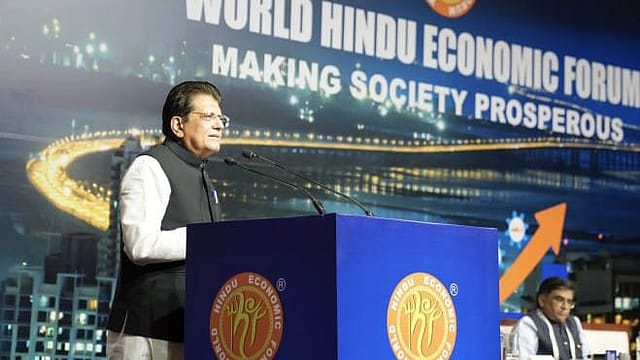
Union Commerce Minister Piyush Goyal today said India will become the world's third-largest economy in the next 2-2.5 years, adding that the country has come a long way from the 10-year misrule of the Congress-led UPA regime, marred by high inflation, interest rates, and bank NPAs. Goyal pointed out that the trade deficit between India and China grew 26 times between 2004 and 2014 due to the UPA's "mismanagement".
Referring to 2014 interim Budget speech, in which Congress leader and the then finance minister P Chidambaram said that India will take 30 years to become the world's third-largest economy, Goyal said, “Under Prime Minister Narendra Modi's decisive leadership and with the effort that 1.4 billion Indians are putting in today, we will become the world's third-largest economy in the next 2-2.5 years.”
Speaking at the World Hindu Economic Forum in Mumbai today, Goyal said that by 2044, the size of the Indian economy would be $25-30 trillion and by 2047, the fixed goal is to be a $30 trillion-plus economy.
Goyal said India’s trade strategy has also shifted. “When we enter into international agreements today, we do so with confidence and self-respect,” he said, adding that India is no longer signing agreements with direct competitors. “There is not a single Free Trade Agreement where the partner country’s per capita GDP is below $20,000,” he said, listing partners such as the UK, Australia, the EFTA bloc and Gulf countries.
Goyal pointed out that due to weak economic management and flawed FTA negotiations during the UPA rule, India’s trade deficit with China widened 26-fold between 2004 and 2014.
“In 2004, India’s trade deficit with China was barely $1.5–2 billion. By 2014, it had risen 26 times, reaching nearly $48 billion,” Goyal said, arguing that sharp cuts in import duties during that decade “broke the backbone of Indian manufacturers and the economy,” while domestic entrepreneurs found little policy support.
Goyal said the deterioration in external balances coincided with macroeconomic stress inherited by the NDA government in 2014—high inflation, elevated interest rates and a banking system burdened with stressed assets.
“Cumulatively, NPAs—along with evergreened and restructured loans—were in double digits, around 10–11%,” he said, adding that the cost of cleaning up bad loans eventually fell on small traders, MSMEs and retail borrowers who had no alternative sources of credit.
Listing out the gains made in the current bilateral trade agreements and ongoing negotiations, Goyal underlined the income profile of the trading partners, which includes the EFTA bloc (Switzerland, Norway, Iceland and Liechtenstein). He said Switzerland’s per capita GDP stands at around $104,000, while Liechtenstein’s is about $180,000, and even the United Kingdom’s per capita GDP is close to $50,000. “Our FTAs are equitable—win-win, bilateral,” he said, adding that these agreements are structured to protect India’s competitiveness.
On the recent trade pact with Oman, Goyal said the deal opens access to sectors that do not pose competitive threats to India. “From Oman, what competition do dates pose to us? A key gain from the agreement was access to marble blocks that were earlier restricted. We will get marble blocks. This will give a boost to the marble industry, particularly in Rajasthan,” Goyal said.
Beyond concluded agreements, Goyal said India is simultaneously engaged in multiple ongoing trade negotiations with other countries, following the same framework of balanced outcomes and mutual benefit. “You will see balance in every FTA; there is nothing in them that damages our competitiveness,” he added.
He also referred to agreements with Mauritius and ongoing engagements with several developed economies. He indicated that upcoming FTAs will be balanced, fair, and designed to protect and promote India’s industry and manufacturing.
Concluding his address, Goyal said that by learning from history, staying united, and working together, Bharat is committed to achieving the goal of Viksit Bharat 2047. He added that India will continue to grow, reform, and lead, without slowing down, until it achieves the goal of a fully developed nation.