
RBI may hike repo rate by 25 bps in October meet: Economists
ADVERTISEMENT
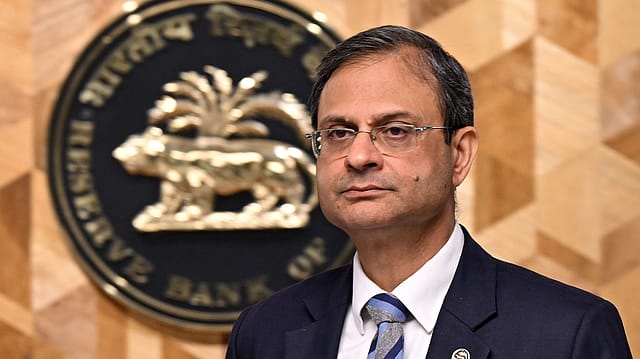
The broadening of domestic inflationary pressures and the resilience in growth despite weakening external macro-economic conditions—including foreign fund outflows—is leading economists to point out that the Reserve Bank of India (RBI) will start hiking interest rates sooner than expected in the October monetary policy meeting.
Economists are also forecasting an additional rate hike in December this year.
The RBI Monetary Policy Committee will meet from October 5 to 7 and is now expected to announce a 25-basis-point hike on October 7, while maintaining a neutral stance. A neutral stance will give the central bank flexibility to keep adjusting policy rates as the economic situation evolves.
The US Fed rate action in September led 30-year bond yields to rise to a multi-decade high. Yields are likely to remain high due to energy-led inflation and no clarity on whether the West Asia war will end soon.
Inflation trending higher
“Our forecasts indicate possibility of Q2 inflation surpassing RBI’s forecast of 4.7% and trending closer to the upper bound of 6% as manufacturers pass on higher input costs to consumers. Further, steady growth could provide comfort to the RBI to start its hiking cycle,” says Indranil Pan, chief economist at YES Bank.
“The minutes of the August MPC meeting indicated nervousness on the inflation dynamics and called for cautious monitoring of the inflation trajectory for signs of emergence of second-round impact,” Pan said.
However, no action was taken in August as MPC members did not see the economy overheating and saw no signs of broadening inflation pressures. Given that there are signs of generalisation of price pressures, we expect the RBI to start its hiking cycle in October by 25 bps.
Pan also said that while India’s monetary policy does not strictly follow the US Fed’s, “the need to hike now may have emerged from a closing interest gap between India and US (around 165 bps now for the 2-year tenor), that is also creating the pressure for foreign flows to move out,” he said.
In September, the net FPI outflows were at $5.9 billion, of which $2.16 billion was on account of debt.
CareEdge Group’s chief economist, Rajani Sinha, and senior economist Sarbartho Mukherjee said, “The inflation outlook remains vulnerable to both external and weather risks. We project average CPI inflation of around 5.0% in FY27,” they said in a note to clients.
They also said the RBI would focus on liquidity management, as a rate hike without corresponding liquidity tightening would be ineffective.
Banks in India were able to garner a record $132.98 billion through the swap window scheme of FCNR(B) deposits by September.
Economists said the FCNR(B) inflows have also injected substantial rupee liquidity into the banking system. Daily surplus liquidity increased from an average of ₹3.7 lakh crore in August to a peak of ₹11 lakh crore in the first week of September.
With all the measures that the RBI has taken in recent weeks, systemic liquidity declined to around ₹4.8 lakh crore as of September 28, 2026, following OMO sales and VRRR auctions by the RBI. However, it is well above the average of ₹1.9 lakh crore seen during H1 CY 2026.
“The market would look for further guidance on additional measures, particularly CRR or I-CRR hikes,” the CareEdge economists said.
“We expect this policy rate hiking cycle to be shallow, with a cumulative 50–75 bps hike in the repo rate,” they added.
Most economists Fortune India spoke to indicated that the RBI Governor’s commentary and statement could be cautious.
Soumya Kanti Ghosh, Member, 16th Finance Commission & Group Chief Economic Advisor at SBI, said, “Amidst an impending global turmoil that may rip aside emerging markets with US yields at 25-year high and destined for even higher levels, the RBI is set to begin the first of the rate hikes by 25 bps.”
“We believe the balance of risks has tilted decisively towards a 25-bps rate hike at this juncture.... a combination of broadening inflationary pressures, worsening global macros, evolving liquidity conditions and a renewed global repricing of risks is making the case for pre-emptive action stronger,” he said in a note.
Goldman Sachs has also brought forward its call for the Reserve Bank of India (RBI) to start its rate-hike cycle in October, from December earlier.
In a note published October 1, 2026, the brokerage expects a 25-basis-point hike each in October and December, followed by another 50 bps of tightening in the first half of 2027, taking the cumulative rate hikes in the current cycle to 100 bps.
Goldman Sachs cited stronger-than-expected growth, broadening inflation pressures and tighter global monetary conditions as reasons for the earlier start to the hiking cycle.
Monsoon needs attention
The report, however, said that the monsoon story deserves attention. The 2026 monsoon was the fourth driest since 2000, at just 87% of LPA, with 43% of districts receiving deficient rainfall.
Punjab and Bihar received 41% and 32% below-normal rainfall, respectively, while Maharashtra has declared drought across 265 talukas. “With low irrigation coverage for crops such as soybean, tur, jowar and bajra, rainfall dependence remains high, while strong El Niño conditions and below-normal October rainfall could pose further risks to Rabi output.”
Ghosh said that they expect RBI to upgrade the GDP forecasts upwards by 30 bps and inflation forecast by 20 bps for FY27.
In a September report, Crisil had said that rainfall deficiency has widened to 14% so far this season, worse than expected for the southwest monsoon. “Although sowing has progressed well, it does not mean the crop sector is out of danger. The focus of concern has shifted from acreage to yields, and crop incomes are likely to moderate as a result,” its chief economist Dharmakirti Joshi and Deshpande said.
The data shows that monsoon shocks do sting crops, but, as seen in previous decades, they have not necessarily translated into higher food inflation.