
RSS chief Mohan Bhagwat shares his take on GDP-rupee, India-US trade deal and relationship with BJP
ADVERTISEMENT
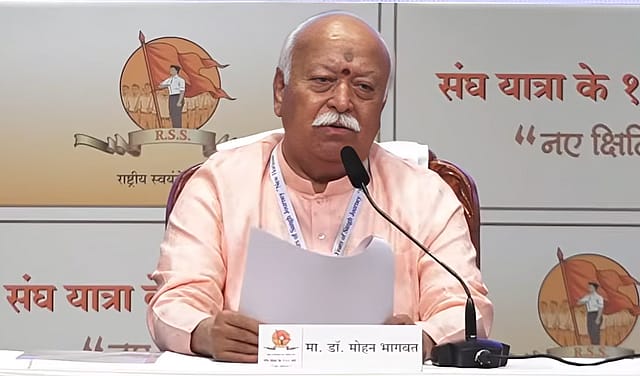
The Rashtriya Swayamsevak Sangh (RSS) held its two-day centenary celebrations at the Nehru Centre Auditorium in Mumbai on 7-8th February. On the second day of the event, prominent industrialists, entrepreneurs, market experts, and Bollywood actors turned up at the event. Some prominent personalities who attended the event on Sunday included Aditya Birla group chairman Kumar Mangalam Birla along with his daughter Ananya Birla, Ajay Piramal, chairman, Piramal group, L&T MD & CEO SN Subrahmanyan, Shashidhar Jagdishan, MD & CEO, HDFC Bank, Ashish Chauhan, MD & CEO, the National Stock Exchange, and the likes.
Mohan Bhagwat, the sixth and current sarsanghchalak (head) of RSS, answered a curated set of questions ranging from politics, religion, to economy in Hindi. Here’s what he had to say on some key topics.
GDP and falling rupee
I don’t have a view on the rising GDP and falling rupee. While the rupee exchange is determined by the economic situation of a country and its trade balance, I believe the GDP does not adequately capture the economic progress and strength of a country. It’s an imperfect criterion, as what is only tangible is what gets captured. While in other countries you buy a can of ready-to-eat food, the buy-and-sell transaction gets captured, but in our country the productive efforts put in by mothers in preparation and feeding of daily meals are not captured. As far as the falling rupee is concerned, there are other variables that go in determining the exchange rate. We should be atma nirbhar (self-reliant) and produce goods in large quantities with better quality standards that will improve the overall GDP and, in turn, strengthen the rupee.
On agri imports and India-US deal
I haven’t gone into details of the US-India trade deal, but the fact remains that every nation’s economic growth is also interlinked with global trade. In deal making, you can’t have a winner-takes-it-all approach. You have to bargain hard and, in equal measure, you also have to relent. I hope such a deal has been struck where we haven’t given in too much. From what I have seen of the current dispensation over the past 10 years, it is a stubborn regime and will not bow down. When I go through the fine print [of the deal], I hope my view gets reinforced.
In terms of agri imports, we are not going to leave the farmers at the mercy of businesses. In agriculture, the farmer should be in control of his destiny. Today, if we let a farmer source genetically modified seeds, the seeds cannot reproduce and you have to source them again from the seller. In such a case, the farmer is not in control of his destiny.
Traditionally, Indian agriculture operates on self-reliant model that includes, manure, pesticide and our own seeds. Indian farmlands have proved to be experimental labs for farmers who have been scientific in their own way. At one point in time, we had over 8,000-9,000 varieties of rice and today we have been left with just 3,000 varieties.
So, in today’s times just to blindly adopt new varieties without examining their benefits, and, in turn, make our farmers the sacrificial lamb is not the right way. We are open to foreign knowledge, but without examining its suitability to our nation’s interests, especially of our farmers, is incorrect. For this reason, we are sensitive to this subject.
On whether the RSS is enjoying acche din with BJP in power
On whether the coming of the Bharatiya Janata Party (BJP) into power has resulted in acche din for RSS, I believe it’s the opposite [of the BJP benefitting]. We follow a thought process and policy, and if there is a general acceptance among the people [of our policy] and if any political party aligns itself to that line of thinking stands to benefit. We were in favour of building the Ram Mandir, and the party that stood by the view benefitted from the outcome. Our stance [on Ram Mandir] was open for any other political party to align itself but they chose not to. We do not favour any political party. RSS has benefited from the hard work put in by the organisation and its ground workers over the years of its existence. We sweated it out on several issues that were of national importance. That’s the reason today we are enjoying the good days.