
Sebi launches Demat 2.0 pilot for tokenised corporate bonds, enables instant settlement
ADVERTISEMENT
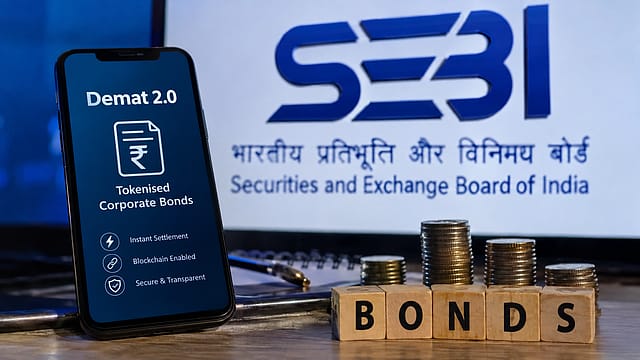
Markets regulator Sebi on Thursday announced the launch of 'Demat 2.0', a pilot project on the tokenisation of corporate bonds, enabling atomic settlement that allows transactions to be completed instantly.
Demat 2.0 is connected to the Reserve Bank of India's wholesale central bank digital currency (CBDC) through the Unified Market Interface (UMI) of the RBI.
The announcement was made jointly by RBI Governor Sanjay Malhotra and Sebi Chairman Tuhin Kanta Pandey at the Global Fintech Fest.
Malhotra also announced the launch of two customer-centric UPI innovations — UPI 'Tap & Pay' on Point-of-Sale (POS) terminals and MyUPI, a customer support solution powered by NPCI's Small Language Model (FiMI).
Sebi’s Demat 2.0 brings tokenised corporate bonds to regulated market infrastructure
Demat 2.0 is the new market infrastructure developed to test a new way of issuing, holding, trading and settling corporate bonds.
Under the pilot, the bond is created as a digital token on a distributed ledger — a shared electronic record maintained simultaneously by market infrastructure institutions using Distributed Ledger Technology (DLT). The ledger is owned by the depositories.
"This (Demat 2.0) enables atomic settlement, i.e., the bond and the money move instantaneously," the Securities and Exchange Board of India (Sebi) said in a statement.
The technology is aimed at improving the efficiency of transactions in the securities market. Asset servicing, including interest payments and redemption, can be handled automatically through smart contracts — instructions written into the ledger that execute on their own.
On the shared ledger, details of bondholders are visible to all authorised institutions at once, while payments reach bondholders' CBDC wallets on the due date.
"Taken together, these features are expected to make the issue, settlement and servicing of corporate bonds faster, more efficient and less error-prone," Sebi added.
Tokenisation pilots and commercial launches have taken place across the globe. Globally, tokenisation has largely been undertaken by individual issuers on separate platforms.
India is the first country in which corporate bonds have been issued natively on a distributed ledger, with the record of ownership held by a country's statutory depositories and the funds leg settled in central bank digital currency, within the existing regulated market infrastructure, Sebi said.
REC, L&T and IIFL issue tokenised bonds worth ₹1,025 crore
Three companies — REC, L&T, and IIFL — have issued tokenised bonds so far, aggregating ₹1,025 crore.
The pilot is being taken forward in phases, with issuances under the first phase currently ongoing.
RBI unveils UPI Tap & Pay, AI-powered MyUPI
UPI 'Tap & Pay' on POS allows users to make faster payments by unlocking their NFC-enabled smartphone and tapping it on an NFC-enabled Point-of-Sale (POS) terminal.
The feature does not rely on the user's mobile internet connectivity, as transactions can be completed using the POS machine's internet connection. The feature is designed to make everyday payments faster and seamless for consumers.
MyUPI, an AI-powered platform built on NPCI's Small Language Model (FiMI), introduces a suite of intelligent enhancements in UPI Help aimed at strengthening trust, safety and convenience across the UPI ecosystem.
Ajay Kumar Choudhary, Non-Executive Chairman and Independent Director, NPCI, along with senior bankers, fintech founders and other participants from the banking and fintech ecosystem, were also present on the occasion.
National Payments Corporation of India (NPCI) is the umbrella entity responsible for operating retail payments and settlement systems in India. It has been established by the RBI and the Indian Banks' Association (IBA).