
RBI MPC: Central bank raises repo rate by 25 bps to 5.5%; first hike since February 2023
ADVERTISEMENT
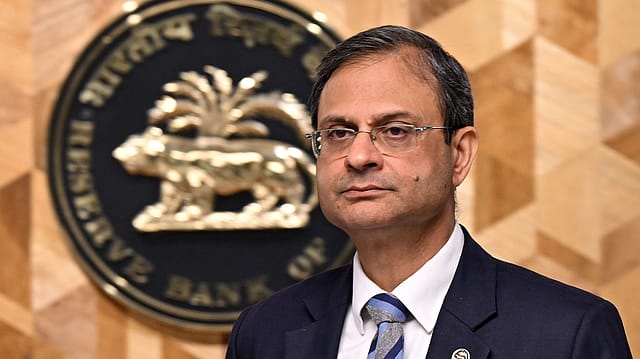
The Reserve Bank of India’s (RBI) Monetary Policy Committee (MPC) on Wednesday "unanimously" decided to raise the benchmark repo rate by 25 basis points to 5.5%, marking the first rate hike since February 2023, when it increased the policy rate by 25 basis points to curb post-pandemic inflation.
The central bank has also changed its policy stance from ‘Neutral’ to ‘Calibrated Tightening’, citing the sudden re-escalation of the West Asia conflict in September, the consequent hardening and volatility in global crude oil prices, worsening global economic sentiment and heightened financial market volatility.
Following the hike, the standing deposit facility (SDF) rate stands adjusted at 5.25%, while the marginal standing facility (MSF) rate and the Bank Rate have been raised to 5.75%.
“Global economic sentiments and heightened financial market volatility” have increased amid the re-escalation of the West Asia conflict, volatility in global crude prices and other global developments, RBI Governor Sanjay Malhotra said.
Policy decision in line with Street expectations
The policy decision by the six-member MPC, chaired by RBI Governor Sanjay Malhotra, was in line with Street expectations, with economists expecting a rate hike amid a spike in crude oil prices and rising inflation. In calendar year 2026, the central bank had kept interest rates unchanged at 5.25%, while in 2025, the RBI cut rates four times and paused on three occasions.
The RBI had last cut the repo rate by 25 basis points in December 2025, bringing it down from 5.50% to 5.25%. It had also kept policy rates unchanged and retained its neutral stance in the three bi-monthly policy reviews of FY27, held in April, June and August 2026.
The Governor said the MPC had reviewed the evolving macroeconomic and financial developments before taking the decision.
“As regards supply-side inflation, the MPC noted that monetary policy primarily acts by containing second-round inflation expectations and firm-level pricing behaviour,” Malhotra said.
He added that it was difficult to distinguish between second-round effects and the indirect impact of supply-side pressures on production costs, energy and other inputs.
“While there is some evidence of elevated inflation expectations and generalisation of inflation, there are limited signs of supply-side pressures getting embedded in pricing behaviour,” the Governor said.
The MPC also noted limited evidence of demand-side pressures, despite monitoring credit and monetary aggregates.
“Considering all these factors, the MPC unanimously decided to increase the policy repo rate by 25 basis points to 5.5%,” Malhotra said.
Explaining the shift in stance, the Governor said the recalibrated policy rate was necessary given the evolving inflation-growth dynamics.
“The current conditions bring risks off the table in the near term and policy action can only be calibrated depending on the evolving conditions and the outlook,” he said.
The Governor added that the duration and extent of the rate cycle would depend on the trajectory of actual growth and inflation developments, particularly underlying inflation, broadening of price pressures and second-round effects of supply shocks.