
Demat 2.0 explained: What Sebi’s tokenised bond pilot means for investors
ADVERTISEMENT
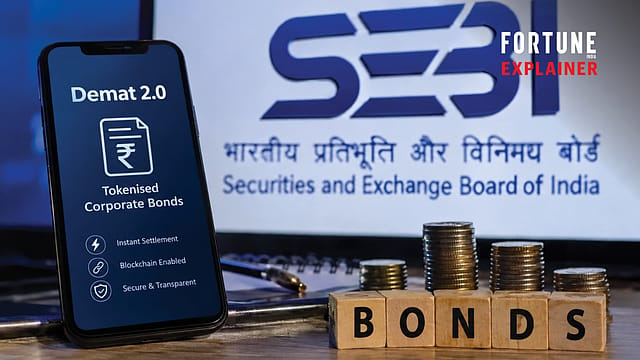
India’s securities market is set to test the next phase of dematerialisation, with the Securities and Exchange Board of India (Sebi) piloting a system that will allow corporate bonds to be issued, held, traded, and settled in tokenised form.
Called Demat 2.0, the pilot uses Distributed Ledger Technology to create a native digital representation of a corporate bond on a private, permissioned network operated by the depositories. The idea is not to create a new kind of security, but to test whether the technology underpinning the ownership and settlement of securities can be redesigned.
What is Demat 2.0?
In the existing system, ownership of securities is recorded electronically in conventional databases maintained by depositories. Under Demat 2.0, the corporate bond itself would be issued as a digital token on a DLT network.
The token would carry the same International Securities Identification Number (ISIN) as the corresponding bond and retain all its existing characteristics—including coupon, maturity, covenants, rating, security and investor rights. In other words, tokenisation changes how the bond is recorded and transferred, not what the bond legally is.
A tokenised corporate bond would continue to be treated as a security under the Securities Contracts (Regulation) Act, 1956, and remain subject to the applicable Sebi regulations.
How will a tokenised bond be issued?
The issuance process would largely remain familiar. An issuer would continue to use the stock exchanges’ existing Electronic Bidding Platform (EBP) for the corporate bond issue. The ISIN would also be obtained from the depositories in the usual manner, although it would be identified as a pilot/tokenised ISIN.
Bidding, modification, cancellation, and allotment timelines would continue as they do today.
The key difference comes after allotment. Instead of conventional dematerialised securities, the depository would credit the tokenised bonds directly to the investor’s Demat 2.0 account, which is essentially an extension of the investor’s existing demat account and not a separate account. The issuer, meanwhile, would receive the issue proceeds in its CBDC wallet.
Does an investor need a new demat account?
No. Investors would not need to open a separate demat account or undergo fresh KYC. The Demat 2.0 arrangement would be linked to the investor’s existing demat account through the depository interface. Investors would also link an eligible account with a CBDC wallet and provide the required consent.
The depositories would hold and manage the private cryptographic keys on behalf of investors. This means investors would not need to manage blockchain keys or operate specialised DLT infrastructure themselves.
Why is CBDC being used?
One of the biggest changes under the pilot is the use of the Reserve Bank of India’s digital currency, or e₹, for the funds leg of the transaction.
The securities and payment legs would be connected through the DLT infrastructure and designed to settle atomically. This is known as atomic Delivery-versus-Payment (DvP).
The bond changes hands only when the corresponding payment happens. If one leg fails, the other does not settle either. This is designed to eliminate the counterparty exposure that can arise from a gap between securities delivery and payment.
Will bonds trade on a new exchange?
No. Demat 2.0 does not envisage creating a separate exchange or market segment for tokenised bonds. Existing Request for Quote platforms and over-the-counter reporting platforms of stock exchanges would remain the channels for price discovery, order handling and reporting. The DLT infrastructure would primarily integrate the securities and payment settlement legs.
The pilot may also eventually enable peer-to-peer or demat-to-demat transfers before full secondary-market trading is introduced.
What happens to coupons and corporate actions?
The bond’s key terms, including coupon rates, payment dates, and redemption terms, can be encoded into a smart contract. This could allow scheduled payments such as coupons and redemption to be triggered automatically based on holdings recorded on the ledger on the relevant record date.
The broader objective is to reduce manual intervention and the reconciliation work currently required among multiple institutions for servicing securities.
What is Sebi trying to test?
The pilot is ultimately a test of whether DLT can make India’s securities infrastructure faster and more automated without disrupting the existing market architecture. The regulator plans to examine tokenised bond issuance and holding, integration with existing EBP and secondary-market infrastructure, atomic DvP using CBDC, smart-contract-based servicing, regulatory controls, cybersecurity, scalability, resilience, and auditability.
The proposed rollout is expected in three stages. The first would focus on tokenised corporate-bond issuance and asset servicing, initially with institutional participation. The second would enable secondary-market trading and expand access to retail investors. The third could bring credit-rating agencies, depository participants, and other regulated entities onto the network and potentially extend the model to other instruments.
If successful, Demat 2.0 could offer near-instant settlement, automated servicing, lower reconciliation costs, and greater traceability while retaining the legal and regulatory framework that governs conventional securities.