
Nifty Realty falls 2% as RBI hikes repo rate; industry sees limited near-term impact, but borrowing costs remain under watch
ADVERTISEMENT
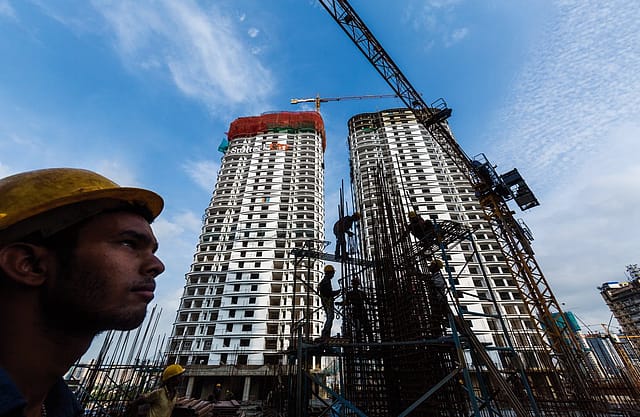
The Indian equity market witnessed broad-based selling on Wednesday, with rate-sensitive realty and auto indices emerging as top laggards after the Reserve Bank of India (RBI) raised the repo rate by 25 basis points and changed its policy stance.
Weighed down by the RBI’s surprise shift in stance towards calibrated tightening, the Nifty Realty index fell nearly 2% in intraday trade, with industry experts expecting some near-term pressure from higher borrowing costs but a limited impact on housing demand.
Among major realty stocks, Prestige Estates Projects, Lodha, Brigade Enterprises, Godrej Properties, Phoenix Mills and DLF fell in the range of 2-3%. Oberoi Realty declined over 1%, while Anant Raj and Sobha rose up to 0.6%.
The RBI’s Monetary Policy Committee (MPC) unanimously raised the benchmark repo rate to 5.50%, marking the first rate hike since February 2023. The central bank also shifted its policy stance from ‘Neutral’ to ‘Calibrated Tightening’, raising concerns that there may be additional rate hikes going forward. Some economists expect another 2-3 rate hikes in the current cycle as the central bank seeks to contain inflationary pressures amid elevated crude oil prices and global financial volatility.
“The RBI’s decision to raise the repo rate to 5.50% signals a clear focus on managing inflationary pressures and maintaining macroeconomic stability. The real estate industry will see an impact through higher borrowing costs and some moderation in buyer sentiment, particularly in interest-rate-sensitive segments,” said Mohit Goel, Managing Director, Omaxe.
However, Goel said the underlying demand for housing remains supported by rising incomes, evolving aspirations and a strong preference for quality, well-planned developments.
Will festive demand cushion the impact?
Real estate industry experts believe the rate hike ahead of the festive season could have some bearing on homebuyer sentiment, although the impact on residential demand is expected to remain limited.
“The festive season is a very important period for the real estate sector, and stability in interest rates during this period remains positive for homebuyers. However, it is also important to control inflationary pressures and maintain stability in the economy,” said Praveen Jain, President, NAREDCO.
Jain said housing demand remains strong and the impact of the 25 bps increase on the residential market is likely to remain limited, supported by strong buyer sentiment, festive demand and the long-term need for homeownership.
Shekhar Patel, President, CREDAI, said the rate hike needs to be viewed in the context of global developments and the RBI’s shift towards calibrated tightening.
“The RBI’s decision to increase the repo rate by 25 basis points from 5.25% to 5.50%, which is the first rate hike since February 2023, needs to be seen in the context of what is happening globally. Besides, the stance has also been changed to calibrated tightening,” Patel said.
He added that the measures would have a bearing on the cost and availability of funds, while the impact on liquidity would need to be watched.
Mid-segment affordability under scanner
Lata Pillai, Senior Managing Director and Head - Capital Markets, India, JLL, said the rate certainty of the past year is likely coming to an end for the real estate sector.
“We do expect that floating home rates will be repriced and higher construction costs will be passed on to the buyers, with mid-segment affordability likely to remain under the scanner,” Pillai said.
However, she said strong demand fundamentals, robust GDP growth, growing investments and a healthy construction sector are likely to absorb the negative impact.
“The pace and extent of any further rate hikes are likely to matter more to the overall market than a single 25 bps hike,” she said.
Pratik Tibrewala, SVP & Head, Corporate Finance, M3M India, said the 25 bps hike was a calibrated step to anchor inflation amid global volatility.
“While borrowing costs may inch up marginally, long-term stability of the rupee helps in attracting global capital and will benefit the real estate sector. The demand for premium housing and commercial assets continues to be strong and is driven by wealth creation,” he said.
Developers remain optimistic
Sahil Agarwal, CEO, Nimbus Group, said the real estate sector remains well placed, supported by healthy demand, improving consumer confidence and sustained interest in quality residential and plotted developments.
“With infrastructure-led growth and expanding opportunities across emerging markets, the sector continues to demonstrate resilience. We remain optimistic about the outlook for real estate, with demand expected to remain steady across metropolitan as well as Tier-2 and Tier-3 cities,” he said.
The rate hike is also expected to have some impact on sectors linked to construction and infrastructure through higher financing costs.
“The RBI’s decision to raise the repo rate by 25 basis points to 5.50% reflects a calibrated tightening in response to evolving inflationary pressures and persistent global uncertainties,” said Rajan Luthra, CFO, ACE-Action Construction Equipment.
“For the construction equipment sector, higher financing costs may impact investment decisions in the near term. However, sustained government capex and infrastructure activity across roads, railways and urban development should continue to support demand and sector growth,” he said.