
Real estate under-construction value rises five-fold to $503 bn; GDP contribution seen doubling to 13% by 2030: CREDAI President
ADVERTISEMENT
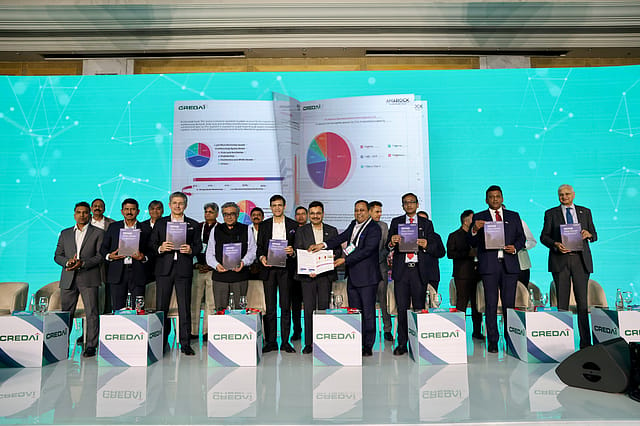
India’s real estate under-construction value has risen more than five-fold to $503 billion in 2025 from $94 billion in 2009, while the sector’s contribution to GDP is expected to more than double to around 13% by 2030 from 6% in 2017, CREDAI President Shekhar G. Patel said.
Patel was speaking at the 24th edition of NATCON in Kolkata, where the Confederation of Real Estate Developers’ Associations of India (CREDAI), in collaboration with ANAROCK Research & Advisory, launched its report, “Indian Real Estate: Growth Trajectory, Sectoral Outlook and Geopolitical Crosscurrents”.
The report estimates that India’s real estate market has grown from $120 billion in 2017 to around $600 billion in 2025 and is projected to reach $1 trillion by 2030 and nearly $5.8 trillion by 2047.
“The value of real estate under construction has grown more than five fold, from $94 billion in 2009 to $503 billion in 2025. Its share of GDP is expected to more than double from 6% in 2017 to about 13% by 2030, and employment to reach 30 million people, second only to agriculture,” Patel said.
The sector’s growth is being driven by three structural trends—urbanisation, formalisation and India’s emergence as a global hub for talent and capital, according to Patel.
“Three enduring forces underpin this progress. The first is urbanisation. Close to 40% of Indians, or 600 million people, will live in cities by 2036, and towns and cities already contribute nearly 70% of national GDP,” he said.
Patel said the sector’s formalisation, supported by RERA, GST rationalisation, REITs and the newer SM REIT framework, has helped build trust among homebuyers and investors and opened the sector to institutional capital.
He also highlighted the growing role of India as a global hub for talent and capital, citing the expansion of GCCs, the entry of international brands and the spread of branded hotels into smaller cities.
Residential demand remains strong
Residential demand has remained resilient, with sales value across the top seven cities rising from ₹2.35 lakh crore in FY22 to ₹6.10 lakh crore in FY26, according to the report.
Quarterly residential sales have remained above ₹1.3 lakh crore for seven consecutive quarters, pointing to sustained demand across major urban markets.
The report also noted the growing contribution of Tier-II and Tier-III cities to the next phase of real estate growth.
“This progress is also becoming more inclusive in its geography. Tier II and III cities are emerging as new centres of demand, and the opportunity remains vast, with organised retail penetration still at just 9%,” Patel said.
GCCs drive office leasing
The office segment has also witnessed structural changes, with global capability centres (GCCs) accounting for around 45% of office leasing in the first half of 2026, the report said.
Listed office REITs have expanded their combined leasable area nearly six-fold since FY19, reflecting the growing institutionalisation of India’s commercial real estate market.
Beyond residential and office spaces, the report identified data centres, warehousing and hospitality as emerging areas of real estate activity.
Patel said the sector’s growth trajectory has remained intact despite challenges in 2026.
“The challenges of 2026 have tested the sector, but they have not changed its direction. The task ahead is to build responsibly, with quality, transparency and sustainability at the core, and to create cities that are liveable and future ready,” he said.
Kolkata and eastern India
Patel also highlighted Kolkata’s potential role in India’s next phase of urban growth. “At the same time, the next phase of India’s urban growth will increasingly extend beyond the traditional metropolitan centres. Kolkata, with its economic depth and position as a gateway to eastern India, can play an important role in this transition,” he said.
“As infrastructure and connectivity improve across West Bengal, they can strengthen economic corridors, bring emerging cities into larger development networks and unlock new opportunities for housing, businesses and investment,” Patel added.
“Bringing NATCON to Kolkata is about focusing the industry’s attention on this opportunity and creating a dialogue on how real estate and infrastructure can together contribute to more connected and competitive cities, in line with the vision of Viksit Bharat,” he said.
CREDAI’s three-day flagship convention, NATCON 2026, is being held from October 2 to 4 at ITC Royal Bengal in Kolkata, with AI and innovation at the centre of discussions.
The event marks the first time in more than a decade that CREDAI’s annual convention is being hosted in India instead of overseas. The convention was initially scheduled for Amsterdam but was later shifted to India. More than 1,000 delegates from the real estate and allied sectors are expected to participate.