
Fortune India MPW 2026: AI won't replace people, but leaders must swap fear with curiosity, say tech leaders
ADVERTISEMENT
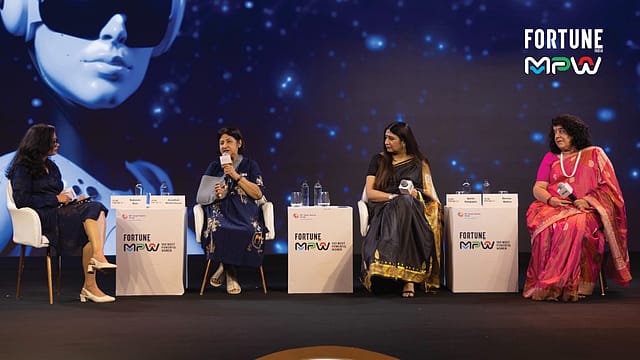
Artificial intelligence may be transforming businesses at an unprecedented pace, but it is unlikely to replace people. Instead, the technology's biggest promise lies in amplifying human capabilities—provided organisations can overcome fear, embrace curiosity and invest in responsible adoption, industry leaders said at a panel discussion.
Speaking at a panel discussion on 'Women in Tech-Tech Titans' at Fortune India's Most Powerful Women (MPW) 2026 event, Arundhati Bhattacharya, chairperson and chief executive officer of Salesforce India and South Asia, said the biggest challenge for organisations was not the technology itself but preparing leaders and employees to embrace it.
"Leadership itself needs to walk the talk. How comfortable are we? How AI-fluent are we? That is something we need to model for the rest of the organisation to follow," she said.
Bhattacharya said leaders must shift employees from anxiety to experimentation by rewarding those willing to adopt AI.
"The main job of leadership is to ensure that people understand learning is a lifelong process, change is constant, and neither of these should become a chore," she said, adding that organisations should make employees "more curious than apprehensive".
AI is an assistant, not a replacement
Echoing similar views, Ipsita Dasgupta, senior vice president and managing director for HP India, Bangladesh and Sri Lanka, said businesses often overstate AI while overlooking its real purpose—to make technology more intuitive.
"We've almost gone too far in saying everything is about AI all the time," Dasgupta said.
She argued that AI lowers, rather than raises, the barriers to technology adoption because users can interact with it naturally.
"Think about it as interacting with a really smart person. You still have to guide the person. You still have to do everything else that you need to do surrounding what that person is telling you. But how intelligently you're able to ask that person is going to drive what you get in return," she said.
Bhattacharya illustrated AI's productivity gains with an example from Salesforce's own operations. A market intelligence report that previously took a three-member team three to four hours can now be completed in around 30 minutes using AI-assisted research, allowing employees to cover significantly more customers across India and ASEAN.
"AI will give you added capability. It is not something that's going to replace you... it's going to enable you to do things that you never could get done properly because it's adding to that capability of yours," she said.
AI hype won't automatically create winners
Offering an investor's perspective, Devina Mehra, founder, chairperson and managing director of First Global, cautioned against equating AI's transformative potential with guaranteed investment returns.
Mehra said her firm had been using artificial intelligence and machine learning long before the recent generative AI boom, relying on what she described as a "human plus machine" investment framework.
"These are all tools, but you have to use them very sensibly. Otherwise, you can really get into spurious correlations," she said, warning that excessive reliance on algorithms without human oversight could lead to flawed investment decisions.
She argued that human judgement remains essential in understanding events such as pandemics, geopolitical developments and other factors that cannot always be captured by quantitative models.
Questioning the higher valuations being attached to AI-related companies, Mehra said history shows that transformational technologies do not necessarily produce the biggest winners in equity markets.
"AI may be a transformational technology, but I can list almost every transformational technology in human history—from railroads to automobiles, aviation to the internet—which has been a graveyard of companies because you don't make return on capital on the amount of capital you put in," she said.
Responsible AI remains key
The discussion also touched on AI governance and inclusion.
Dasgupta said AI systems are only as unbiased as the data they are trained on and stressed the need to build more representative datasets, particularly from Tier II, Tier III and rural India.
"AI will allow us to remove gender bias from things like hiring and investing, if we use the systems correctly," she said.
Mehra, however, warned that today's large language models can also amplify existing biases because they learn from historical datasets.
"They actually amplify gender bias, they amplify race bias, rather than reducing it," she said, urging organisations to exercise caution as AI becomes increasingly embedded in decision-making.
The panel broadly agreed that while AI will fundamentally reshape businesses, its success will depend less on the technology itself and more on how responsibly organisations deploy it, how effectively leaders prepare their workforce, and how closely human judgment remains integrated into AI-driven decision-making.