
Karnataka unveils plan for India's first government-run AI university at Google event
ADVERTISEMENT
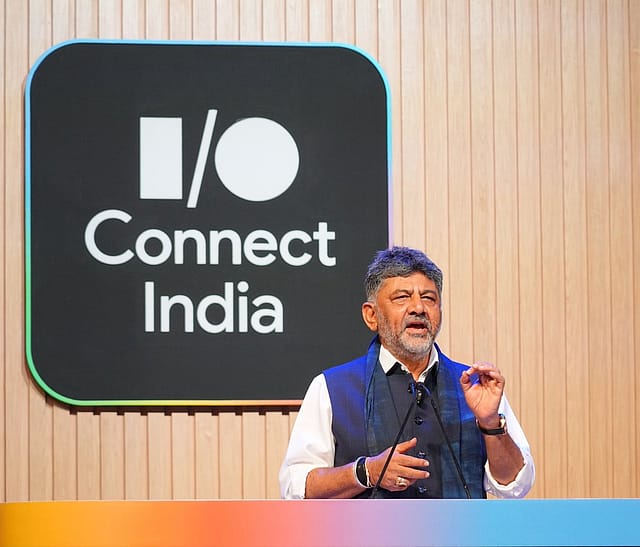
Karnataka on Tuesday announced plans to establish India's first government-run artificial intelligence university, marking the centrepiece of the state's broader ambition to become an "AI-native" state, as Google unveiled a raft of AI initiatives spanning education, enterprise computing, cybersecurity and healthcare at Google I/O Connect India 2026 in Bengaluru.
Speaking at the inaugural session, Chief Minister D.K. Shivakumar said the proposed university would "nurture world-class research and the next generation of AI talent" while strengthening collaboration between academia, industry and government. Alongside the university, the state will establish an AI Innovation Hub to support AI research and startups, introduce AI learning from the school level, and develop next-generation green data centres in coastal districts and near Bengaluru.
"India's first and largest AI University in Bengaluru on a 100-acre world class campus, with regional campuses in Kalaburagi, Belagavi, Hubballi-Dharwad, Mangaluru and Mysuru," the CM's X post stated.
"Our first ambition is to make Karnataka an AI native state," Shivakumar said, adding that AI should be used "carefully, responsibly, and effectively" to improve lives. "AI must help teachers teach better. It must help doctors diagnose earlier. It must help farmers get better advice. It must help citizens access government services with dignity and speed. It must help small businesses compete confidently."
The Chief Minister said that Karnataka was well-positioned to lead India's AI transition, noting that the state contributes nearly 40% of India's software exports, Bengaluru is home to more than 17,000 startups, and thousands of global capability centres operate from the state. "If a technology works for India, across languages, incomes, devices, regions and use cases, it can work for the world," he said.
Shivakumar also invited Google to deepen its partnership with Karnataka by building AI solutions for education, healthcare, agriculture and small businesses, supporting startups, expanding AI learning pathways for students and helping make Karnataka "one of the world's foremost laboratories for responsible Artificial Intelligence."
Google expands AI offerings for India
Alongside the state's announcements, Google launched a series of AI products and programmes targeted at developers, enterprises and public sector organisations. The company introduced ATL Saathi, a Gemini-powered assistant for teachers in Atal Tinkering Labs, and expanded Google DeepMind's AI Research Foundations curriculum to India through partnerships with NASSCOM, IISc Bengaluru and AVPN. ATL Saathi will initially be rolled out to 100 schools before expanding to 10,000 schools, while the 56-hour curriculum is designed to train learners to build and fine-tune large language models.
Google also said Indian enterprises and government organisations will be able to run Gemini on Google Distributed Cloud from data centres within India, with Gemini 3.5 Flash now available with "strict in-country machine learning processing commitments" to support localisation requirements.
"India's builders are already deploying AI faster than almost anywhere else," said Preeti Lobana, Country Manager, Google India. "As we drive the shift into the agentic era, where AI moves from answering queries to securely executing tasks, our focus is on providing the underlying infrastructure and guardrails the ecosystem needs to scale safely."
Among the other announcements, Google extended access to its specialised cybersecurity agent Sec-Gemini V3 to Indian testers, open-sourced its CAPSEM security framework for AI agents, expanded Gemini Live to support more than 25 Indian languages and dialects, and said researchers at AIIMS Delhi are using its MedGemma models to develop India-specific AI models for leprosy and sexual and reproductive health. The company also said the Google Play and Android ecosystem generated an estimated ₹5.3 lakh crore in revenue for app publishers and the wider Indian economy in 2025, according to third-party research.