
Behind Agnikul’s 4-engine cluster test and the race to a late-2026 orbital launch
ADVERTISEMENT
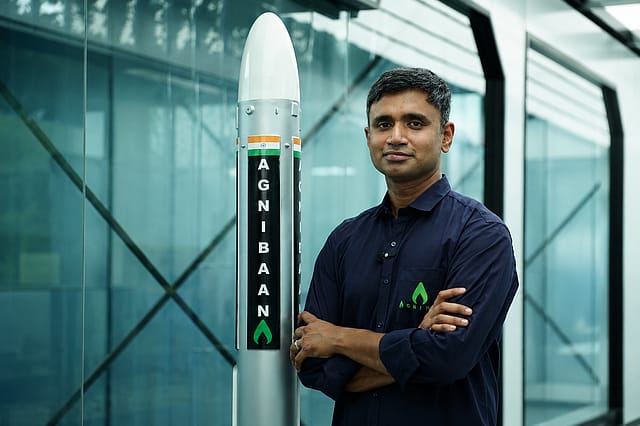
On May 19, Indian space-tech startup Agnikul Cosmos achieved a critical engineering milestone that separates conceptual rocket designs from flight-ready orbital vehicles: they successfully fired a cluster of four semi-cryogenic rocket engines simultaneously.
While the company’s previous milestones—including a successful suborbital technological demonstrator (Agnibaan SOrTeD) in May 2024 and a massive single-booster test in early 2026—proved that their proprietary 3D-printed engine technology works, the multi-engine cluster test proves that it can scale.
In an exclusive chat with Fortune India, Agnikul co-founder and CEO Srinath Ravichandran detailed the technical leap this test represents, the company’s strict focus on vertical integration, and why "schedule certainty" is the ultimate currency in the commercial space market.
The May 19 milestone: synchronising the fire
The May 19 test was not about proving a new engine design, but rather proving that multiple existing engines could operate flawlessly as a single functional unit. The test involved firing four of Agnikul's signature Agnilet engines (which typically produce 6.2 kN of thrust each) in perfect unison.
To achieve this, the system’s avionics had to coordinate eight electric pumps, eight independent motors, and eight speed-control algorithms.
"Our previous controlled launch was built around a deliberately challenging objective. We had to hit a precise point in the trajectory, at a precise moment, despite real-world variables like wind and vehicle performance," Ravichandran said. "What remained to be validated was engine clustering. We have now demonstrated reliable clustering from one engine to four, with no changes to the underlying architecture."
Why is 'clustering' so difficult?
Imagine trying to drive four separate cars forward in a perfectly straight line, at the exact same speed, using only one steering wheel and one gas pedal. If even one engine produces 2% less thrust, or starts a millisecond later than the others, the entire rocket will tilt, veer off course, or vibrate so violently that it tears itself apart. Engine clustering requires the rocket's central computer to constantly monitor and micro-adjust the fuel and oxygen flowing into every single engine simultaneously to ensure perfectly balanced thrust.
"Native scaling" and the path to orbit
The Agnibaan rocket is designed to be highly modular. Depending on the weight of the customer’s payload, the first stage of the rocket can be configured with a cluster of anywhere from four to seven engines.
When asked about the compounding complexity of adding more pumps, motors, and algorithms to a seven-engine cluster, Ravichandran said that Agnikul engineered the system to scale naturally without requiring fundamental redesigns.
"What looks like multiple systems at the hardware level operates as one at the functional level," he explained. "We built it that way across mechanical hardware, electronics, and software, so that scaling is a natural feature of the architecture... The real advantage is an architecture where scaling is a built-in feature, not a redesign effort."
With the clustering software and hardware validated, the company is moving toward the final physical test before attempting an orbital launch. "Each step up in engine count builds confidence in our ability to scale reliably," Ravichandran said. "The next milestone is stage-level testing, where we fire all engines in a ground-clamped configuration, replicating actual launch conditions before we fly."
The engineering moat: single-piece 3D printing
Agnikul's core technological differentiator remains its manufacturing process. The Agnilet is widely recognised as the world's first single-piece 3D-printed semi-cryogenic rocket engine.
By utilising additive manufacturing, Agnikul prints the entire combustion chamber and injector block as one continuous piece of hardware. The company can reportedly print a full engine in just seven days, accelerating manufacturing timelines by over 90% compared to traditional aerospace casting and machining.
Explaining 3D printing and use of semi-cryogenic fuel
Zero welds: Traditional rocket engines are assembled from hundreds of parts bolted or welded together. Every weld is a weak point that can crack under the extreme heat and pressure of a launch. By 3D-printing the engine as a single piece, Agnikul eliminates these joints, exponentially increasing the engine's durability.
Semi-cryogenic: Instead of volatile, highly explosive solid fuels or fully cryogenic fuels (which require keeping both fuel and oxygen at insanely cold temperatures), Agnikul uses a mix of aviation-grade kerosene (stored at room temperature) and liquid oxygen (super-cooled). This makes the rocket much safer, cheaper, and easier to fuel on a mobile launchpad.
This manufacturing strategy is paired with an aggressive push for localised production. The company’s "Rocket Factory-1" in Chennai handles design, printing, and testing under one roof. "We’ve deliberately built vertical integration into our model... This reduces dependencies and accelerates our development cycle," Ravichandran said, hinting that more details on their supply chain localisation will be revealed in the coming months.
Certainty over cost
As of early 2026, Agnikul Cosmos holds a valuation of over $500 million, backed by more than $40 million in venture funding. The company’s financial stability was further validated earlier this year when the Tamil Nadu government, via TIDCO, injected ₹25 crore into the startup—marking the first time an Indian state government has taken an equity stake in a private space enterprise.
This financial runway is supporting a broader commercial vision. Beyond standard orbital launches, Agnikul is exploring high-concept revenue streams, recently partnering with NeevCloud to prototype space-based AI data centers that utilize the vacuum of space for natural server cooling.
However, their immediate commercial pitch for the Agnibaan rocket focuses on solving a specific pain point in the small-satellite market. While operators can buy cheaper "rideshare" slots on massive rockets like SpaceX’s Falcon 9, they are at the mercy of the primary payload’s schedule and are often dropped off in generic orbits, forcing them to use onboard fuel to reach their final destination.
Agnibaan operates more like a private taxi.
"We offer customers three levers of flexibility: mission-specific access, rapid turnaround, and competitive pricing," Ravichandran stated. "When we talk to customers, schedule certainty and orbit specificity come up consistently as their core needs. That is where our architecture is most differentiated."
With their clustering technology now proven, Agnikul is rapidly closing the gap between R&D and commercial operations. Every successful ground test reduces the remaining unknowns, and as Ravichandran confirmed, the company remains firmly focused on achieving its first full orbital launch by the end of 2026.