2025 was a decent year for India’s auto sector. What does 2026 look like?
/ 4 min read
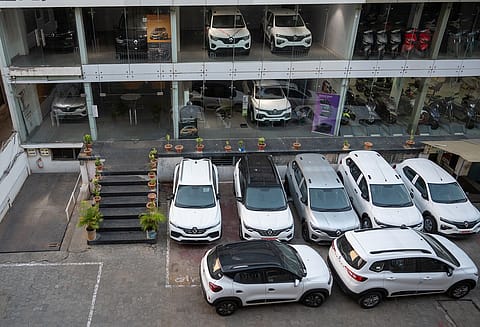
Waiting for buyers | Credits: Shutterstock
2025 was a decent year for India’s auto sector. What does 2026 look like?
India's auto sector experienced a boost in 2025 due to GST cuts, leading to a 20% increase in sales. The outlook for 2026 remains positive, driven by GST 2.0, new model launches, and stable rural economic indicators. Automakers are preparing for price hikes, while EVs and SUVs are expected to drive growth, marking a year of consolidation and selective expansion.
This summary is AI-generated, and Fortune India is not responsible for its content or any associated copyright issues.
The GST cuts were a significant driver of sales in 2025. New launches next year and good rains this year could keep sales ticking in 2026.
THIS STORY FEATURES
Waiting for buyers | Credits: Shutterstock
It’s been a rather delightful year for the country’s automakers.
And at the centre of that was the Narendra Modi government’s decision to cut GST on vehicles ahead of the festive season, which immediately sparked a buying frenzy and, in the process, gave the segment a much-needed impetus. In November, a little over a month after the government cut vehicle tax rates, sales were up 20 percent with passenger vehicle sales growing by 18.7%, from 3,47,522 units sold in November 2024 to 4,12,405 in the same month in 2025. India is the third-largest automobile market in the world.
The strong showing in recent months has also meant that vehicle sales for the April-November period in the country are up by about 3 percent, highlighting how significant the much-celebrated tax cuts were in arresting otherwise declining car sales.
“2025 was less about headline growth and more about normalisation for the auto sector,” Harshvardhan Sharma, the Group Head, Automotive Tech & Innovation Group at Nomura, says. “Demand held up reasonably well, but the year was defined by sharper segmentation rather than broad-based momentum. SUVs continued to anchor volumes and profitability; OEMs stayed disciplined on incentives, and supply-side volatility eased compared to earlier years. EV growth continued, but at a more measured pace, with consumers clearly prioritising value, charging confidence, and real-world usability over early-adopter enthusiasm.”
The GST cuts, which took effect on September 22, introduced a two-slab taxation system for vehicles: 18 percent for all vehicles except luxury vehicles and 40 percent for luxury vehicles. Earlier, all cars were taxed at 28 percent, with an additional cess ranging from 17 percent to 22 percent, depending on body style and engine size. On September 22, the day the GST rate cuts took effect, Tata Motors reported sales of approximately 10,000 passenger vehicles, while Maruti Suzuki and Hyundai reported sales of 30,000 and 11,000 units, respectively.
“The Indian Automotive industry is currently at a crossroads amidst changing consumer preferences, technological advancements, and focus for sustainability,” Srikumar Krishnamurthy, Senior Vice President & Co-Group Head, Corporate Ratings, ICRA Limited, said in a statement. “The recently concluded festive season has reinforced the strong consumption base of the country, supported by favourable rural sentiments following good monsoons and firm crop prices, positive effects of GST overhaul, and interest rate cuts.”
Then, there was the change in pecking order in the Indian automotive world in 2025, with Korean automaker Hyundai slipping to fourth and being eclipsed by homegrown carmakers Mahindra and Tata Motors. Mahindra, which has had a phenomenal year, on the back of the success of its wildly popular Thar Roxx and its electric offerings, has been a standout performer. Tata Motors, which could not build on the frenzy with its SUV coupe Curvv, has now managed to turn heads with its latest SUV, the Tata Sierra, which has already mopped up over 70,000 bookings in a day.
Hyundai, which has since decided to invest a staggering $5 billion and launch as many as 26 cars, including its first hybrid vehicle tailored for India, will be looking to recover lost ground after decades as the country's second-largest automaker.
There were also growing concerns about rare-earth magnets, prompted by China’s decision to curtail exports, which has since been resolved. “The demand sentiments are expected to remain stable in the coming year as well, with the expectation of stable economic activities,” adds Krishnamurthy. ‘Nevertheless, factors like supply chain-related headwinds, softened global auto demand, and higher US tariffs on exports from India are critical monitorables.”



How’s it looking for 2026
“The outlook for India’s auto retail over the next 3 months remains firmly positive, supported by sustained momentum from GST 2.0 tax rationalization, strong enquiry pipelines, and improving rural economic indicators as 74% of dealers expect growth, underscoring broad-based confidence across segments,” the Federation of Automobile Dealers Association said in a statement. “Expected price increases in January, new model launches for 2026, and marriage season demand are set to drive conversions, while crop realization liquidity is expected to reinforce retail traction across Bharat.”
Among others, a whole host of launches are expected in the automotive space in 2026, with Kia’s new Seltos hitting the road, the new Renault Duster, Maruti Suzuki’s electric offering, the eVitara, Nissan Gravite, and Volkswagen Tayron, among others. “Continued new model launches by the OEMs and an expectation of sustained demand are likely to support further volume growth for the industry,” ICRA said in a report in December.
{{#most-powerful-women-snapshot-individual.slug}} {{/most-powerful-women-snapshot-individual.slug}} {{^most-powerful-women-snapshot-individual.slug}} {{/most-powerful-women-snapshot-individual.slug}} {{#showRanking}} {{current-rank}} {{/showRanking}} {{#photo.0.url}}
{{name}}
Across the country, most automakers are gearing up to hike prices, as is an annual practice at the start of the year. Already, JSW-MG Motors has announced plans to hike prices by 2 percent, while BMW Motorrad India has announced a 6 percent hike. Electric vehicle maker Ather has also announced a Rs 3,000 hike for its vehicles. Mercedes-Benz has outlined plans to increase prices quarterly to mitigate the impact of the rupee’s depreciation against the Euro.
“2026 is likely to be more execution-driven than sentiment-driven,” adds Sharma of Nomura. “Volume growth, where it happens, will come from specific pockets: SUVs, select EV launches, and replacement demand rather than a rising tide across segments. OEMs that manage costs well, control dealer inventories, and differentiate clearly on either price or brand will outperform. EVs should see broader acceptance, but not a dramatic inflection unless affordability and charging convenience improve meaningfully. Overall, it looks like a year of consolidation and selective bets rather than aggressive expansion.”
Follow Fortune India
NEXT STORY