Ampstar: How JSW is betting on electric trucks and buses to reshape commercial mobility
/ 5 min read
The market is still small, particularly for electric heavy commercial vehicles. But JSW believes that could change as fleet operators become more comfortable with the economics of electric vehicles.
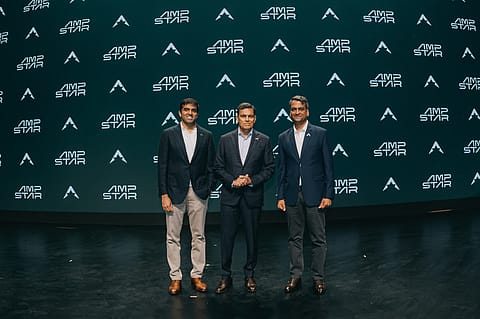
(L to R) Parth Jindal, Sajjan Jindal, Sumit Mittal
For JSW Group, making electric commercial vehicles work in India will require more than putting a bigger battery into a truck or bus. The group’s newly launched electric commercial vehicle brand Ampstar is taking a broader approach, combining the vehicle with charging, fleet operations and financing, while increasing the amount of local content over time.
The market is still small, particularly for electric heavy commercial vehicles. But JSW believes that could change as fleet operators become more comfortable with the economics of electric vehicles.
Sumit Mittal, CEO, JSW Greentech, said around 2.75 lakh heavy commercial vehicles were sold last year, while electric tractor-trailer sales were only around 800. He expects the latter to reach about 3,000 this year.
Parth Jindal, managing director, JSW Cement, said the potential market is much larger than the current electric tractor-trailer numbers suggest. According to Jindal, around 75,000 vehicles used for point-to-point, intracity and intercity movement could eventually shift to electric.
That opportunity is not limited to trucks. Ampstar is also entering the electric bus market, with vehicles ranging from seven metres to 18 metres. The portfolio includes nine-metre and 12-metre buses, as well as low-floor and standard-floor models, along with larger articulated and intercity buses.
Jindal said India has about 1.2 buses per 1,000 people, compared with around 3.2 in Mexico, and argued that the country needs a much larger bus fleet. He estimated that India could require around 60 lakh buses over time. He also expects electric bus sales to rise from around 5,500 units last year to 10,000-11,000 this year and at least 30,000 by 2030.
For Ampstar, therefore, the opportunity is split between two very different commercial vehicle markets: high-utilisation trucks, where fuel costs are a major consideration, and buses, where government and institutional procurement can help create larger electric fleets.
What is JSW trying to solve with Ampstar?
JSW’s entry into commercial vehicles is rooted in the group’s own businesses, Jindal said. Steel and cement, for instance, involve large volumes of freight movement, making transport costs an important part of the economics.
The group is also looking at the issue from the standpoint of India’s dependence on imported oil. Jindal said trucks and buses account for around 40% of diesel consumption and pollution in India.
JSW has already tested electric trucks within its businesses. The experience has helped the group build a case around the running economics of electric commercial vehicles, particularly when vehicles are used intensively and run predictable routes.
The group has put around ₹2,500 crore into its electric commercial vehicle project at Chhatrapati Sambhajinagar. The facility has an initial annual capacity of 15,000 buses and trucks, with production expected to begin within the next 30 days.
{{#most-powerful-women-snapshot-individual.slug}} {{/most-powerful-women-snapshot-individual.slug}} {{^most-powerful-women-snapshot-individual.slug}} {{/most-powerful-women-snapshot-individual.slug}} {{#showRanking}} {{current-rank}} {{/showRanking}} {{#photo.0.url}}
{{name}}
Ampstar is starting with the more demanding end of the commercial vehicle market. Its first truck is a 55-tonne electric tractor-trailer, while the bus range covers seven-metre to 18-metre vehicles. The company plans to add other truck formats, including tippers and fixed-body dumpers.
Mittal said the decision to start with heavy commercial vehicles was deliberate. The segment requires more complex engineering, while the light commercial vehicle market is more dependent on distribution and volumes. JSW wants to establish the product and its engineering credentials before moving down the commercial vehicle chain.
How is localisation and engineering helping Ampstar?
Ampstar’s vehicles have been developed as electric platforms rather than conventional diesel vehicles converted to electric, according to Mittal. The battery is integrated into the chassis, helping keep the centre of gravity low.
The company is also working on battery-cooling systems to manage temperature differences across cells and maintain battery performance in Indian operating conditions. The approach is to design the vehicle around its electric drivetrain rather than add electrification to an existing architecture.
The manufacturing process is another part of the pitch. The Chhatrapati Sambhajinagar plant uses a Pre-Treatment and Electro Deposition (PTED) process for the vehicle structure. According to JSW, the process improves corrosion resistance and increases structural strength by around 50%. The company describes the facility as India’s first commercial-vehicle plant with a PTED system.
Localisation is also being increased in stages. Mittal said buses are already around 70-75% localised. For trucks, the company is targeting 50% localisation within six months and around 75% within nine to 12 months.
Battery cells and motor magnets remain among the components that are yet to be fully localised. Mittal said Ampstar is evaluating three to four global cell suppliers instead of depending on a single source. Motor magnets, meanwhile, are not yet available in India at the scale the company requires.
JSW is also looking at government-led procurement to build the bus business. Jindal said the company is participating in and evaluating contracts under the PM e-Bus Sewa programme, with its buses being developed around tender requirements.
The group sees the availability of supply as another factor in the market. Jindal said the electric vehicle market is increasingly constrained by the number of vehicles manufacturers can actually supply, rather than by a lack of interest from customers. For Ampstar, building production capacity is therefore as important as building demand.
Can lower running costs make electric trucks work?
For fleet operators, the key calculation is the cost of running an electric truck over its lifetime rather than simply its purchase price.
Mittal said Ampstar’s calculations indicate a potential fuel-cost saving of around ₹30 per kilometre. At 100,000 kilometres of annual running, that works out to about ₹30 lakh in potential annual savings. The actual benefit, however, would vary depending on electricity prices, vehicle utilisation, financing and the route on which the truck operates.
Charging is another part of the equation. Ampstar is offering both conventional fixed charging and battery swapping. For fleets where vehicles can be parked for longer periods, fixed charging can work. For high-utilisation routes, swapping can reduce the time a truck spends off the road. Mittal said the swapping process can take around seven minutes under ideal conditions. The objective is to keep vehicles running for longer and increase utilisation, particularly on predictable routes where charging infrastructure can be planned around the fleet.
That is also why Ampstar is starting with a B2B model instead of immediately building a nationwide dealership network. Charging and maintenance infrastructure can be placed around large fleets and specific routes rather than built out uniformly across the country.
The JSW Group itself gives Ampstar a ready pool of potential demand. At the same time, the company is talking to external fleet operators and logistics companies. For the first year, Mittal said the company is targeting 500-1,000 vehicles. “This year, we are targeting anything between 500 and 1,000 units,” he said. The initial plant can produce 15,000 vehicles a year, with expansion possible as utilisation increases. Over time, JSW expects capacity utilisation to reach around 70-75%.
Follow Fortune India
NEXT STORY