Auto industry must invest boldly in clean, emerging technologies to build for global markets: H.D. Kumaraswamy
/ 3 min read
Heavy Industries Minister calls for greater scale, localisation and faster innovation as India seeks to strengthen its position in the global mobility supply chain.
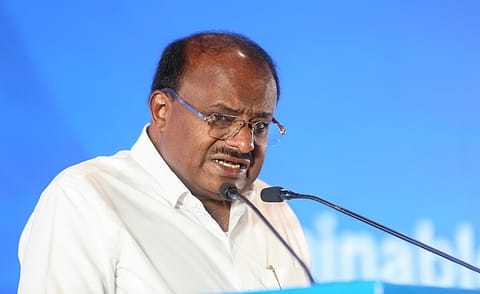
H. D. Kumaraswamy, Union Minister of Heavy Industries and Steel, Government of India | Credits: Sanjay Rawat
Union Heavy Industries and Steel Minister H.D. Kumaraswamy on Wednesday Auto industry urged automobile and component manufacturers to step up investments in clean and emerging technologies, saying India’s automotive ambitions must extend beyond catering to domestic demand to developing products and technologies for global markets.
Addressing the 66th annual session of the Automotive Component Manufacturers Association of India (ACMA), Kumaraswamy said the industry’s next phase of growth must be built around greater scale, deeper localisation and faster innovation, with design and domestic value addition becoming critical to India’s transition towards electric and cleaner mobility.
“I urge the automobile and auto component industry to invest more boldly in cleaner, efficient and emerging technologies, not merely to make in India but to make for the world,” Kumaraswamy said.
He said the automotive and auto component industry is central to India’s manufacturing ambitions because of its extensive linkages with steel, electronics, engineering, chemicals, logistics and services. The sector also supports millions of livelihoods and anchors a vast MSME ecosystem, giving it a significant multiplier effect across the wider economy.
EV transition must go beyond vehicle sales
Kumaraswamy said India’s green mobility transition is gathering momentum, but the success of the shift to electric vehicles should not be assessed simply by the number of EVs sold.
“However, our success cannot be measured only by the number of electric vehicles sold. It must also be measured by how much technology is designed in India, how much value is added domestically, how many MSMEs participate in the new supply chains, and how effectively Indian products compete in global markets,” he said.
The minister said government schemes are supporting investment, domestic value addition, advanced technology manufacturing and the transition towards cleaner mobility.
He said the Production Linked Incentive (PLI) scheme for Advanced Chemistry Cell battery storage, with an outlay of ₹18,100 crore, is aimed at creating 50 GWh of domestic battery manufacturing capacity.
The government has also initiated measures to develop domestic capacity for sintered rare-earth permanent magnets, a key input for electric motors.
“This initiative will help reduce strategic input dependence and strengthen supply chain security,” Kumaraswamy said.
Auto PLI investment reaches ₹45,477 crore
The minister said the PLI scheme for the automobile and auto component industry is also showing encouraging results, with companies approved under the programme reporting investments of ₹45,477 crore as of June 30, 2026.
{{#most-powerful-women-snapshot-individual.slug}} {{/most-powerful-women-snapshot-individual.slug}} {{^most-powerful-women-snapshot-individual.slug}} {{/most-powerful-women-snapshot-individual.slug}} {{#showRanking}} {{current-rank}} {{/showRanking}} {{#photo.0.url}}
{{name}}
These investments have resulted in more than 67,000 employment opportunities, Kumaraswamy said.
He said the government's incentive programmes are aimed at encouraging investment, increasing domestic value addition and promoting advanced technology manufacturing while supporting the industry's transition towards cleaner mobility.
Kumaraswamy said the next phase of India's automotive development must focus not only on expanding production but also on building capabilities that can compete globally.
As India advances towards the goal of Viksit Bharat 2047 envisioned by Prime Minister Narendra Modi, the objective should be for the country to emerge as a leader in the global mobility transition, he said.
“India should not merely participate in the global mobility transition; India should help lead it,” Kumaraswamy emphasised.
He said this would require the industry to build scale, deepen localisation, accelerate innovation and establish India as a globally competitive hub for advanced and green mobility technologies.
Government steps up EV support
Kumaraswamy also outlined the government's growing support for electric mobility through the PM E-DRIVE scheme.
The scheme’s outlay has been increased by ₹1,000 crore to ₹11,900 crore, with the enhanced allocation aimed at continuing support for electric two-wheelers. The scheme now targets support for around 45.79 lakh electric two-wheelers.
More than 25.66 lakh electric two-wheelers and 2.75 lakh electric three-wheelers have been supported so far, the minister said. Support has also been extended to 53 electric trucks.
The government has allocated ₹4,391 crore for the deployment of 14,028 electric buses, of which around 13,800 have already been allocated.
Charging infrastructure is also being expanded alongside vehicle adoption. The government has earmarked ₹2,000 crore for public charging infrastructure, while proposals worth ₹729 crore covering 7,254 chargers have been approved.
Separately, the PM e-Bus Sewa Payment Security Mechanism, with an outlay of ₹3,435 crore, is aimed at supporting the deployment of more than 38,000 electric buses by providing payment security to operators. Kumaraswamy said 27,555 e-buses have already been registered under the mechanism.
The minister said the Ministry of Heavy Industries would continue working with ACMA, the Society of Indian Automobile Manufacturers (SIAM) and other industry stakeholders to improve the implementation of government schemes and address operational challenges.
“The Ministry of Heavy Industries will continue to work closely with ACMA, SIAM, and industry stakeholders to improve scheme implementation, resolve operational issues, and create an enabling environment for investment and innovation,” Kumaraswamy said.
He said the automobile and component industry would remain a key pillar of India's manufacturing journey, with its ability to create domestic capabilities, support MSMEs and develop globally competitive technologies determining how effectively the country can capitalise on the global shift towards cleaner mobility.
“India should not merely participate in the global mobility transition; India should help lead it,” Kumaraswamy said.
NEXT STORY