Can Battery as a Service change India’s EV landscape for good?
/ 3 min read
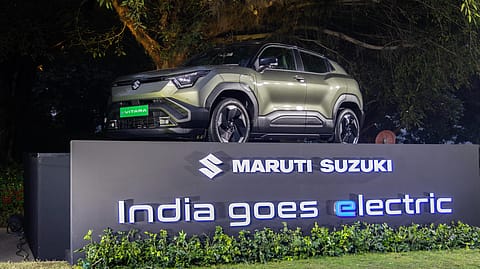
Maruti Suzuki India has launched e VITARA Born EV | Credits: Sanjay Rawat
Can Battery as a Service change India’s EV landscape for good?
Battery as a Service (BaaS) is gaining traction in India, with major automakers like Tata Motors and Maruti Suzuki adopting the model. By decoupling battery costs, BaaS reduces the upfront price of electric vehicles, potentially boosting EV adoption. While it offers flexibility, challenges remain, such as consumer hesitance and higher tax rates on rental payments.
This summary is AI-generated, and Fortune India is not responsible for its content or any associated copyright issues.
Battery as a Service allows customers to purchase an electric vehicle at a lower upfront cost and pay for the battery on a pay-per-use basis. This reduces the upfront cost of buying an EV and offers flexible payment options
Maruti Suzuki India has launched e VITARA Born EV | Credits: Sanjay Rawat
It started with MG Motors.
Now, everybody from Maruti Suzuki to Tata Motors is making a beeline for it.
On February 20, as Tata Motors launched the facelifted version of its wildly popular compact SUV, the Punch, the automaker announced plans to offer battery-as-a-service to buyers. A week before that, Maruti Suzuki, India’s largest automaker, also announced it would offer battery-as-a-service to buyers of its newly launched e Vitara.
Tata Motors' decision to give in to the Battery as a service program is a far cry from a little over a year ago, when the company was vehemently opposed to the idea. “We have done the mathematics. We have seen the process. We remain unconvinced, particularly in passenger vehicles,” P.B. Balaji, then group chief financial officer of Tata Motors, said then. Now, though, that has changed.
Essentially, Battery as a Service allows customers to purchase an electric vehicle at a lower upfront cost and pay for the battery on a pay-per-use basis. This reduces the upfront cost of buying an EV and offers flexible payment options. The battery cost is financed on a per-kilometre basis for a certain tenure and interest rate, depending on the financier. Charging expenditures are not included in the battery usage costs.
The price difference is quite staggering at first glance. The Tata Punch for instance is priced at Rs 9.69 lakh (ex-showroom, Mumbai), with the battery-as-a-service (BaaS) structure starting at Rs 6.49 lakh plus a battery usage charge of Rs 2.6 per km. That’s a difference of Rs 3.2 lakh up front.
In 2024, JSW MG Motor launched the Windsor EV, with a battery-as-a-service offering for ₹9.99 lakh. At that time, under the plan, customers had to shell out Rs 3.5 per kilometre for usage and had to pay for at least 1,500 kms per month under the battery-as-a-service model. That meant an average monthly payment of Rs 5,250, excluding the charging costs.
“The intent is to reduce the entry barrier to electric mobility. By decoupling the battery cost, customers can step into EV ownership at a lower upfront price and choose a plan aligned with their driving needs,” Partho Banerjee, Senior Executive Officer (Marketing & Sales) at Maruti Suzuki, had said at the time of the launch.
"BaaS helps bring customers into the showroom,” says Puneet Gupta, Director at S&P Global Mobility. “Attracting footfall is the hardest part of electric vehicle sales today. With EVs, many buyers still have concerns around battery life and costs. BaaS lowers that risk and builds confidence. We expect more innovation in this model, along with the rise of dedicated BaaS service providers
India plans to achieve a 30% share of electric vehicles in total vehicle sales by 2030. Sales of EVs in India went up from 50,000 in 2016 to 2.3 million in 2025. Simultaneously, India’s EV penetration was only about one-fifth of the global average in 2020 but has risen to over two-fifths in 2024, according to the NITI Aayog.
It’s into this mix that the BaaS scheme fits, with the potential to drive more adoption. “It’s a clever psychological ploy to generate initial enquiries and showroom traffic by optically showcasing the price closer to ICE counterparts,” Vinay Piparsania, founder and principal of MillenStrat Advisory & Research and a former executive director at Ford India, says. “Maruti’s foray into the BaaS segment clearly shows that something is working so far, even though only about 15 percent of the buyers eventually choose the BaaS scheme.”
{{#most-powerful-women-snapshot-individual.slug}} {{/most-powerful-women-snapshot-individual.slug}} {{^most-powerful-women-snapshot-individual.slug}} {{/most-powerful-women-snapshot-individual.slug}} {{#showRanking}} {{current-rank}} {{/showRanking}} {{#photo.0.url}}
{{name}}
Currently, Tata Motors offers BaaS for its Punch EV at Rs 2.6 per kilometre, which means a daily usage of 60 kilometres would cost Rs 4680 per month. For eVitara buyers, this would translate to about Rs 7,100 per month.
“It's not like buying a vehicle on EMI,” adds Piparsania. “Under BaaS, the car is with you, but the battery, which is about 40 percent of the cost, is not owned by you. That dissuades many buyers who do not want that uncertainty. They might be thinking: what happens if there's a change in policy or price tomorrow? Indian consumers often prefer to own the entire product. Another factor is that when you buy an EV, the GST rate is 5%. When you take BaaS, the rental payment is charged at an 18 percent tax rate.”
For now, BaaS remains in its infancy. It’s definitely likely to change shape and rewrite the rules of the EV game in the months to come.
Follow Fortune India
NEXT STORY