Exicom targets nearly ₹1,000 crore revenue in FY26 amid EV charging and critical power expansion
/ 3 min read
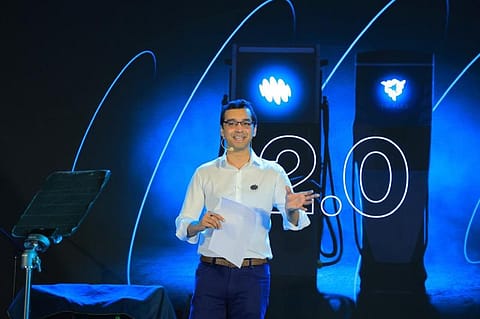
Exicom MD & CEO Anant Nahata | Credits: Anant Nahata's LinkedIn account
Exicom targets nearly ₹1,000 crore revenue in FY26 amid EV charging and critical power expansion
Exicom Tele-Systems aims for nearly ₹1,000 crore revenue in FY26, recovering from a dip in FY25 due to global EV market softness. CEO Anant Nahata highlights strong growth in FY24 and anticipates a 25-30% annual increase in the EV charging segment. The company is expanding its Hyderabad facility and enhancing its product portfolio for global markets.
This summary is AI-generated, and Fortune India is not responsible for its content or any associated copyright issues.
Strategic investments in manufacturing, R&D, and OEM partnerships position Exicom to capitalize on India’s growing EV infrastructure and telecom power markets
Exicom MD & CEO Anant Nahata | Credits: Anant Nahata's LinkedIn account
India’s EV and critical power solutions provider, Exicom Tele-Systems, is targeting nearly ₹1,000 crore in revenue for FY26, rebounding from a modest dip in FY25 caused by softness in the global EV market. Speaking to Fortune India, CEO Anant Nahata highlighted that while FY24 had been strong at over ₹850 crore, FY25 reflected broader market challenges.
“FY24 was a really great year for us, we did about north of ₹850 crore. FY25 was a slight dip for us because of softness in EVs… But from FY26, we are super excited,” Nahata said, noting that the EV charging segment, currently accounting for roughly one-third of revenues, is expected to grow 25–30% annually.
On the balance between the critical power and EV charging businesses, Nahata noted, “Eventually, if one business keeps growing faster than the other, we will reach a point where both segments contribute equally. But as a company, we are happy with growth in either—this is just how the market evolves.” The critical power segment, largely telecom-focused, contributes about two-thirds of revenue and grows at 8–10% annually, though cyclical investment patterns can cause fluctuations.
Organic growth, global expansion and product development
Exicom has invested around ₹ 216 crore in its Hyderabad facility, significantly expanding production. Nahata said, “AC charger capacity has moved from 70,000 units in Gurgaon to nearly 2 lakh annually here, and DC chargers will almost double to 4,000 units. We are ready for the growth we see coming.” Incremental CAPEX is planned for additional lines and liquid power converter technologies.
Exports are expected to account for more than 15% of EV charger revenues next year, particularly in Southeast Asia and the Middle East. “We are a challenger brand in these markets, and our goal is to continuously expand our portfolio,” Nahata said. Domestically, Exicom works with at least two of India’s top three EV car brands and plans to increase B2C home charger sales.
When asked about the development of next -generation chargers, Nahata maintained, “Our R&D efforts are focused on both incremental innovation and path-breaking products. Gen 3 DC chargers will offer higher power and better scalability to match growing battery capacities.”
Exicom’s software capabilities, including a remote management system with 50+ sensors, simplify operations and enhance the user experience.
Hyderabad facility goes on stream
Exicom recently inaugurated its integrated manufacturing facility in Hyderabad, spanning 18.4 acres and ~2,80,000 sq ft. The plant increases manufacturing capacity by roughly 2.5 times in the first phase and creates over 750 jobs. It produces EV charging systems, lithium-ion battery solutions, and critical power equipment for telecom networks and data centres.
AC charger capacity has expanded to ~1 lakh units annually, soon to reach nearly 2 lakh, while DC fast chargers will increase to 4,000 units from 2,400. Automation, robotics, digital traceability, and specialised testing infrastructure support advanced manufacturing and future expansion.
Founded in 1994, Exicom has operations across India, Southeast Asia, Europe, and the Middle East. Listed in February 2024, the company continues to expand its manufacturing footprint, technology capabilities, and global reach to support India’s rapidly evolving EV charging ecosystem.
Follow Fortune India
NEXT STORY