Fortune India exclusive: Maruti Suzuki looks to take its underbody CNG breakthrough across other product lines
/ 3 min read
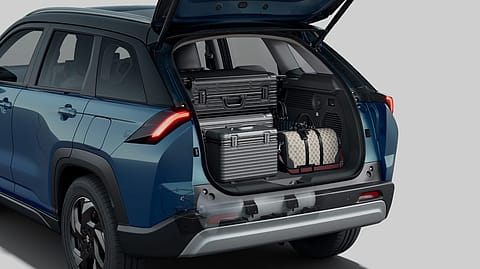
At present, Maruti Suzuki's Victoris mid-SUV is equipped with underbody CNG tank | Credits: Maruti Suzuki
Fortune India exclusive: Maruti Suzuki looks to take its underbody CNG breakthrough across other product lines
Maruti Suzuki is set to expand its underbody-mounted CNG tank technology to more vehicle lines, addressing luggage space issues in factory-fitted CNG cars. While smaller models will retain the current S-CNG setup, SUVs and MPVs with higher ground clearance will likely adopt the new technology, enhancing practicality without compromising luggage capacity.
This summary is AI-generated, and Fortune India is not responsible for its content or any associated copyright issues.
After debuting the packaging solution in a recent SUV launch, the country’s largest carmaker is preparing to extend the technology across more models as competition intensifies in India’s rapidly expanding CNG passenger vehicle market
At present, Maruti Suzuki's Victoris mid-SUV is equipped with underbody CNG tank | Credits: Maruti Suzuki
Maruti Suzuki India Limited (MSIL) is preparing to extend its underbody-mounted Compressed Natural Gas (CNG) tank technology across other product lines, a move that could address one of the biggest limitations of factory-fitted vehicles running on the fuel—the loss of usable luggage space.
Sources familiar with the development said smaller models such as the Alto, WagonR and S-Presso, as well as compact cars including the Swift and Baleno, are likely to continue with the company’s existing S-CNG configuration. The underbody-mounted CNG tank technology, however, is expected to be deployed in vehicles with higher ground clearance, such as SUVs and MPVs.
"The company has already begun testing the technology on the Brezza, though plans to introduce it in other models are yet to be finalised. The technology could be rolled out across other models such as Grand Vitara, wherever it is technically feasible,” a person aware of the development said.
When contacted by Fortune India, a spokesperson for Maruti Suzuki declined to comment on the development, stating that the company does not comment on future product plans.
The move comes at a time when CNG has become an increasingly important pillar of Maruti Suzuki’s sales mix. In FY2025, around 34% of the company’s passenger vehicle sales came from CNG models, translating to about 6.2 lakh units during the year, reflecting the growing demand for lower-cost mobility options.
The trend has continued into the current fiscal year as well. Industry estimates suggest that CNG vehicles account for roughly 35–36% of Maruti Suzuki’s passenger vehicle sales so far in FY26, underscoring how strongly the fuel has resonated with Indian buyers amid volatile petrol prices.
Victoris Sets the template for Maruti’s new CNG packaging Strategy
The country’s largest carmaker first rolled out the underbody CNG packaging in the Maruti Suzuki Victoris, a mid-size SUV introduced in 2025. Positioned in one of the country’s most competitive segments, the model is priced between ₹10.5 lakh and ₹19.9 lakh (ex-showroom), depending on the variant.
In the Victoris, the CNG version uses two cylinders mounted beneath the vehicle body, enabling the SUV to retain its full luggage capacity—something that conventional CNG layouts often compromise.
“Customer response to the CNG variant of the Victoris has been encouraging, especially from buyers seeking lower running costs without sacrificing luggage space,” Partho Banerjee, Senior Executive Officer, Marketing and Sales at MSIL, had earlier told reporters, adding: “The underbody cylinder packaging helps deliver that balance.”
Encouraged by the practicality benefits, the company is now studying how the technology can be adapted across additional vehicles in its lineup.
A selective deployment strategy takes shape
Even as the carmaker explores wider deployment, not every model may require the new configuration.
{{#most-powerful-women-snapshot-individual.slug}} {{/most-powerful-women-snapshot-individual.slug}} {{^most-powerful-women-snapshot-individual.slug}} {{/most-powerful-women-snapshot-individual.slug}} {{#showRanking}} {{current-rank}} {{/showRanking}} {{#photo.0.url}}
{{name}}
People familiar with product planning say the Maruti Suzuki Ertiga MPV may not necessarily move to the underbody tank layout, as the vehicle’s existing packaging already offers relatively usable luggage space despite the conventional cylinder placement.
“In such cases, the incremental advantage of relocating the tank beneath the vehicle is less significant,” revealed another source, adding that other models where luggage packaging is tighter could potentially benefit from the layout.
Analyst View
According to Puneet Gupta, packaging innovations could help broaden the appeal of CNG vehicles beyond their traditional base.
“CNG has historically been strongest in entry-level vehicles because buyers prioritise lower running costs,” Gupta said. “But compromises such as loss of luggage space have sometimes discouraged adoption in other categories.”
“Technologies that solve that practicality issue—such as underbody-mounted cylinders—can strengthen the value proposition of CNG vehicles and help expand their appeal,” he added.
Competitive pressure from rivals
The push also reflects intensifying competition in the factory-fitted CNG segment.
Tata Motors has been aggressively expanding its CNG lineup with its patented “iCNG” twin-cylinder technology, which splits gas storage into two smaller cylinders placed under the luggage floor, allowing vehicles to retain usable boot space.
The technology first appeared on the Tata Altroz and has since been rolled out across multiple models including the Tata Tiago, Tata Tigor and Tata Punch. Prices for these iCNG variants typically range from around ₹6.5 lakh to ₹9.6 lakh (ex-showroom), depending on the model and variant.
South Korean carmaker Hyundai Motor India Limited (HMIL) has also introduced alternative packaging solutions in its CNG portfolio. Models such as the Hyundai Exter feature “Hy-CNG Duo” technology, which similarly uses dual cylinders positioned beneath the luggage floor to reduce the impact on cargo space.
NEXT STORY