The FAQs are AI-generated, and Fortune India is not responsible for its content or any associated copyright issues.
From volume race to value game: What FY26 reveals about the reinvented Indian auto industry
/ 4 min read
Record PV sales, rising SUV dominance and a ₹50,000-crore investment cycle underline how India’s automakers are prioritising margins, premiumisation and future technologies over pure volume growth
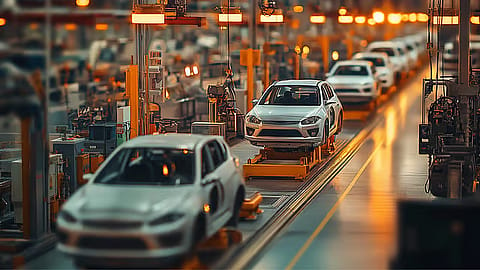
The investment cycle extends beyond passenger vehicle leaders.
India’s Passenger Vehicle (PV) industry closed FY26 with record domestic sales of nearly 4.64 million units, but the earnings season revealed that the sector’s defining trend was not volume growth alone. Financial results across automakers pointed to a widening gap between topline and bottomline growth, with profitability increasingly driven by SUVs, premiumisation and product mix.
Maruti Suzuki India Limited (MSIL), the country’s largest carmaker, crossed the ₹1.5 lakh crore revenue mark in FY26, aided by higher volumes, better realisations and an expanding utility vehicle portfolio. However, profit growth remained relatively muted despite the revenue surge, reflecting elevated discounts, forex pressures and rising competition in the mass-market segment. Utility vehicles (UVs) accounted for a steadily rising share of the company’s sales mix as consumer preference continued shifting towards SUVs.
Mahindra & Mahindra (M&M) emerged as one of the strongest performers during the year, with automotive revenue crossing ₹90,000 crore and Profit after Tax (PAT) rising about 35%, driven by sustained demand for higher-margin products such as the Scorpio-N, XUV700 and Thar. Strong operating leverage, lower incentives and richer product mix helped M&M report some of the strongest margins in the domestic PV space.
Hyundai Motor India Limited (HMIL) also maintained healthy revenue growth during the year, with SUVs such as the Creta, Venue and Alcazar contributing a dominant share of domestic volumes. Exports remained a key earnings cushion, while the company continued focusing on premiumisation and localisation.
Tata Motors’ passenger vehicle business, meanwhile, adopted a more calibrated approach towards growth amid intensifying competition in SUVs and EVs. The broader Tata Motors group reported consolidated revenue exceeding ₹4 lakh crore during FY26, while maintaining robust profitability across businesses. The company prioritised product mix and inventory discipline over aggressive wholesale expansion.
“FY26 shows Indian auto has structurally decoupled volume from value. SUVs now make up 67% of the PV mix, up from 51% just three years ago, and that shift is rewriting the P&L across the board. M&M's PAT grew 35% on SUV-led premiumisation while Maruti's revenue surged 20% but profit barely moved at 1%, exposing how differently each OEM is capturing value from the same demand pool. The 4.64 million units matter less than what each unit earns, with Indian carmakers being no longer in a volume race, but in a margin game,” says Mohit Yadav, Director, AltInfo.
ICRA noted that FY2027 capex across the automotive sector is expected to remain elevated, particularly in passenger vehicles, where investments will be driven by EV platforms, product development and selective capacity expansion.
According to Rohan Kanwar Gupta, Vice President and Sector Head, Corporate Ratings, ICRA Limited, "Automakers are likely to remain financially disciplined, phasing investments while maintaining strong liquidity buffers despite an uncertain geopolitical environment." He added that while EV-led investments may exert near-term pressure on return ratios, OEM balance sheets are expected to remain robust, supported by scale, healthy cash flows and parent backing.
₹50,000-crore capex cycle gathers momentum
Ratings agencies noted rising focus on dealer profitability and calibrated wholesales, signalling a more mature phase for the domestic PV market where margins and return on capital matter as much as dispatch volumes.
At the same time, automakers and component makers have lined up nearly ₹50,000 crore in capex for FY27 across EVs, localisation and SUV platforms. Maruti Suzuki has earmarked around ₹14,000 crore towards capacity expansion and EV production, while Hyundai Motor India plans investments of about ₹7,500 crore for SUV launches, EV programmes and expansion of the Talegaon facility. Tata Motors and M&M are also continuing large investments into EV architectures and premium SUVs.
According to Poonam Upadhyay, Director, Crisil Ratings, "The passenger vehicle segment will account for the largest share of investments, driven by EV platforms, capacity additions and regulatory compliance, while two-wheelers are also expanding capacity with a strong push towards electrification. She added that commercial vehicle investments will remain relatively measured, given moderate utilisation levels and a more cautious demand outlook."
RANK
COMPANY NAME
REVENUE
(INR CR)
(INR CR)
{{#current-rank}} {{current-rank}} {{/current-rank}} {{^current-rank}} {{rank}} {{/current-rank}} {{name}} {{#revenue}} {{revenue}} {{/revenue}} {{^revenue}} {{noi}} {{/revenue}}
The investment cycle extends beyond passenger vehicle leaders. TVS Motor Company has outlined capex of around ₹3,500 crore towards EV expansion and premium motorcycle platforms, while Hero MotoCorp is expected to invest over ₹1,500 crore across electric mobility, digital technologies and premium products. Component makers are also increasing investments in electronics and precision engineering to deepen localisation.
Crisil also highlighted that EV platforms and battery localisation will attract the highest incremental investments in FY27, with one leading PV OEM alone targeting capacity expansion of about 5 lakh units.
According to Poonam Upadhyay, Director, Crisil Ratings, "Battery import dependency and elevated raw material costs remain key risks, though most players are expected to sustain capex cycles supported by internal accruals and selective pricing actions." She added that EV-related tooling and technology costs may lead to near-term margin pressure until localisation improves cost structures.
Frequently Asked Questions
NEXT STORY