FY26 car sales: Maruti Suzuki Dzire rules sales charts, defies SUV surge as hatchbacks, MPVs hold ground
/ 3 min read
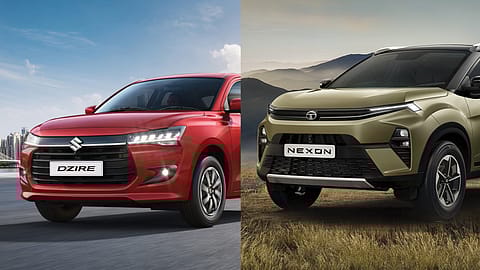
As per industry trackers, Maruti Suzuki accounted for five of the top 10 models, underlining its ability to sustain volumes across segments
FY26 car sales: Maruti Suzuki Dzire rules sales charts, defies SUV surge as hatchbacks, MPVs hold ground
India’s passenger vehicle market hit a record 4.7 million units in FY26, powered by SUVs that formed 56% of sales, yet Maruti Suzuki’s Dzire sedan topped the charts with 2.29 lakh units. The result highlights a split between aspiration-led SUV growth and value-led sedan, hatchback and MPV volumes, with Maruti placing five models in the top ten.
This summary is AI-generated, and Fortune India is not responsible for its content or any associated copyright issues.
Growth is shifting to SUVs, but scale still comes from traditional segments.
As per industry trackers, Maruti Suzuki accounted for five of the top 10 models, underlining its ability to sustain volumes across segments
India’s domestic Passenger Vehicle (PV) market touched a record 4.7 million units in Financial Year (FY) 2025-26, led by sustained demand for Sport Utility Vehicles (SUVs). Yet, the year’s top-selling model was not an SUV. The Maruti Suzuki Dzire, which is positioned in the entry-level sedan segment, led the charts, pointing to a clear split in the market—between where growth is coming from and where volumes still lie.
Partho Banerjee, Senior Executive Officer – Marketing & Sales at Maruti Suzuki, said the Dzire’s performance reflects continued demand for sedans despite the SUV shift. He noted that the company’s sedan segment share has risen from 45.8% in FY17 to 57.2%.
As per industry trackers, Maruti Suzuki accounted for five of the top 10 models, underlining its ability to sustain volumes across segments. This comes even as Tata Motors, Hyundai Motor India (HMIL), and Mahindra continue to expand their SUV portfolios aggressively.
“While some Ciaz customers are upgrading to SUVs and MPVs, others continue to consider the Dzire, in line with Maruti Suzuki’s strategy of maintaining a presence across segments,” said Banerjee. He also maintained that differentiated use cases continue to support sedan demand, with the recent model update strengthening the Dzire’s positioning.
SUVs rule the roost
SUVs accounted for 56% of total PV sales during the fiscal, reinforcing their position as the industry’s primary growth engine. Models such as the Tata Nexon and Hyundai Creta remained among the top sellers, supported by strong consumer preference for higher ground clearance, features, and perceived versatility.
The Nexon mini-SUV sold over 2.16 lakh units in FY26, up from about 1.63 lakh units last fiscal, registering growth of over 32%. The Creta, with over 2.01 lakh units, sustained volumes on a high base, registering a modest growth of around 3–4% year-on-year during the same period.
Talking about the Creta’s performance, Tarun Garg, Managing Director & CEO, Hyundai Motor India Limited, had earlier stated that the model’s momentum is also reflected in the rise of first-time buyers—from 13% in 2020 to an impressive 32% in 2025.
“Aspirations of Creta’s customers have also evolved over the years, with sunroof-equipped variants contributing more than 70% of Creta’s sales in calendar year 2025. In addition, the diesel powertrain contributes a strong 44% share to its sales,” said Garg, adding, “It has been the highest-selling mid-size SUV in India every completed year, cementing its position as the market leader in one of our country’s most competitive and prestigious automotive segments.”
Other SUVs, including the Mahindra Scorpio and Maruti Suzuki Brezza, also posted steady gains—Scorpio volumes rose by around 8–9% year-on-year, while the Brezza saw a mid-single-digit decline of about 4–5%, pointing to some moderation after strong previous years.
Numbers do the talking
However, volumes continue to be anchored by non-SUV segments. The Dzire led the market with 2.29 lakh units, up from around 1.65 lakh units in FY25, translating into nearly 39% growth, as per industry trackers. The Ertiga followed with close to 2 lakh units, growing over 4%, reflecting stable demand in the multi-purpose vehicle segment.
Hatchbacks delivered mixed outcomes. Maruti Suzuki’s Swift and Baleno posted modest growth of around 3–4%, while the WagonR saw a decline of over 9% despite volumes of 1.8 lakh units. The Tata Punch also recorded a drop of around 6%, indicating some pressure in entry-level segments even as they remain significant in absolute terms.
{{#most-powerful-women-snapshot-individual.slug}} {{/most-powerful-women-snapshot-individual.slug}} {{^most-powerful-women-snapshot-individual.slug}} {{/most-powerful-women-snapshot-individual.slug}} {{#showRanking}} {{current-rank}} {{/showRanking}} {{#photo.0.url}}
{{name}}
Industry observers say the divergence between growth and volumes is becoming more pronounced. Puneet Gupta, Director, S&P Global Mobility, said the market is splitting between aspiration-led and value-led demand.
“SUVs may be driving growth, but it is the high-volume segments—sedans and hatchbacks—that are sustaining the market. They continue to deliver where it matters most: cost of ownership and efficiency,” he said.
NEXT STORY