Maruti Chairman R.C. Bhargava urges Centre to accelerate reforms, improve ease of doing business
/ 3 min read
On India’s journey towards net zero, Maruti Suzuki India Chairman R.C. Bhargava said the country needs to adopt multiple technologies to achieve its goal of reaching net zero.
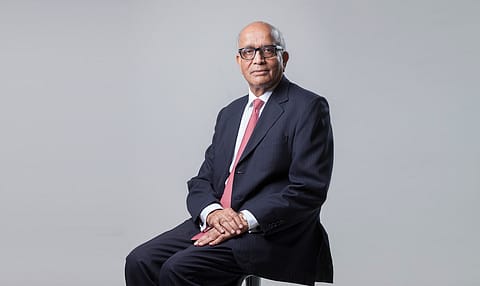
R. C. Bhargava, chairman, Maruti Suzuki India | Credits: Sanjay Rawat
Maruti Suzuki India Chairman R.C. Bhargava has urged the Centre and state governments to accelerate reforms and take further steps to improve the ease of doing business, saying faster wealth creation is critical for India to make up for the time it has lost.
In his address to shareholders in the company’s annual report for 2025-26, Bhargava called for greater use of technology to reduce corruption and delays, while stressing the need to trust the private sector and allow competition to play a bigger role in driving economic growth.
“Use more technology as it has shown that it reduces corruption and delays. Time saving is a major factor in lowering costs of production,” Bhargava said.
According to Bhargava, faster wealth creation is critical for India to make up for the time it has lost. He pointed to the automobile industry as an example of how greater competition can create both wealth and jobs.
“My request to all political parties is to support reforms and programmes that create wealth,” he said, adding that the government and the Opposition should ensure that the additional resources generated through economic growth are used to build a more equitable and just society.
Bhargava also said the recent GST reforms had provided fresh momentum not only to the automobile industry but also to several other sectors of the economy.
On India’s journey towards net zero, Bhargava said the country needs to adopt multiple technologies to achieve its goal. He said Maruti Suzuki strongly believes that biogas can be generated in large quantities from locally available resources.
“This form of energy would substitute for imported CNG and be clean and renewable with zero import content. In addition, there would be many valuable byproducts,” he said.
Small cars could see sharper recovery
On the auto sector outlook, Bhargava said India’s passenger vehicle market could grow to 6.1-6.3 million units by FY31, with the small-car segment expected to grow at a significantly faster pace than it has over the past five years.
Maruti Suzuki is assessing how the domestic passenger vehicle market could evolve over the next five years, particularly following the recent GST reforms.
“We are in the process of making as accurate an estimate as possible of the likely growth of the car market in the next five years,” Bhargava said. “Presently, we are estimating that the car industry would grow to 6.1 to 6.3 million units by FY 2030-31 and that the share of the small car market would grow significantly faster than its pace of growth in the last five years.”
{{#most-powerful-women-snapshot-individual.slug}} {{/most-powerful-women-snapshot-individual.slug}} {{^most-powerful-women-snapshot-individual.slug}} {{/most-powerful-women-snapshot-individual.slug}} {{#showRanking}} {{current-rank}} {{/showRanking}} {{#photo.0.url}}
{{name}}
The outlook comes as Maruti Suzuki sees signs of recovery across several parts of its business. Small cars have begun to regain momentum, while SUVs continue to increase their share of the company's portfolio. Higher exports, additional manufacturing capacity and a focus on multiple powertrain technologies are also expected to support growth.
Maruti Suzuki sold a record 24.22 lakh vehicles in FY26, including 4.47 lakh units in overseas markets. The company crossed the two-million annual sales mark for the third consecutive year and expects to reach its next million-vehicle milestone sooner than previously anticipated.
In the first quarter of FY27, total sales increased 29.3% to 682,724 units from 527,861 units. Domestic small-car sales rose 34.1%, SUV sales grew 44.6% and exports increased 28.6%. The company's domestic market share improved by 2.3 percentage points to 41.2%.
Plans seven SUVs in next 5-6 years
Maruti Suzuki Managing Director and CEO Hisashi Takeuchi said the company had brought forward its capacity expansion plans as it remained confident about medium-term demand.
The company added 500,000 units of manufacturing capacity during FY27 and plans to launch seven SUVs over the next five to six years as it seeks to strengthen its presence in a segment that has steadily gained importance in the Indian market.
The company is also exploring biogas as part of its efforts to support India's net-zero ambitions. Maruti's board has approved an investment of ₹561 crore to set up four biogas plants in the first phase.
Bhargava said the company sees significant potential to produce biogas from locally available resources, which could reduce dependence on imported CNG while providing a cleaner and renewable fuel. The first phase will allow Maruti to gain experience with the technology before considering larger investments in biogas production and distribution.
Maruti's growth outlook comes even as the company faced margin pressure in the June quarter. Consolidated net profit fell 10.8% year-on-year to ₹3,352 crore in Q1 FY27, from ₹3,758 crore a year earlier. Revenue from operations rose 36.4% to ₹49,959 crore from ₹36,621 crore, while operating EBITDA declined 6.7% to ₹4,311 crore in June quarter of FY27.
The company said margins were impacted by higher commodity prices amid the West Asia conflict, adverse foreign exchange movements, unfavourable fixed-cost incidence due to inventory depletion, higher employee expenses owing to seasonal factors, and increased depreciation following the commissioning of its Kharkhoda plant.
NEXT STORY