Maruti Suzuki e Vitara debuts with BaaS pricing, aims to redefine India’s midsize eSUV market
/ 3 min read
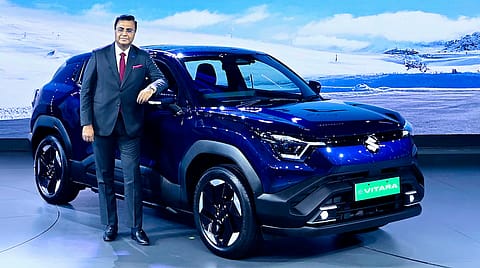
Maruti Suzuki's Senior Executive Officer for Marketing and Sales, Partho Banerjee, with the new e Vitara. | Credits: Maruti Suzuki
Maruti Suzuki e Vitara debuts with BaaS pricing, aims to redefine India’s midsize eSUV market
Maruti Suzuki has launched the eVitara, its first electric SUV, with a disruptive Battery-as-a-Service (BaaS) pricing model. By separating battery costs from the vehicle's price, Maruti aims to lower entry barriers in India's price-sensitive EV market. The eVitara offers a range of 543 km and comes with extensive charging infrastructure and service support.
This summary is AI-generated, and Fortune India is not responsible for its content or any associated copyright issues.
Maruti Suzuki enters India’s electric SUV space with the e Vitara, leveraging a BaaS model, aggressive introductory pricing and a nationwide charging ecosystem to accelerate mainstream EV adoption
Maruti Suzuki's Senior Executive Officer for Marketing and Sales, Partho Banerjee, with the new e Vitara. | Credits: Maruti Suzuki
India’s largest carmaker, Maruti Suzuki India Ltd. (MSIL), has formally entered the electric passenger vehicle market with the e Vitara, choosing a disruptive pricing architecture to challenge well-entrenched rivals in the crowded midsize electric SUV space.
The company has rolled out the eVitara at an introductory base price of Rs 10.99 lakh under a Battery-as-a-Service (BaaS) plan, with battery usage charges set at Rs 3.99 per kilometre. The offer is valid until March 31, after which a detailed price list across variants will be released.
Pricing reset in a price-sensitive market
By separating the battery cost from the vehicle’s upfront price, Maruti has significantly lowered the entry barrier — a critical factor in a market where EV penetration has remained stuck at around 4–5 percent.
Rather than competing purely on range or features, Maruti has anchored its strategy around a Battery-as-a-Service (BaaS) model, separating the cost of the battery from the vehicle’s upfront price. This significantly lowers the initial acquisition cost, a key hurdle in India’s price-sensitive EV market, while shifting battery expenses to a usage-linked subscription plan.
Partho Banerjee, Senior Executive Officer (Marketing & Sales), said the launch marks a structural shift and that the company’s approach was guided by accessibility and scale. “The intent is to reduce the entry barrier to electric mobility. By decoupling the battery cost, customers can step into EV ownership at a lower upfront price and choose a plan aligned with their driving needs,” he said.
Beyond the product: Building the ecosystem
Rather than competing purely on specifications, Maruti has anchored its strategy around ownership economics and ecosystem readiness. The all-new e Vitara offers a claimed range of 543 km from a 61-kWh battery pack and comes with an eight-year/1.6 lakh km battery warranty. Buyers also receive a complimentary 7.4 kW AC home charger with installation, along with one year of free charging at Maruti’s network for purchases made before March 31.
Defending the company’s relatively late EV entry, Banerjee added that the delay was deliberate. “We are not just launching a product; we are launching an ecosystem,” he said, pointing to investments in charging partnerships, service readiness and resale assurance. Maruti has tied up with 13 charging operators, integrated over 14,000 charging points into its ‘e for me’ app, and equipped its NEXA dealerships and 1,500 workshops with charging facilities, supported by 1.5 lakh trained technicians.
On safety and durability, the e Vitara has secured a five-star Bharat NCAP rating and features seven airbags as standard. The company is also offering assured buyback options and extended warranty packages to address long-term ownership concerns.
Undercutting rivals in a crowded segment
The pricing undercuts key rivals in the segment. The MG ZS EV starts at around Rs 13 lakh under its BaaS structure, while the Hyundai Creta Electric, Tata Curvv EV and Mahindra BE 6 are positioned significantly higher.
Industry analysts reckon that Maruti’s EV push could move electric mobility beyond early adopters — and potentially reshape pricing benchmarks in the segment.
Puneet Gupta, Director at S&P Global Mobility, said Maruti has crafted a strong value proposition. “While the product may not lead purely on specifications, the overall package makes it compelling for mainstream buyers,” he noted.
{{#most-powerful-women-snapshot-individual.slug}} {{/most-powerful-women-snapshot-individual.slug}} {{^most-powerful-women-snapshot-individual.slug}} {{/most-powerful-women-snapshot-individual.slug}} {{#showRanking}} {{current-rank}} {{/showRanking}} {{#photo.0.url}}
{{name}}
Deepesh Rathore, Founder of InsightEV, said BaaS could be a viable long-term pricing model in India as it separates battery cost and responsibility. He added that Maruti’s extensive charging network could help overcome infrastructure anxieties.
Meanwhile, production constraints at the Gujarat facility may limit early volumes, but capacity expansion is expected after July. With over 40 percent share of India’s passenger vehicle market, Maruti’s entry is being closely watched by the industry.
Follow Fortune India
NEXT STORY