The FAQs are AI-generated, and Fortune India is not responsible for its content or any associated copyright issues.
Maruti Suzuki targets 35% rail dispatch share by FY31; Manesar siding hits 1 lakh vehicles in 9 months
/ 2 min read
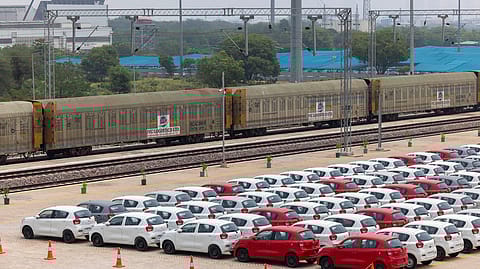
Maruti Suzuki Manesar in-plant automobile railway siding | Credits: Sanjay Rawat
Maruti Suzuki targets 35% rail dispatch share by FY31; Manesar siding hits 1 lakh vehicles in 9 months
Maruti Suzuki is ramping up its rail-based logistics, aiming for 35% of vehicle dispatches via rail by FY31, up from 26% now. The Manesar siding has already dispatched 1 lakh vehicles in nine months, highlighting the shift towards sustainable logistics. This move aligns with India's net-zero goals and aims to reduce emissions and costs.
This summary is AI-generated, and Fortune India is not responsible for its content or any associated copyright issues.
The country's biggest carmaker sharpens green logistics strategy as rail volumes surge, cutting emissions and easing road congestion
Maruti Suzuki Manesar in-plant automobile railway siding | Credits: Sanjay Rawat
Maruti Suzuki India Limited (MSIL) is accelerating its shift towards rail-based vehicle logistics, with plans to increase the share of dispatches via railways to 35% by FY2030-31, up from 26% currently, as it looks to build a more sustainable and cost-efficient supply chain.
The strategic push comes as the passenger vehiclemaker’s Manesar in-plant railway siding crossed 1 lakh vehicle dispatches within nine months of commencing operations in June 2025, underlining the growing role of rail in its outbound logistics mix.
Rail pivot gathers pace
“In CY2025, the company set a record by dispatching over 5.85 lakh vehicles through railways. Interestingly, in the past decade, our share of rail mode in outbound logistics has grown exponentially, from 5% in 2016 to 26% in 2025,” said Hisashi Takeuchi, Managing Director & CEO. He added that the company aims to scale up rail-based dispatches to 35% by FY31, aligning with its broader sustainability roadmap and India’s net-zero ambitions.
The Manesar siding milestone—achieved in under a year—signals a structural transition in logistics planning, as automakers increasingly look beyond road transport to manage costs, reduce emissions, and improve turnaround times, according to MSIL.
Green logistics gains traction
In an official statement, Maruti Suzuki claimed that the Manesar facility has helped the company avoid an estimated 16,800 metric tonnes of CO₂ equivalent emissions so far, reinforcing the environmental benefits of rail-led distribution.
Several high-volume models, including Alto, WagonR, Brezza, Dzire and Ertiga, are being dispatched through the facility, which connects 380 cities via a hub-and-spoke network spanning 17 logistics hubs.
At full capacity, the siding can handle up to 4.5 lakh vehicle dispatches annually, offering significant headroom for scaling rail volumes in the coming years.
Recommended Stories
“This initiative reinforces our commitment to reduce carbon footprint in vehicle dispatches while easing overall road congestion,” Takeuchi added.
Infra bets underpin strategy
The Manesar railway siding—India’s largest automobile in-plant rail facility—is part of the PM GatiShakti National Master Plan and the second such terminal for the company after its Gujarat plant.
Developed along the Haryana Orbital Rail Corridor, the project has seen Maruti Suzuki invest about ₹452 crore, including contributions towards corridor development and internal yard infrastructure.
Spread across 46 acres, the fully electrified facility is equipped with multiple full-length tracks, advanced train interlocking systems, and dedicated rail handling infrastructure, enabling faster and more efficient vehicle movement.
RANK
COMPANY NAME
REVENUE
(INR CR)
(INR CR)
{{#current-rank}} {{current-rank}} {{/current-rank}} {{^current-rank}} {{rank}} {{/current-rank}} {{name}} {{#revenue}} {{revenue}} {{/revenue}} {{^revenue}} {{noi}} {{/revenue}}
Having secured India’s first Automobile-Freight-Train-Operator licence in 2013, Maruti Suzuki has transported over 29.5 lakh vehicles via rail since FY15, positioning rail logistics as a core pillar of its long-term distribution strategy. (With inputs from PTI)