Maruti Suzuki working on sub-₹10 lakh BEV for mass market, to take on Tata Tiago.ev and Hyundai’s upcoming e-car
/ 4 min read
The upcoming Maruti EV is expected to be built on a new platform at the company’s Hansalpur facility in Gujarat and sold in India as well as global markets
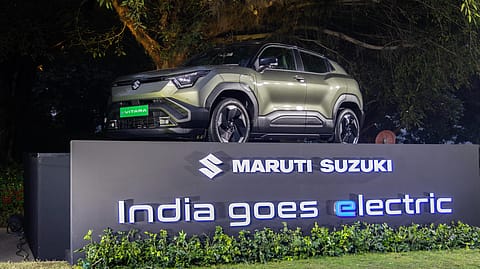
Maruti Suzuki entered India's passenger EV market with the e Vitara, which is retailed through its premium Nexa network | Credits: Sanjay Rawat
Maruti Suzuki is reportedly working on an affordable electric car that is expected to be priced below ₹10 lakh (ex-showroom), according to sources aware of the development. The Battery Electric Vehicle (BEV), which will be positioned below the e Vitara in Maruti Suzuki’s EV portfolio, is likely to be introduced over the next two years as the company looks to take electric mobility deeper into the mass market.
It has been learnt from well-informed sources that the upcoming EV is expected to be based on a new platform, allowing Maruti Suzuki to optimise the vehicle around an electric powertrain rather than adapt an existing internal combustion engine architecture.
“Just like the e Vitara, the upcoming model will be based on a new vehicle architecture and will be solely manufactured in India, with the country also serving as its export base for international markets,” revealed a source privy to the company’s product development plans.
Another source said a high level of localisation and a smaller battery pack could help keep the price in the range of ₹8.5 lakh-₹10.5 lakh (ex-showroom). While technical details remain under wraps, the entry-level e-car is expected to prioritise affordability rather than chase the long-range figures of premium electric SUVs.
“For a compact mass-market EV, such a range would be aimed primarily at daily urban and suburban use, where buyers are likely to value low running costs and ease of charging over long-distance capability. The approach would also help Maruti Suzuki keep the battery pack relatively compact, which could be critical in achieving the targeted price point,” revealed a source requesting anonymity.
One of the sources indicated that its range per charge could be in a similar ballpark to the Tata Tiago EV, which offers claimed ranges of around 250-315 km, depending on the battery and variant.
An emailed query sent by Fortune India to a Maruti Suzuki spokesperson seeking details on the product remained unanswered till the time of publication.
Meanwhile, Maruti Suzuki Managing Director and CEO Hisashi Takeuchi told shareholders at the company’s recently-held annual general meeting that smaller electric cars would be introduced once charging infrastructure has developed sufficiently across the country.
From e Vitara to a mass-market EV
Maruti Suzuki entered India's passenger EV market with the e Vitara, which is retailed through its premium Nexa network. The electric SUV is manufactured at the company's Hansalpur facility in Gujarat, which has emerged as Maruti Suzuki's global production hub for the model. The e Vitara is already exported to numerous countries, including Europe.
The new BEV, in contrast, is expected to target the company's core mass-market customer base and could be sold through the Arena network. This would give the model access to one of India's largest passenger vehicle retail networks and allow Maruti Suzuki to target customers who currently buy models such as the Swift, WagonR and Baleno.
“The new BEV is expected to be targeted at the company's core mass-market customer base and could be sold through the Arena network. That would potentially give the model access to one of India's largest passenger vehicle retail networks,” added one of the sources quoted above.
{{#most-powerful-women-snapshot-individual.slug}} {{/most-powerful-women-snapshot-individual.slug}} {{^most-powerful-women-snapshot-individual.slug}} {{/most-powerful-women-snapshot-individual.slug}} {{#showRanking}} {{current-rank}} {{/showRanking}} {{#photo.0.url}}
{{name}}
Maruti Suzuki's Hansalpur facility currently produces the e Vitara alongside models including the Fronx, Baleno and Swift, and has a total annual capacity of one million vehicles following the commissioning of its fourth plant.
“The unnamed model is also expected to be built exclusively in India and exported to global markets, reinforcing Suzuki's strategy of using India as a manufacturing base for its electric vehicle portfolio,” revealed one of the sources quoted above.
Speculation is also rife that a badge-engineered version of this model will also be sold by Toyota Kirloskar Motor (TKM).
Price could be the biggest differentiator
According to industry analysts, the biggest attraction of the upcoming Maruti EV is expected to be its price. At this price point, Maruti Suzuki would enter one of the most important gaps in India's passenger EV market—the space immediately around the price of conventional small cars.
“The company has traditionally built its market leadership around affordability, low running costs and a widespread sales and service network. Replicating that formula in electric vehicles could give it an advantage in bringing EVs to buyers who have so far been deterred by their higher upfront cost,” stated Puneet Gupta, Director, Automotive Mobility Global.
The price positioning would put the upcoming Maruti EV in direct competition with Tata Motors' Tiago EV and Punch EV, along with MG Motor India's Comet EV and other models operating around or just above the ₹10 lakh mark.
Tata's Punch.ev starts at ₹9.69 lakh ex-showroom and offers a 30kWh battery at the entry level, while higher variants get a larger battery. The MG Comet EV, meanwhile, has established another entry point into electric mobility, particularly for urban buyers looking for a compact city car. Current market listings put the Comet in the ₹6 lakh-₹10 lakh bracket.
Hyundai Motor India is also preparing a made-for-India A+ segment electric SUV, which the company has indicated is scheduled for launch around 2027. The model is expected to be heavily localised and positioned as a more accessible EV than Hyundai's current Creta Electric.
Part of Maruti Suzuki's EV roadmap
The upcoming EV is part of Maruti Suzuki's broader battery electric vehicle roadmap. The company had earlier outlined plans to introduce six electric vehicles in India by FY31, with the company's MD and CEO Hisashi Takeuchi among the senior executives who spoke about the roadmap.
In 2024, Takeuchi said the company was considering an electric hatchback and that multiple EVs would be introduced at different price points.
The road ahead and challenges
Maruti Suzuki's move into the sub-₹10 lakh EV space could significantly alter the competitive dynamics of India's electric passenger vehicle market.
Gupta believes that a competitively priced electric car from the country's largest carmaker could bring EVs closer to mainstream buyers and force rivals to reassess their pricing and product strategies. However, an affordable EV programme would also come with significant challenges.
According to Avik Chattopadhyay, an auto industry veteran, “Battery costs remain a key determinant of EV pricing, while achieving the required scale and localisation could require substantial investment. The company would also have to balance affordability with range, safety, performance and features expected by increasingly demanding customers.”
Charging infrastructure is another consideration. While India's public charging network has expanded rapidly, availability remains uneven across cities and regions.
“For a mass-market EV, easy access to charging would be particularly important in building consumer confidence,” added Chattopadhyay.
NEXT STORY