SML Mahindra targets 10-12% CV market share by FY31 after business consolidation
/ 3 min read
“We will target to reach 10-12% by FY31 at the latest…and 20% around FY36,” says Vinod Sahay, president of Trucks and Buses at M&M and executive chairman of SML Mahindra.
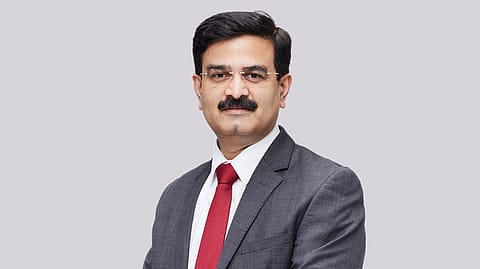
Vinod Sahay, president of Trucks and Buses at M&M and executive chairman of SML Mahindra | Credits: SML Mahindra
Mahindra & Mahindra Ltd. (M&M) is stepping up its commercial vehicle (CV) ambitions, targeting a 10-12% share of India’s CV market by FY31 and 20% by FY36 as it consolidates its truck and bus operations with SML Mahindra, formerly SML Isuzu.
The combined business currently has around 7.2% of the domestic CV market, giving M&M a stronger platform to take on market leaders Tata Motors and Ashok Leyland. The strategy hinges on plugging gaps in its product portfolio, leveraging scale and extracting synergies across sourcing, manufacturing, product development and after-sales.
“We will target to reach 10-12% by FY31 at the latest…and 20% around FY36,” Vinod Sahay, president of Trucks and Buses at M&M and executive chairman of SML Mahindra, said at a media roundtable in Delhi on the sidelines of new product launches.
M&M acquired a 58.96% stake in SML Isuzu in August 2025 from Sumitomo Corporation and Isuzu Motors. The company was subsequently renamed SML Mahindra. In July 2026, the SML Mahindra board approved the acquisition of M&M’s truck and bus division, bringing the group’s truck and bus operations under a single entity. The transaction is expected to close in FY27.
“We were very clear at that time that finally, you want to house both the businesses under one roof because it does not make sense to keep two different brands of truck and bus in two different listed companies,” Sahay said.
Consolidation to unlock synergies
The consolidation is expected to deliver savings across the value chain, with the company already seeing benefits from greater bargaining power with common suppliers.
SML Mahindra can now leverage M&M’s scale with suppliers of components such as tyres, batteries and Bosch systems. The benefits from pooling common vendors are expected to begin flowing into the profit and loss account from this year, Sahay said.
Product development is another area where M&M sees room for efficiencies. Instead of developing separate platforms for the two brands, the company can build common architectures while differentiating products through styling, body configurations and powertrain calibration.
For example, as the industry shifts towards wider 2.6-metre buses, the two brands can share an underlying platform while retaining distinct designs and tuning.
The company is also combining its after-sales networks. M&M’s truck and bus business and SML Mahindra each had around 300 service stations, and dealers of one brand are now being allowed to service the other, except where outlets are located in close proximity.
For SML Mahindra customers, this has already expanded the available service network from around 300 to 475 workshops, Sahay said.
{{#most-powerful-women-snapshot-individual.slug}} {{/most-powerful-women-snapshot-individual.slug}} {{^most-powerful-women-snapshot-individual.slug}} {{/most-powerful-women-snapshot-individual.slug}} {{#showRanking}} {{current-rank}} {{/showRanking}} {{#photo.0.url}}
{{name}}
Trucks, buses offer room to gain share
The combined entity has already strengthened its position in buses. In the LCV and ICV bus segment, SML Mahindra is now the second-largest player, according to Sahay.
Heavy trucks remain a bigger opportunity. The company currently ranks fifth in the segment but expects its latest products to help it move up the pecking order.
“With the launch of BLAZO X trucks, we are very hopeful that in a month or two we'll become the number-four brand,” Sahay said.
The combined business sold around 16,000 buses last year, with buses contributing roughly 55-60% of the overall trucks and buses business and trucks accounting for the balance.
Electric buses to initially target corporate fleets
M&M plans to initially focus its electric-bus strategy on school and corporate employee-transport fleets, rather than state transport undertakings, where subsidies have driven much of the adoption so far.
Although the company does not currently compete in the large city-bus segment, it plans to introduce electric buses for its existing customer base. Sahay said the company is already receiving requests from corporates looking to meet ESG and carbon-neutrality targets.
M&M expects electric buses to account for at least 10% of its bus volumes within a couple of years of launch.
CV demand expected to pick up
Sahay remains optimistic about India's commercial vehicle cycle, pointing to replacement demand, economic activity and higher truck utilisation.
M&M's truck and bus business grew 47% through July, ahead of the industry's 37% growth, he said.
“We still believe that while the base will be higher in quarter four and part of quarter three, for the full year, we should still have at least around higher single-digit growth, for sure,” Sahay said.
Replacement demand is expected to be particularly supportive for heavy trucks, while manufacturing, construction and mining activity should underpin broader CV demand. A recovery in services activity, meanwhile, could support the bus segment.
NEXT STORY